An adoption certificate is an official document associated with the legal adoption of a child. It records important information about the adoption and may be prepared after a court finalizes the adoption. Depending on the jurisdiction, the adoption record can be used as part of the process for creating or updating the adopted person’s official birth record.
Adoption records and birth certificate procedures vary by state and country. In the United States, an adoption may result in an amended or new birth certificate that reflects the adoptive parents, while the original birth certificate may be sealed or otherwise restricted under state law. The adoption certificate itself and the amended birth certificate are therefore not necessarily the same document.
Understanding the purpose of an adoption certificate can help adoptive parents, adult adoptees, attorneys, social workers, and others involved in the adoption process understand which documents may be created, what information they contain, and where official copies may be obtained.
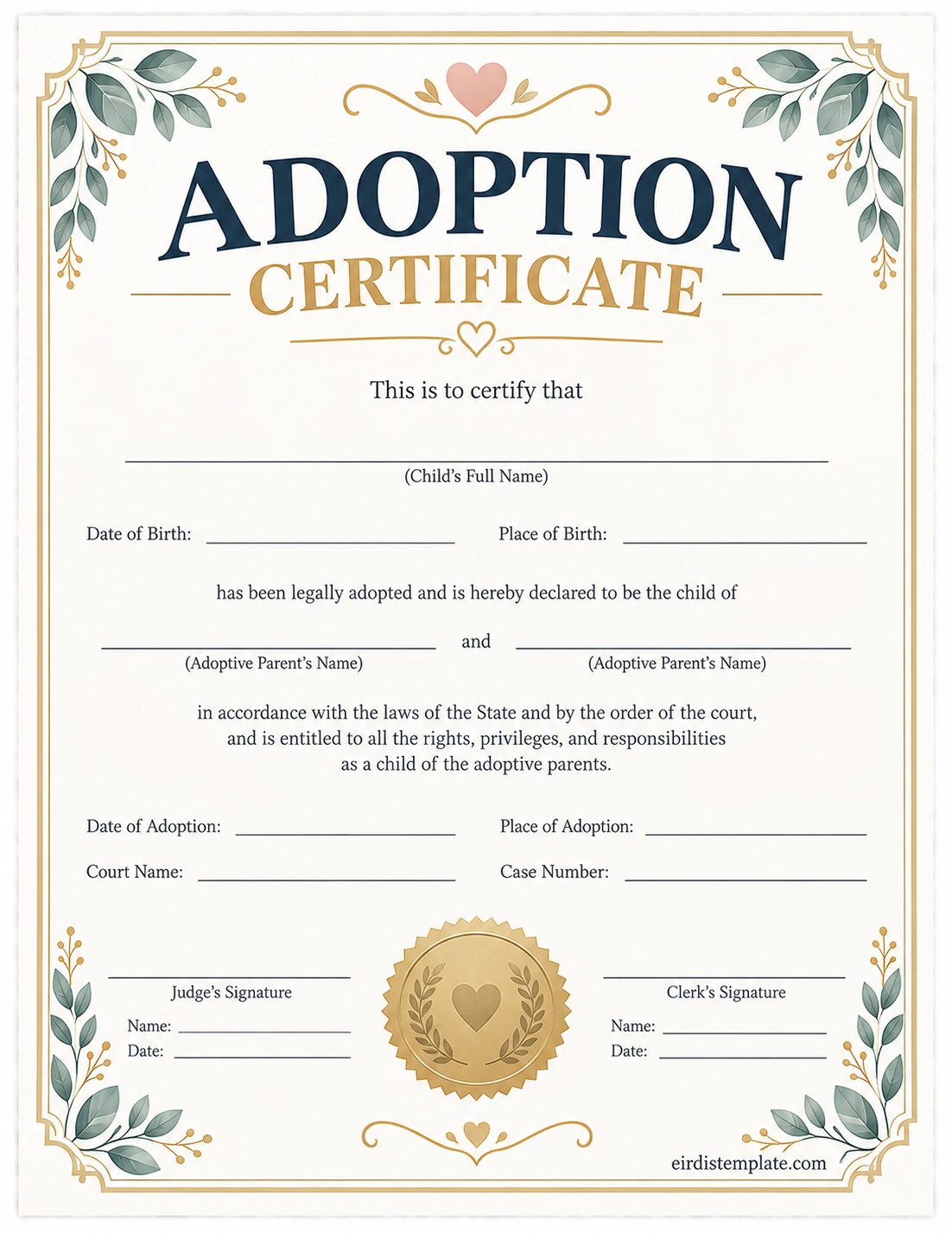
What Is an Adoption Certificate?
An adoption certificate is a document that records information connected to a legal adoption. It may be prepared or filed as part of the official adoption process after a court enters an adoption decree or final order.
The terminology can differ between jurisdictions. Some authorities use the term certificate of adoption, while others may use related terms for documents associated with an adoption order or amended vital record.
Under the U.S. Model State Vital Statistics Act, for example, a certificate of adoption provides information needed to identify the person’s birth record and establish a new birth certificate following an adoption. Actual state procedures may differ from this model.
For this reason, an adoption certificate should not automatically be treated as a replacement for a birth certificate. The official document that serves as the person’s current birth record may be an amended or newly issued birth certificate, depending on the applicable law and circumstances.
What Is the Purpose of an Adoption Certificate?
The primary purpose of an adoption certificate is to document important information related to a completed adoption. It can form part of the official record showing that the adoption was legally established.
An adoption-related record may be important for several reasons:
- Documenting the legal adoption
- Connecting the adoption order with the person’s vital record
- Supporting the creation or amendment of a birth certificate
- Providing official information about the adoption
- Maintaining a record of the court proceeding
- Supporting certain administrative or legal procedures
The specific legal effect of the document depends on the jurisdiction and the type of adoption involved.
Adoption Certificate vs. Birth Certificate
One of the most common sources of confusion is the difference between an adoption certificate and a birth certificate.
Adoption Certificate
An adoption certificate generally relates specifically to the legal adoption. It may contain information about the adoption order, adopted person, adoptive parents, court, and date of adoption.
Amended or New Birth Certificate
An amended or newly issued birth certificate is a vital record that may be created after an adoption is finalized. In many U.S. jurisdictions, it can list the adoptive parents and may reflect a legal name change resulting from the adoption. The precise process varies by state.
Original Birth Certificate
The original birth certificate records the birth information as originally registered. Depending on state law, an original birth certificate may be sealed after adoption and access may be restricted. Access rules for adult adoptees and other eligible individuals vary considerably between jurisdictions.
These documents can therefore serve different purposes even though they may be closely connected within the adoption and vital-record system.
What Information Is Included in an Adoption Certificate?
The information included in an adoption certificate depends on the issuing authority and applicable law. A document may contain several categories of information.
Information About the Adopted Person
The record may identify the adopted person by name and may include information such as date of birth or place of birth when required for official recordkeeping.
Adoptive Parent Information
The names of the adoptive parents may be included to document the legal relationship established through the adoption.
Adoption Date
The date on which the adoption was finalized or legally ordered may appear on the document.
Court Information
The certificate may identify the court or jurisdiction responsible for the adoption proceeding. A case number or other identifying reference may also be included.
Official Signatures or Certification
Depending on the document, there may be a signature, certification, seal, or other authentication from the appropriate court or vital records authority.
A decorative adoption certificate template may contain many of these fields for informational or commemorative purposes, but a printable template should not be confused with an official government-issued record.
When Is an Adoption Certificate Issued?
An adoption certificate or related adoption record is generally associated with the completion of the legal adoption process. The exact timing depends on the court, vital records office, adoption agency, and applicable jurisdiction.
After an adoption is finalized, information from the adoption proceeding may be sent to the appropriate vital records authority so that the person’s birth record can be amended or a new record can be established when required. The U.S. model vital statistics procedures describe this connection between a certificate of adoption and the establishment of a new birth certificate.
Families should follow the instructions provided by the court or relevant vital records office rather than assuming that every adoption follows the same document process.
How to Obtain an Adoption Certificate or Related Record
The process for obtaining an adoption-related document depends on where the adoption occurred and the person’s eligibility to access the record.
1. Identify the Relevant Authority
Determine whether the document is maintained by a court, state vital records office, adoption agency, or another authorized organization.
2. Confirm Which Document You Need
Before submitting a request, determine whether you need an adoption certificate, certified adoption decree, amended birth certificate, or another official record. These documents may be issued by different authorities.
3. Check Eligibility Requirements
Adoption records may contain sensitive or confidential information. Access rules can depend on the person’s relationship to the adoption, age, state law, court orders, consent requirements, and other circumstances.
4. Prepare Supporting Information
A records office may request information such as the adopted person’s name, date and place of birth, adoptive parent information, adoption date, court location, case number, or identification documents.
5. Submit the Request
Follow the instructions provided by the relevant government office or court. The U.S. Centers for Disease Control and Prevention notes that vital records are maintained by state or local authorities rather than by a single federal office, so the correct state or local authority must be identified.
What Happens to the Original Birth Certificate After Adoption?
The treatment of an original birth certificate after adoption varies according to jurisdiction. In many U.S. states, the original record is sealed and an amended or new birth certificate may be issued after an adoption is finalized. However, access to the original record can vary significantly under state law.
This means that the phrase “replaces the original birth certificate” can be misleading if it suggests that the original record is simply destroyed or permanently eliminated. In many jurisdictions, the original record remains part of the official vital records system but may be confidential or restricted from ordinary access.
If an adult adoptee needs access to an original birth certificate or adoption record, the applicable state rules should be reviewed carefully because eligibility and procedures differ.
What Is an Adoption Certificate Template?
An adoption certificate template is a pre-designed document that provides a structured format for recording adoption-related information. Templates can be useful for commemorative purposes, family records, educational materials, or creating a personalized certificate that celebrates an adoption.
A template may include fields such as:
- Adopted person’s name
- Date of birth
- Place of birth
- Adoptive parent’s names
- Date of adoption
- Place of adoption
- Court name
- Case number
- Signature fields
- Certificate or record notes
However, a privately created template does not automatically become a legal or government-issued document. An official adoption record should be obtained from the appropriate court or government authority.
Tips for Using an Adoption Certificate Template
If you are using a printable adoption certificate for a commemorative or organizational purpose, a few practices can make it more useful.
- Use accurate information: Check names, dates, and other details carefully.
- Keep official documents separate: Do not use a decorative template as a substitute for a certified government record.
- Choose a readable design: Important names and dates should be easy to see.
- Include appropriate fields: Only include information that is relevant to the purpose of the certificate.
- Protect sensitive information: Adoption records can contain private information, so store copies securely.
- Follow local requirements: If an official document is needed, obtain it from the appropriate authority.
Common Mistakes to Avoid
Adoption documents can be sensitive and legally significant, so accuracy is especially important.
- Assuming every state uses the same adoption certificate format
- Confusing an adoption certificate with an amended birth certificate
- Assuming a printable template is an official legal record
- Using incorrect names or dates
- Sharing confidential adoption information without authorization
- Requesting the wrong type of official record
- Assuming that access to an original birth certificate is the same in every state
Frequently Asked Questions About Adoption Certificates
What is an adoption certificate?
An adoption certificate is an official record associated with a legal adoption. It may document information needed to connect the adoption proceeding with the adopted person’s vital record. The exact document and terminology vary by jurisdiction.
Does an adoption certificate replace a birth certificate?
Not necessarily. In many U.S. jurisdictions, an adoption can result in an amended or newly issued birth certificate. The adoption certificate and the birth certificate are different records, even though they may be connected as part of the adoption process.
Does an adopted person have a new birth certificate?
In many cases, a new or amended birth certificate is issued following adoption, but procedures vary by state and circumstances. The relevant vital records authority can explain which record is issued and how it can be obtained.
Can an adopted person access the original birth certificate?
Access depends on the applicable state or jurisdiction. Some jurisdictions provide adult adoptees with greater access, while others may require a court order, consent, or another qualifying condition.
Can I use an adoption certificate template as an official document?
A printable adoption certificate template should not be treated as an official government record unless it has been issued or authenticated by the appropriate authority. A template is best used for commemorative, organizational, or educational purposes.
Where can I get an official adoption record?
The appropriate authority depends on the jurisdiction and the type of record requested. It may be a state or local vital records office, court, or another authorized records agency. The CDC provides state and territorial information for locating vital records offices in the United States.
Conclusion
An adoption certificate is an important document associated with the legal adoption process and can help connect the adoption proceeding with the adopted person’s official records. It may contain information about the adopted person, adoptive parents, adoption date, court, and other identifying details.
It is important, however, to distinguish an adoption certificate from an amended or newly issued birth certificate. In the United States, adoption and vital-record procedures vary by state, including rules concerning original birth certificates and access to adoption records.
For official legal or identity purposes, always obtain the appropriate certified document from the responsible court or vital records authority. A printable adoption certificate template can still be useful for commemorative or organizational purposes when it is clearly presented as a template rather than an official government record.
Download: Adoption Certificate Template

- Free Printable Affidavit Form Template - October 2, 2026
- Printable Adoption Certificate Template - October 2, 2026
- Free Printable Address Label Template - October 2, 2026
