A certificate of origin is an important international trade document that identifies the country where goods were grown, manufactured, or processed. Exporters and importers use it to support customs clearance, determine applicable import duties, and demonstrate compliance with trade requirements.
Depending on the destination country and the trade agreement involved, a certificate of origin may also help a shipment qualify for preferential tariff rates. However, the document must meet the rules established by the relevant customs authority or trade agreement.
Whether you are exporting products for the first time or managing regular international shipments, understanding how a certificate of origin works can help you prepare accurate paperwork and avoid unnecessary delays.
What Is a Certificate of Origin?
A certificate of origin (COO) is a trade document that states the country of origin of the goods being exported. It helps customs authorities determine where products originate and whether they meet applicable import requirements.
The country of origin is not always the same as the country from which a product is shipped. For example, a product manufactured in Vietnam and shipped to the United States from Singapore may still have Vietnam as its country of origin.
Origin is generally determined by the applicable rules, which may consider where a product was wholly obtained, manufactured, or substantially transformed. The exact requirements depend on the importing country, product, and relevant trade agreement.
Why Is a Certificate of Origin Important?
A certificate of origin can serve several important purposes in international trade. Its usefulness depends on the destination market, the type of goods, and the rules that apply to the shipment.
1. Supporting Customs Clearance
Customs authorities may request proof of origin as part of the import clearance process. Providing the required documentation helps officials review a shipment and determine whether it complies with local import regulations.
2. Determining Import Duties
The origin of a product can affect the customs duty rate applied to an imported shipment. Some countries impose different tariffs depending on the product’s origin, trade policies, or applicable agreements.
3. Claiming Preferential Tariffs
Eligible products may receive reduced or zero customs duties under a free trade agreement or other preferential trade arrangement. To claim these benefits, the importer must satisfy the relevant rules of origin and provide the required proof in the accepted format.
A standard certificate of origin does not automatically qualify goods for preferential treatment. The document and the goods must meet the requirements of the applicable program.
4. Meeting Trade Compliance Requirements
Origin information may help authorities enforce trade restrictions, quotas, sanctions, and embargoes. Accurate documentation supports regulatory checks and reduces the risk of inconsistent information across shipping records.
What Information Does a Certificate of Origin Include?
The exact layout varies by country, issuing organization, and trade agreement. However, a typical certificate of origin template may include the following details.
- Exporter information: The name, address, and contact details of the business sending the goods.
- Consignee information: The name and address of the buyer, importer, or receiving party.
- Producer information: The manufacturer or producer’s details, when required or applicable.
- Country of origin: The country determined under the applicable rules of origin.
- Goods description: A clear description of each product included in the shipment.
- HS code: The relevant Harmonized System classification, when required by the form or procedure.
- Quantity and unit of measure: The amount of goods being shipped.
- Transport and destination details: Shipping information requested by the issuing body or customs procedure.
- Invoice or shipment references: Details used to connect the certificate with the commercial transaction.
- Declaration and certification: The required statements, signatures, stamps, or electronic authentication.
Some certificates also include a certificate number, issue date, authorized signatory, or details of the chamber of commerce or other issuing authority. Not every field is required for every shipment.
Certificate of Origin Template
A certificate of origin template provides a structured way to organize exporter details, consignee information, product descriptions, and origin declarations. It can be useful when preparing shipment documentation or learning which details may be requested.
Use the sample below as a general reference. Before using any form for an actual export, confirm that it is accepted by the relevant customs authority, issuing organization, or trade agreement.
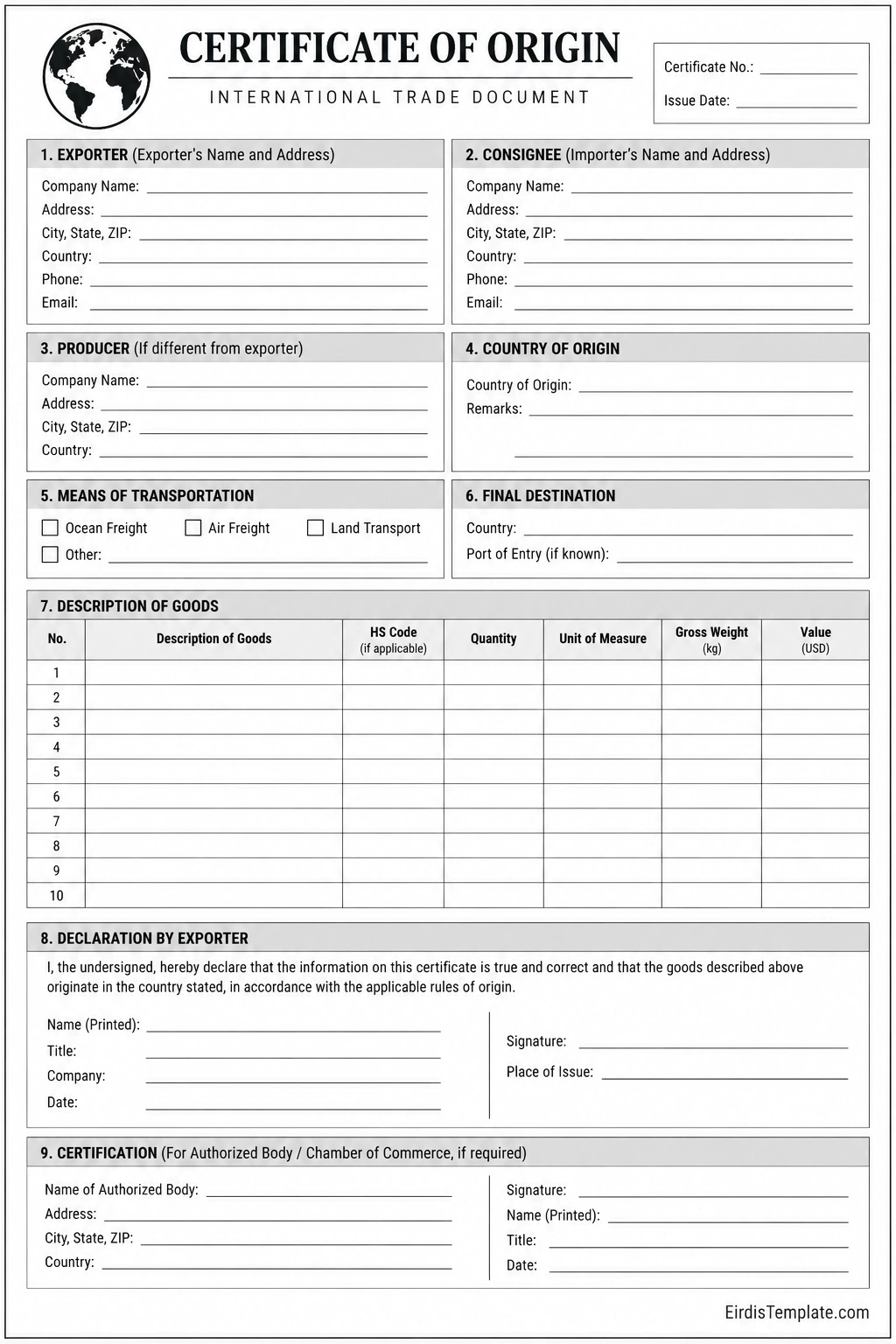
A general template may not replace an official certificate. Certain destinations require a prescribed form, electronic filing, certification by an authorized organization, or a specific declaration of origin.
How to Complete a Certificate of Origin
Preparing an accurate certificate of origin begins with confirming the origin rules and the documentation required for the shipment. Follow these steps as a general guide.
Step 1: Confirm the Applicable Origin Rules
Determine how the destination country defines origin for your product. The rules may differ depending on whether the goods are wholly obtained in one country, manufactured from local materials, or produced using imported components.
Do not assume that the country where a product is packaged, stored, or shipped automatically determines its origin.
Step 2: Gather Supporting Documents
Collect the records needed to verify the information on the certificate. Depending on the shipment, these may include:
- Commercial invoices
- Packing lists
- Manufacturing or production records
- Supplier declarations
- Material sourcing records
- Shipping documents
- Product classification information
Not every shipment requires every document. Follow the instructions provided by the importer, customs authority, issuing organization, or relevant trade agreement.
Step 3: Enter the Exporter and Consignee Details
Write the legal business names and addresses accurately. Check that the information matches the commercial invoice and other shipping records. Inconsistent names or addresses may lead to questions during document review.
Step 4: Describe the Goods Clearly
Identify the products in enough detail for customs officials to understand what is being shipped. Include the required product description, quantity, unit of measure, and classification details when applicable.
Avoid vague descriptions that do not adequately identify the goods. Use the product terminology and classification information requested by the relevant authority.
Step 5: State the Country of Origin
Enter the country of origin based on the applicable rules and supporting evidence. If the shipment contains products originating in different countries, check whether the form requires separate entries or additional documentation.
Step 6: Review and Obtain Certification
Check the completed form against the invoice, packing list, and other supporting records. Then follow the required process for signing, certifying, or submitting the document. Depending on the destination and procedure, this may involve a chamber of commerce, another authorized body, or an approved electronic system.
Types of Certificates of Origin
Certificates and origin declarations vary by trade route and purpose. Two broad categories are commonly discussed in international trade.
Non-Preferential Certificate of Origin
A non-preferential certificate of origin identifies the origin of goods without claiming a specific preferential tariff benefit. It may be requested for customs clearance, trade policy enforcement, documentary requirements, or commercial purposes.
Preferential Proof of Origin
Preferential proof of origin supports a claim for reduced or eliminated duties under an applicable trade agreement or preference program. It must satisfy the specific rules of origin and documentary requirements of that arrangement.
Depending on the agreement, acceptable proof may be a prescribed certificate, an origin declaration on a commercial document, or another authorized form of certification. Always check the rules for the specific trade route.
Who Issues a Certificate of Origin?
The issuing process depends on the country, destination, and type of certificate. In many trade routes, a chamber of commerce or another authorized organization can issue or certify a non-preferential certificate of origin.
For certain preferential trade arrangements, an exporter, producer, importer, or approved authority may be permitted to provide the required proof of origin. Some systems use electronic certificates or declarations rather than a traditional paper form.
Before applying, contact the relevant issuing organization or consult official customs guidance to confirm the accepted form, supporting documents, fees, and processing times.
Common Certificate of Origin Mistakes to Avoid
Small documentation errors can create delays or lead to questions about a shipment. Review the following points before submitting your certificate.
- Using the wrong origin country: Apply the relevant origin rules rather than relying only on the shipping location.
- Providing inconsistent product descriptions: Keep descriptions consistent with the commercial invoice and supporting records.
- Entering incorrect business details: Check legal names, addresses, and contact information.
- Choosing the wrong certificate type: Confirm whether a non-preferential certificate or preferential proof of origin is required.
- Leaving required fields incomplete: Follow the instructions for the specific form and issuing process.
- Using an unapproved template: A generic printable form may not be accepted for official use.
- Assuming origin guarantees a lower tariff: Preferential treatment depends on eligibility, the applicable rules, and the required proof.
Practical Tips for Exporters and Importers
Good document management can make the certificate of origin process easier to handle, especially for businesses that ship products regularly.
- Confirm documentary requirements with the importer before shipping.
- Check the importing country’s official customs guidance.
- Keep supplier and production records that support origin claims.
- Use consistent product descriptions across invoices, packing lists, and certificates.
- Verify whether electronic filing or an authorized form is mandatory.
- Keep copies of submitted certificates and supporting documents according to your record-retention requirements.
- Ask a qualified customs broker or trade compliance professional when origin rules are unclear.
These steps can help reduce avoidable errors, but they do not replace advice from the relevant customs authority or a qualified trade professional.
Frequently Asked Questions About Certificates of Origin
What is the main purpose of a certificate of origin?
The main purpose is to document the country of origin of exported goods. Customs authorities may use it to assess duties, review import requirements, and enforce trade rules. It can also support preferential tariff claims when the relevant requirements are met.
Is a certificate of origin always required for international shipping?
No. Whether a certificate is required depends on the destination country, the product, the trade agreement, and the importer’s or customs authority’s requirements. Confirm the rules before shipping.
Is a certificate of origin the same as a commercial invoice?
No. A commercial invoice records transaction details, such as the seller, buyer, goods, and price. A certificate of origin documents the origin of the goods. Both may be required for the same shipment.
Does a certificate of origin guarantee lower customs duties?
No. A certificate alone does not guarantee preferential rates. The goods must qualify under the applicable rules of origin, and the importer must meet the agreement’s documentation and claim requirements.
Can I use a printable certificate of origin template?
A printable template can help organize information or serve as a reference. However, official use depends on whether the destination, issuing organization, or trade agreement accepts that format. Some procedures require a prescribed form or electronic submission.
Who is responsible for obtaining the certificate of origin?
Responsibility varies by transaction and trade arrangement. An exporter may apply for a certificate, while an importer may request proof of origin to meet customs requirements. Confirm responsibilities with the trading partner and relevant issuing authority.
What is the difference between country of shipment and country of origin?
The country of shipment is where goods are dispatched from. The country of origin is determined under the applicable origin rules. These countries can be different if goods are stored, transported, or traded through another country before reaching the destination.
Conclusion
A certificate of origin is an important document for many international shipments because it identifies the origin of goods and helps support customs and trade compliance requirements. It may also play a role in preferential tariff claims when the goods and documentation qualify under the relevant rules.
Before preparing a certificate of origin, confirm the destination country’s requirements, verify the product’s origin, and ensure that the information matches your supporting documents. A printable certificate of origin template can help organize the details, but always use an accepted form and certification process for official shipments.
Download: Certificate of Origin Template

- Change Management Planning Template - October 26, 2026
- Certificate of Recognition Template - October 26, 2026
- Certificate of Participation Template - October 26, 2026
