A child custody agreement is a written plan that explains how separated or divorced parents will share responsibility for raising their child. It typically covers where the child will live, when the child will spend time with each parent, and how important decisions about education, healthcare, and other needs will be made. A clear agreement helps parents establish consistent routines and focus on their child’s well-being.
When parents live separately, uncertainty about parenting schedules and responsibilities can create unnecessary stress. A detailed custody agreement provides a practical framework for handling everyday arrangements, school holidays, transportation, communication, and unexpected changes. It can also help parents resolve disagreements more constructively.
In this guide, you’ll learn what a child custody agreement is, which sections to include, how to create a parenting schedule, and what to consider before signing. You’ll also find a practical checklist, an example of common agreement terms, and answers to frequently asked questions.
What Is a Child Custody Agreement?
A child custody agreement is a document that sets out parenting arrangements for a child whose parents live separately. Depending on the jurisdiction, it may be called a parenting plan, custody agreement, or parenting agreement.
The agreement can address both legal custody, which concerns decision-making authority, and physical custody or parenting time, which concerns where the child lives and how time is shared. The terminology and legal effects vary by location.
A child custody agreement commonly covers:
- The child’s identifying information
- Each parent’s contact information
- Legal custody and decision-making responsibilities
- The child’s primary residence, where applicable
- Regular parenting time and visitation schedules
- Weekend, holiday, and school-break arrangements
- Transportation and exchange locations
- Communication between the child and each parent
- Healthcare, education, and extracurricular activities
- Procedures for handling disagreements or requesting changes
The goal is to create a clear, workable plan that supports the child’s safety, stability, and developmental needs. A written agreement should reflect the family’s actual circumstances rather than simply copying a generic template.
Why Is a Child Custody Agreement Important?
A well-organized parenting agreement can reduce confusion and help both parents understand their responsibilities. It also gives the child a more predictable routine during a significant family transition.
1. Provides Stability for the Child
Children often benefit from knowing where they will stay, who will pick them up, and when they will see each parent. A consistent schedule can make transitions easier and help maintain routines for school, sleep, activities, and friendships.
2. Clarifies Parental Responsibilities
The agreement explains who makes major decisions and how routine matters are handled. Clear responsibilities can prevent disagreements about school enrollment, medical appointments, travel, and other important issues.
3. Reduces Misunderstandings
When parenting time, holidays, and transportation are documented, both parents can refer to the same plan. This reduces reliance on memory and informal conversations that may lead to different expectations.
4. Supports Cooperative Co-Parenting
A practical agreement encourages parents to communicate about the child’s needs and coordinate their responsibilities. It can establish expectations for sharing information, requesting schedule changes, and addressing disagreements respectfully.
5. Provides a Framework for Legal Approval
Depending on local law and the circumstances, parents may submit their agreement to a court for review or approval. A private agreement is not automatically a court order, and enforceability depends on the applicable legal process.
What Should a Child Custody Agreement Include?
Every family has different needs, but the following sections can help parents create a comprehensive parenting plan.
1. Parent and Child Information
List the parents’ full names and relevant contact information. Include the child’s name and date of birth, along with any additional information required by the court or local authority.
Keep contact information current so both parents can communicate about school, healthcare, emergencies, and schedule changes.
2. Legal Custody and Decision-Making
Explain how major decisions will be made. Depending on local terminology and law, parents may share legal custody or one parent may have authority over certain decisions.
Major decisions may involve:
- School enrollment and educational support
- Non-emergency medical and dental care
- Mental health services, where relevant
- Religious or cultural upbringing, when applicable
- Major extracurricular commitments
Clarify how parents will exchange information, consult one another, and respond when they disagree. Emergency medical decisions and other urgent situations may need separate provisions consistent with local law.
3. Physical Custody and the Child’s Residence
Describe the child’s living arrangements and how parenting time will be divided. Some children primarily live with one parent and spend scheduled time with the other. Other families use a shared schedule with more balanced parenting time.
The best arrangement depends on the child’s age, school routine, distance between homes, individual needs, and other relevant circumstances. The schedule should be practical and focused on the child’s best interests.
4. Regular Parenting Time Schedule
Specify which days and times the child will spend with each parent. Avoid vague terms such as “reasonable visitation” when a more precise schedule would reduce confusion.
A parenting schedule may include:
- Weekday and weekend arrangements
- Overnight stays and pickup times
- School-day and non-school-day transitions
- Alternating weekends, if applicable
- Regular activities that affect the schedule
Include the start and end times for each period and identify who is responsible for transportation.
5. Holidays, Birthdays, and School Breaks
Holiday arrangements can be a common source of disagreement. Explain how the parents will divide major holidays, the child’s birthday, school vacations, and other significant occasions.
Some parents alternate holidays each year, while others divide the day or assign specific holidays to each parent. The agreement should also explain whether holiday arrangements take priority over the regular weekly schedule.
6. Transportation and Exchange Locations
Identify who will pick up and drop off the child and where exchanges will occur. Depending on the family’s circumstances, exchanges may take place at a parent’s home, school, childcare center, or another agreed location.
If travel time, safety, or distance is a concern, include practical arrangements for late arrivals, transportation costs, and notifying the other parent about delays.
7. Communication Between Parents and Child
Explain how the child may communicate with the parent they are not currently staying with. Depending on the child’s age and needs, this might include reasonable phone calls, video calls, or messages.
Parents may also agree on a communication method for sharing school notices, medical updates, activity schedules, and other important information. The plan should protect the child’s privacy and avoid placing the child in the middle of parental disagreements.
8. Healthcare and Education
Clarify how the parents will share relevant medical and school information. Include procedures for notifying the other parent about appointments, illnesses, school meetings, and significant developments.
If the parents share decision-making authority, explain how they will consult each other before making major decisions. The agreement should remain consistent with applicable law and any existing court orders.
9. Travel and Relocation
Consider whether the agreement should address domestic travel, international travel, passport arrangements, advance notice, and consent requirements. These rules can be especially important when one parent plans to travel with the child for an extended period.
Relocation provisions should explain how a proposed move will be communicated and handled under applicable law. Parents should not assume that a custody agreement automatically permits a move that would affect the other parent’s rights.
10. Dispute Resolution and Schedule Changes
Explain how parents will request changes to the schedule and handle disagreements. They may agree to communicate in writing, use mediation when appropriate, or seek legal assistance if an issue cannot be resolved.
Specify whether temporary changes must be confirmed in writing. Informal flexibility can be helpful, but parents should keep records of important agreements and follow any applicable court order.
How to Create a Child Custody Agreement Step by Step
Step 1: Identify the Child’s Needs
Begin with the child’s school schedule, healthcare needs, activities, age, and established routines. Consider what arrangement will provide safety, stability, and meaningful relationships with both parents when appropriate.
Step 2: Discuss Parenting Responsibilities
Work through decision-making, living arrangements, regular parenting time, holidays, transportation, and communication. Be specific about responsibilities and discuss practical challenges before finalizing the plan.
Step 3: Build a Realistic Schedule
Create a calendar showing regular parenting time, school holidays, and special occasions. Check travel times and work schedules to make sure the plan can be followed consistently.
Step 4: Put the Terms in Writing
Use clear language and organize the document into sections. Include the information needed to understand each arrangement, and avoid terms that could be interpreted differently by each parent.
Step 5: Review Legal Requirements
Check the requirements in the relevant jurisdiction. Some courts provide approved parenting-plan forms or require particular information. A family-law attorney or qualified legal professional can explain the applicable rules.
Step 6: Sign and Seek Approval When Required
Follow the correct signing process. If court approval is necessary or appropriate, submit the agreement through the required procedure. Do not assume that signing a private agreement automatically makes every provision legally enforceable.
Step 7: Keep a Copy and Review as Needed
Both parents should retain a copy of the final document and any applicable court order. Review the arrangements when the child’s needs change, while following the required legal process for formal modifications.
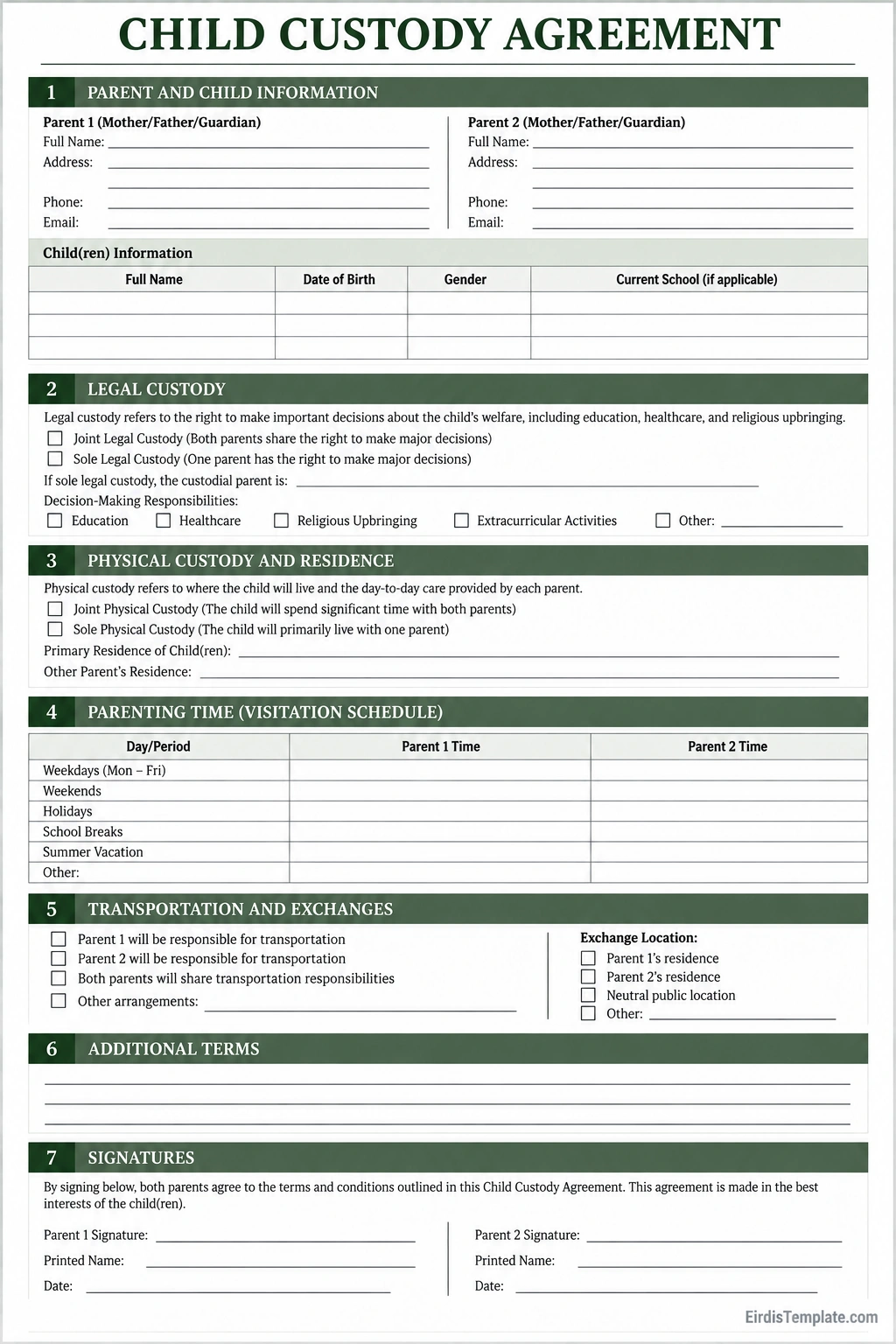
Example of a Child Custody Agreement Schedule
The following example illustrates how parents might describe a basic parenting schedule. It is for general information only and should be adapted to the child’s needs and any applicable legal requirements.
- Weekdays: The child stays with Parent A on school nights, unless otherwise agreed.
- Alternate weekends: The child spends designated weekends with Parent B, from the agreed pickup time until the agreed return time.
- School holidays: Parents divide school breaks according to a written calendar.
- Major holidays: Parents alternate specified holidays each year.
- Transportation: The agreement identifies who is responsible for pickup and drop-off.
- Schedule changes: Parents provide advance notice and confirm agreed changes in writing.
This is only an illustration, not a recommended arrangement for every family. Parenting schedules should reflect the child’s best interests, practical circumstances, and applicable legal requirements.
Common Child Custody Agreement Mistakes to Avoid
- Using vague schedules: Specify dates, times, exchange locations, and transportation responsibilities.
- Ignoring holidays: Include school breaks, birthdays, and significant holidays.
- Leaving decision-making unclear: Explain how major healthcare and education decisions will be handled.
- Overlooking communication: Establish reasonable ways to share important updates.
- Making unrealistic arrangements: Consider school, travel time, work schedules, and the child’s needs.
- Using the child as a messenger: Encourage direct, respectful communication between parents.
- Ignoring existing court orders: Ensure the agreement is consistent with current legal requirements.
- Failing to update the plan: Review arrangements when circumstances change and follow the required modification process.
Frequently Asked Questions About Child Custody Agreements
What is the purpose of a child custody agreement?
A child custody agreement sets out parenting responsibilities, living arrangements, parenting time, decision-making authority, and other practical matters. Its purpose is to provide clarity and support the child’s well-being after the parents separate.
Is a child custody agreement legally binding?
That depends on local law and how the agreement was created or approved. A private written agreement may not have the same legal status as a court order. Parents should check local requirements and seek legal advice when necessary.
Can parents create a custody agreement without going to court?
In some jurisdictions and circumstances, parents can negotiate a parenting agreement privately. However, court approval may be required or advisable, especially when a case is already pending or an existing court order needs to be changed.
What is the difference between legal custody and physical custody?
Legal custody generally concerns authority to make important decisions about a child’s upbringing, while physical custody or parenting time concerns where the child lives and when the child spends time with each parent. Terminology and legal definitions vary by jurisdiction.
Can a child custody agreement be changed?
Yes, arrangements may sometimes be modified when circumstances change. The process depends on local law and whether the existing agreement is a court order. Parents should document agreed changes and follow any required approval process.
What happens if one parent does not follow the agreement?
The available options depend on whether the agreement is legally enforceable and whether a court order applies. Parents should document relevant events, review the governing terms, and seek qualified legal advice about appropriate next steps.
Should a child custody agreement include child support?
Child support may be addressed in a separate document or coordinated with the parenting plan, depending on local law and the circumstances. Custody and parenting time do not automatically determine every child support obligation. Check the applicable legal requirements.
Do I need a lawyer to prepare a child custody agreement?
Not every situation requires the same level of legal assistance, but a family-law professional can help explain local requirements and identify unclear or potentially problematic provisions. Legal guidance is especially important when parents disagree, safety concerns exist, or a court order is involved.
Conclusion
A child custody agreement helps separated parents establish clear arrangements for their child’s care, living schedule, decision-making, transportation, holidays, and communication. A thoughtful plan can reduce misunderstandings and provide greater stability during a family transition.
When preparing an agreement, focus on the child’s best interests, use specific and realistic terms, and plan for changes or disagreements. Review the applicable legal requirements and seek qualified family-law advice when necessary.
A clear, child-focused parenting plan can help both parents understand their responsibilities and support a more consistent routine for their child.
Download: Child Custody Agreement Template

- Free Printable Chore Chart Template - October 27, 2026
- Childcare Enrollment Form Template - October 27, 2026
- Child Custody Agreement Template - October 27, 2026
