A character reference letter is a personal recommendation that describes someone’s character, values, and positive qualities. Unlike a professional reference, which focuses mainly on work experience and job performance, a personal character reference highlights traits such as honesty, reliability, responsibility, and compassion. It helps the reader understand the individual beyond their resume or formal qualifications.
A character reference letter may be requested for a job application, academic admission, volunteer position, housing application, or certain legal proceedings. The purpose is to provide an honest account of the person’s character based on firsthand experience. A well-written letter uses specific examples to explain why the individual may be suitable for the opportunity or situation.
In this guide, you’ll learn what a character reference letter should include, how to structure it, who should write one, and how to make it convincing. You’ll also find a sample letter, practical writing tips, and answers to frequently asked questions.
What Is a Character Reference Letter?
A character reference letter, also known as a personal reference letter, is a written statement from someone who knows an individual personally and can describe their character. The writer explains how they know the person and provides relevant examples of their behavior, values, and personal qualities.
Unlike an employment reference, a character reference does not need to focus on professional achievements. Instead, it may describe how someone treats others, handles responsibilities, responds to challenges, or contributes to their community.
A character reference letter may be used for:
- Job applications, especially when an employer requests a personal reference
- College, university, or scholarship applications
- Volunteer opportunities and community programs
- Rental or housing applications, when personal references are accepted
- Professional licensing or membership applications, where permitted
- Court proceedings or other legal matters, when a character reference is appropriate
The letter should always match the purpose of the request. For example, a letter for a volunteer role might emphasize compassion and dependability, while a reference for an academic program might highlight integrity, perseverance, and a willingness to learn.
Why Is a Character Reference Letter Important?
A strong personal reference can provide context that formal records and applications may not show. It allows a decision-maker to hear from someone who has observed the individual’s character firsthand.
It Highlights Personal Qualities
A character reference can describe qualities such as honesty, patience, maturity, empathy, and accountability. These traits may be important when evaluating whether someone is suitable for a particular role or opportunity.
It Provides Real-Life Examples
Specific examples make a recommendation more meaningful. Rather than simply calling someone dependable, the writer can explain how the person consistently kept commitments or helped others during a difficult situation.
It Adds a Personal Perspective
A resume or application lists qualifications and achievements, but it may not reveal how someone behaves in everyday situations. A personal reference can offer additional insight into their relationships, decision-making, and sense of responsibility.
It Supports an Application
When requested by an employer, admissions committee, organization, or court, a character reference may help provide a more complete picture of the individual. However, its influence depends on the requirements and decision-making process of the recipient.
What Should a Character Reference Letter Include?
A character reference letter should be organized, relevant, and easy to read. Most letters can be written in a few clear paragraphs that explain the relationship, describe the person’s qualities, and offer a direct recommendation.
1. Writer’s Contact Information
For a formal letter, include your name and relevant contact details at the top. Depending on the recipient’s requirements, you may include your mailing address, phone number, email address, and the date.
2. Recipient Information
If you know the recipient’s name or organization, include those details. When the recipient is unknown, a general greeting such as “To Whom It May Concern” may be appropriate, although a specific greeting is usually more personal.
3. A Clear Opening Statement
Begin by identifying the person you are recommending and stating the purpose of the letter. This lets the reader understand immediately why you are writing.
4. Your Relationship With the Individual
Explain how you know the person and how long you have known them. You might be a friend, neighbor, community volunteer, mentor, or family acquaintance. Be accurate about the relationship and avoid implying professional experience if you do not have it.
5. Relevant Character Traits
Choose two or three qualities that are relevant to the situation. Examples include:
- Honesty: Demonstrating truthfulness and integrity.
- Reliability: Keeping promises and meeting responsibilities.
- Compassion: Showing consideration and care for others.
- Accountability: Accepting responsibility for decisions and actions.
- Perseverance: Continuing to work toward a goal despite challenges.
- Respect: Treating people fairly and thoughtfully.
- Initiative: Taking helpful action without always needing direction.
6. Specific Supporting Examples
Use one or two examples that demonstrate the qualities you describe. For instance, you might explain how the person organized a community event, supported a neighbor, or consistently fulfilled volunteer commitments.
Keep examples truthful, relevant, and respectful of other people’s privacy. A credible letter is more persuasive when it explains what the writer personally observed.
7. A Direct Recommendation
Conclude the main body by explaining why you believe the individual is suitable for the opportunity or why you are comfortable recommending them. Avoid making claims you cannot support.
8. Closing and Signature
End with a professional closing, such as “Sincerely” or “Kind regards.” Include your name and appropriate contact information so the recipient can request clarification if needed.
How to Write a Character Reference Letter Step by Step
Step 1: Understand the Purpose
Ask the person requesting the letter what it will be used for and whether the recipient has specific requirements. A letter for employment may need to emphasize dependability, while an academic reference may focus on maturity and perseverance.
Step 2: Confirm That You Can Provide an Honest Reference
Only agree to write the letter if you know the person well enough to describe their character accurately. You do not need to claim expertise or make promises about their future behavior. Your role is to share an honest personal perspective.
Step 3: Choose Relevant Character Traits
Select a small number of qualities that relate directly to the purpose of the letter. Too many generic adjectives can make the recommendation feel vague. A few well-supported traits are usually more effective.
Step 4: Gather Specific Examples
Think about situations in which you personally observed the individual’s behavior. Consider how they handled a responsibility, helped someone, resolved a disagreement, or responded to a challenge.
Step 5: Draft the Letter
Use a simple structure: introduction, relationship, character traits, supporting examples, recommendation, and closing. Keep the tone professional and sincere. Most general-purpose character reference letters can fit on one page unless the recipient requests a different length.
Step 6: Review the Details
Check the person’s name, the recipient’s details, grammar, spelling, and dates. Make sure the letter addresses the intended purpose and does not include irrelevant personal information.
Step 7: Submit It as Requested
Follow the recipient’s instructions for delivery. Some organizations accept a printed letter, while others require an email, an online form, or a signed document. Confirm any formatting or submission requirements before sending it.
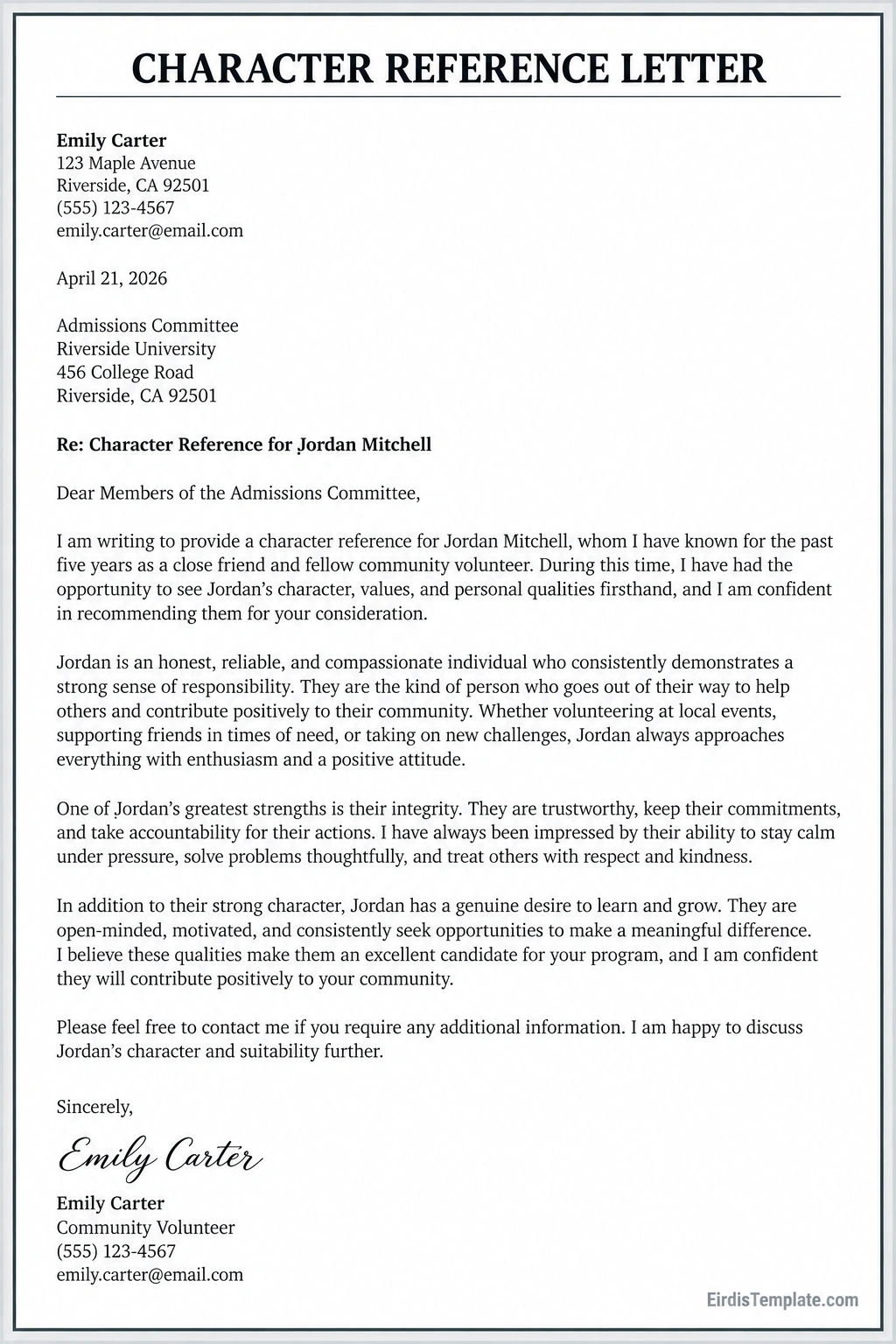
Character Reference Letter Example
The following sample shows how to organize a personal recommendation. Replace the sample names and details with accurate information, and adapt the content to the recipient’s requirements.
Subject: Character Reference for Jordan Mitchell
Dear Members of the Admissions Committee,
I am writing to provide a character reference for Jordan Mitchell, whom I have known for five years through our friendship and community volunteer work. During this time, I have had many opportunities to observe Jordan’s personal values, sense of responsibility, and interactions with others.
Jordan is an honest, reliable, and considerate individual who takes commitments seriously. During our volunteer activities, Jordan has consistently shown a willingness to help others, work cooperatively, and contribute to shared goals. These experiences have demonstrated Jordan’s dependability and positive attitude.
One quality I particularly appreciate is Jordan’s integrity. Jordan communicates respectfully, treats people fairly, and approaches responsibilities thoughtfully. When challenges arise, Jordan makes a genuine effort to find practical solutions and follow through on commitments.
Based on my personal experience, I believe Jordan would make a positive contribution to your program. I am pleased to recommend Jordan for your consideration and would be happy to provide additional information if needed.
Sincerely,
Emily Carter
Community Volunteer
(555) 123-4567
[email protected]
This example is a starting point, not a statement that should be copied without review. A genuine reference should reflect the writer’s actual relationship with the person and firsthand observations.
Tips for Writing an Effective Character Reference Letter
Be Specific Rather Than Generic
Instead of listing many positive adjectives, describe a real situation that demonstrates a relevant quality. Specific examples help the reader understand why you hold your opinion.
Keep the Tone Professional
Write naturally and respectfully. Even if you know the person well, avoid slang, exaggerated praise, or overly casual language when the letter is intended for a formal decision-maker.
Be Honest and Balanced
Do not invent achievements, exaggerate your relationship, or claim knowledge you do not have. You can recommend someone confidently without suggesting that they are perfect or have never made a mistake.
Protect Personal Information
Include only information that is relevant and appropriate to the purpose of the letter. Avoid disclosing sensitive personal details without permission, especially when discussing difficult circumstances.
Keep It Concise
Aim for a focused letter that explains the relationship, supports key qualities with examples, and provides a clear recommendation. Remove repeated points and unnecessary background details.
Common Mistakes to Avoid
- Using vague praise: Support positive statements with real examples.
- Misrepresenting the relationship: State clearly how you know the individual.
- Making unsupported claims: Describe only what you can honestly attest to.
- Ignoring the purpose: Choose examples that relate to the intended role or application.
- Including irrelevant details: Keep the letter focused on character and suitability.
- Using an overly casual tone: Match the language to the recipient and situation.
- Forgetting contact information: Include a way for the recipient to follow up when appropriate.
- Submitting without proofreading: Check names, dates, grammar, and formatting before sending.
Frequently Asked Questions About Character Reference Letters
What is the purpose of a character reference letter?
A character reference letter provides a personal perspective on an individual’s character, values, and behavior. It may support an application or formal process by offering examples of qualities that are not fully reflected in a resume or application form.
Who can write a character reference letter?
A suitable writer is someone who knows the individual well enough to provide an honest, firsthand account of their character. Depending on the recipient’s rules, this may be a friend, neighbor, mentor, community leader, or volunteer coordinator. Some applications exclude family members or require specific types of references.
How long should a character reference letter be?
Many character reference letters are about three to five paragraphs and fit on one page. Follow any instructions from the recipient, and focus on relevant qualities and specific examples rather than length.
What is the difference between a character reference and a professional reference?
A character reference focuses on personal qualities, values, and behavior. A professional reference typically emphasizes work experience, skills, job performance, and workplace conduct. Some letters may include both, depending on the writer’s relationship with the individual and the recipient’s requirements.
Can I use a character reference letter template?
Yes. A template can help organize the letter and ensure that important sections are included. Personalize it with truthful details, relevant examples, and the recipient’s specific requirements rather than submitting a generic letter unchanged.
Can a character reference letter be used in court?
A character reference may be submitted in some legal proceedings, depending on the court’s rules and the purpose of the letter. Requirements can be strict, and the letter should be truthful, relevant, and appropriately addressed. For a court matter, follow the instructions of the person’s attorney or the court.
Should a character reference letter be signed?
A signature can help establish who wrote the letter. Whether a handwritten signature, electronic signature, notarization, or another formality is required depends on the recipient’s instructions and the intended use.
Can I decline a request to write a character reference?
Yes. If you do not know the person well enough, cannot provide an honest recommendation, or are uncomfortable with the request, it is reasonable to decline politely. A sincere reference is more useful than one written out of obligation.
Conclusion
A character reference letter helps a reader understand an individual’s personal qualities through an honest recommendation and specific examples. Whether the letter supports a job application, academic opportunity, volunteer position, or another formal request, its effectiveness depends on relevance, credibility, and clear writing.
Before writing your letter, understand its purpose, explain your relationship with the individual, choose meaningful character traits, and support your statements with firsthand examples. Keep the tone professional, protect personal information, and follow the recipient’s submission requirements.
A thoughtful, accurate character reference can provide useful context and help the recipient make a more informed decision.
Download: Character Reference Letter Template

- Free Printable Chore Chart Template - October 27, 2026
- Childcare Enrollment Form Template - October 27, 2026
- Child Custody Agreement Template - October 27, 2026
