A Separation Agreement is a written contract that allows separating partners or spouses to clearly document how important matters will be handled while they live apart. Depending on the circumstances and local law, the agreement may address property, debts, child custody, child support, spousal support, and other financial or personal responsibilities.
Creating a written agreement can give both parties a clearer understanding of their responsibilities and reduce uncertainty during a difficult transition. Instead of leaving important decisions to informal conversations, the parties can put their agreed terms in writing and review them carefully before signing.
However, a separation agreement is a legal document, and the requirements for validity and enforceability vary by jurisdiction. When significant assets, children, support obligations, or other complex issues are involved, obtaining independent legal advice can be an important step.
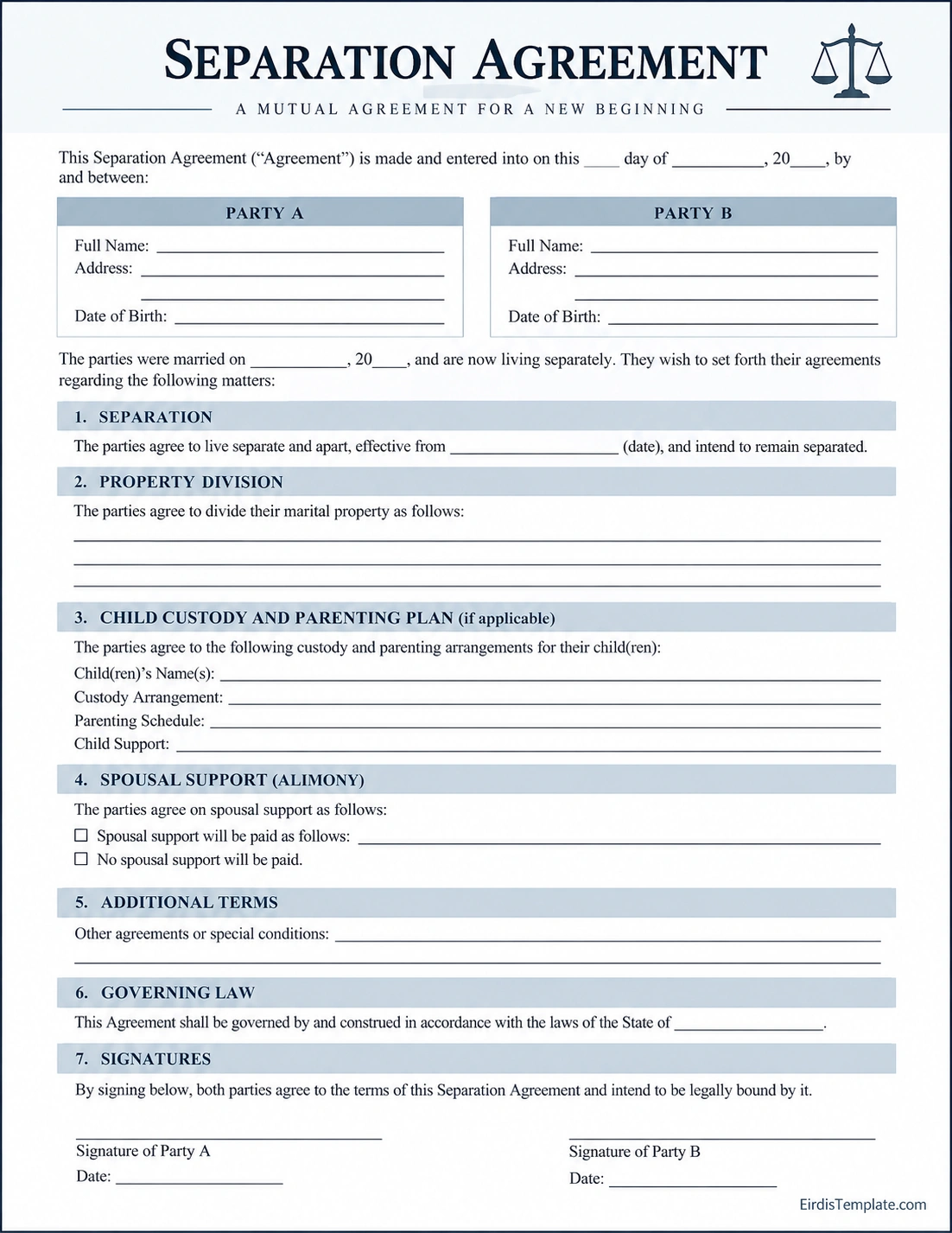
What Is a Separation Agreement?
A separation agreement is a written document in which two separating parties set out the terms they have agreed to follow while living separately. It can be used by married spouses or, where applicable under local law, unmarried partners.
The agreement can cover practical issues that need to be resolved after separation. Rather than relying on verbal promises, the parties can document their arrangements so that each person has a clear record of what was agreed.
Common subjects include:
- Division of marital or jointly owned property
- Responsibility for debts and financial obligations
- Child custody and parenting arrangements
- Child support
- Spousal support or alimony
- Use or ownership of the family home
- Insurance and other financial responsibilities
- Tax-related responsibilities where appropriate
- Methods for resolving future disagreements
The exact contents should reflect the circumstances of the parties and the laws that apply to them.
Why Use a Separation Agreement?
Separation can involve many decisions at the same time. A written agreement provides a structured way to address those decisions and establish expectations for both parties.
Provides Clarity
A written document can reduce misunderstandings by clearly identifying who is responsible for particular property, expenses, support payments, parenting duties, and other obligations.
Helps Reduce Conflict
When the parties agree on important matters in advance, there may be fewer issues requiring repeated negotiation. Clear written terms can also provide a reference if a disagreement arises later.
Gives the Parties More Control
Where legally permitted, reaching a voluntary agreement can allow the parties to participate directly in deciding their arrangements rather than leaving every unresolved issue for a court to determine.
Creates a Written Record
A signed agreement provides documentation of the terms the parties intended to follow. Whether particular provisions are legally enforceable depends on applicable law and the circumstances in which the agreement was created and signed.
What Should a Separation Agreement Include?
A well-organized separation agreement should address the issues that are relevant to the relationship and the parties’ future circumstances. There is no single form that works for every situation.
Information About the Parties
The document generally identifies the people entering into the agreement and may include their full names, addresses, relationship or marriage information, and the effective date of separation.
Property Division
The agreement can describe how property will be divided between the parties. Depending on the situation, this may include a home, vehicles, bank accounts, investments, furniture, personal property, or business interests.
It is useful to describe important assets specifically rather than using vague language. The parties may also need to identify who will retain possession of particular property and whether any property will be sold and the proceeds divided.
Debt and Financial Obligations
Debts should be addressed separately from assets. The agreement may specify responsibility for mortgages, loans, credit accounts, taxes, utilities, or other obligations.
Child Custody and Parenting Arrangements
If the parties have children, the agreement may establish parenting arrangements, including where the children will live, how parenting time will work, and how important decisions will be made.
A parenting plan can also address holidays, school breaks, transportation, communication, and procedures for handling future schedule changes.
Child Support
The parties may document arrangements concerning child support, including payment amounts, payment schedules, and responsibility for certain child-related expenses. Child support is often subject to mandatory legal rules, so an agreement should comply with the requirements of the applicable jurisdiction.
Spousal Support
Where applicable, the agreement can address spousal support, sometimes referred to as alimony or maintenance. The terms may specify whether support will be paid, the amount, duration, payment schedule, or other applicable conditions.
Because support rights and waiver requirements vary considerably, this section may require particular attention before signing.
How to Create a Separation Agreement
List the Issues That Need to Be Resolved
Start by making a complete list of the matters that need an agreement. Consider property, debts, children, support, housing, insurance, and recurring expenses.
Making this list before drafting the document can help prevent important issues from being overlooked.
Gather Relevant Information
Collect documents that help establish the parties’ financial and practical circumstances. Depending on the situation, this may include property records, loan information, account statements, income information, insurance documents, and records relating to children.
Discuss and Negotiate the Terms
The parties should discuss each issue and clearly identify areas where they agree or disagree. Mediation or professional assistance may be useful when direct discussions become difficult.
Put the Agreement in Writing
Once the terms have been discussed, put them into a structured document. Use clear language and identify specific responsibilities, amounts, dates, and procedures wherever possible.
Review the Document Carefully
Each party should understand the agreement before signing it. Independent legal advice can help a person understand how the proposed terms may affect their rights and obligations.
Sign the Agreement Properly
Signing requirements differ by jurisdiction. Depending on local law, witnessing, notarization, disclosure requirements, or other formalities may apply. The parties should follow the requirements that apply where the agreement will be used or enforced.
Separation Agreement vs. Divorce Agreement
A separation agreement and a divorce-related agreement are not necessarily the same document. A separation agreement generally addresses arrangements during separation, while a divorce proceeding may formally end a marriage and resolve legal issues as part of that process.
In some jurisdictions, a separation agreement may later be incorporated into a divorce judgment or used as part of the divorce process. Whether this happens depends on local law and the circumstances of the case.
Tips for Writing a Clear Separation Agreement
- Use specific language: Clearly identify property, payments, responsibilities, and dates.
- Avoid vague promises: Replace phrases such as “when necessary” with practical conditions whenever possible.
- Address future changes: Consider how changes in income, residence, schedules, or children’s needs will be handled.
- Keep financial information organized: Make sure assets and debts are identified consistently.
- Consider dispute resolution: Explain how the parties will attempt to resolve disagreements before taking further legal action, where appropriate.
- Review local requirements: Legal requirements can differ substantially between states and countries.
- Consider independent advice: Each party may benefit from obtaining separate legal advice before signing.
Common Mistakes to Avoid
One common mistake is creating an agreement that is too general. For example, saying that “the property will be divided fairly” may leave significant questions unanswered. Identifying specific assets and responsibilities can make the document clearer.
Another mistake is overlooking debts and recurring expenses. An agreement that discusses assets but ignores liabilities may leave important financial questions unresolved.
Parents should also avoid creating parenting provisions that are so vague that they become difficult to follow. A practical parenting schedule should be understandable and workable for everyone involved.
Finally, signing a document without understanding its legal consequences can create serious problems. A separation agreement may have significant financial and family-law implications, so professional legal advice should be considered when appropriate.
Can a Separation Agreement Be Changed?
A separation agreement may sometimes be modified when both parties agree or when applicable law provides another basis for modification. The procedure depends on the terms of the original agreement and the laws governing it.
Changes should generally be documented in writing rather than relying on informal verbal arrangements. For important modifications, the parties should determine whether additional signing, witnessing, notarization, court approval, or other legal procedures are required.
Is a Separation Agreement Legally Binding?
A separation agreement can be legally binding when it satisfies the requirements of the applicable law. However, simply putting two people’s signatures on a document does not guarantee that every provision will be enforceable.
Issues such as voluntary consent, disclosure of financial information, proper execution, fairness, prohibited provisions, and compliance with family-law requirements can affect enforceability. Rules also differ between jurisdictions.
For that reason, a template should be treated as a starting point for organizing information rather than a substitute for jurisdiction-specific legal advice.
Final Thoughts on Separation Agreements
A Separation Agreement can provide a practical framework for separating partners or spouses who want to document their arrangements clearly. By addressing property, debts, parenting, child support, spousal support, and other relevant matters, the parties can reduce uncertainty and create a written record of their agreed responsibilities.
The most useful agreement is one that is specific, understandable, complete, and appropriate for the parties’ circumstances. Because family-law requirements vary by location, anyone preparing or signing an agreement should consider checking the applicable legal requirements and obtaining independent legal advice when necessary.
Download: Separation Agreement Template

- Printable Weekly Food Chart Template - September 18, 2026
- Free Printable Weekly Cleaning Chart Template - September 18, 2026
- Free Separation Agreement Template (Word) - September 18, 2026
