A behavior contract is a structured agreement designed to help improve specific behaviors by clearly defining expectations, responsibilities, rewards, and possible consequences. It is often used between a student and teacher, parent, caregiver, counselor, or another trusted adult to create a consistent approach to behavior management.
Instead of simply telling someone to behave better, a behavior contract identifies the exact behavior that needs to change and explains what successful behavior looks like. It can also provide positive reinforcement when expectations are met. This makes the agreement easier to understand, track, and review.
A well-designed behavior contract should be realistic, specific, and easy to follow. Whether it is used in a classroom, at home, or in another structured environment, the goal is to encourage accountability while providing clear support and consistent feedback.
What Is a Behavior Contract?
A behavior contract is a written agreement that identifies specific behaviors a person is expected to demonstrate. It also explains how progress will be measured and what may happen when the agreed expectations are met or not met.
Behavior contracts are commonly used with students who need additional structure or support. However, they can also be adapted for use at home, in counseling settings, youth programs, or other situations where clear behavioral expectations are helpful.
The agreement should focus on observable actions rather than vague statements. For example, “show respect” may be difficult to measure, while “raise your hand before speaking during class” provides a much clearer expectation.
Why Use a Behavior Contract?
A behavior contract can create a shared understanding between the people involved in a behavior management plan. Everyone knows what is expected, how progress will be evaluated, and what type of positive reinforcement may be provided.
Creates Clear Expectations
Clear expectations reduce confusion. A person can understand exactly which behaviors are expected instead of trying to interpret general instructions.
Encourages Accountability
A written agreement makes responsibilities visible. When goals are specific, it becomes easier to review whether the agreed behaviors are being demonstrated consistently.
Provides Positive Reinforcement
Many behavior contracts include rewards or incentives for meeting goals. Positive reinforcement can encourage a person to continue practicing desired behaviors.
Promotes Consistency
Teachers, parents, caregivers, and other adults can use the same expectations and responses. Consistency can make a behavior support plan easier to understand and follow.
Who Can Use a Behavior Contract?
A behavior contract can be adapted for different relationships and settings. The people involved should agree on the expectations and understand their respective responsibilities.
- Students and teachers: To address classroom behavior, participation, organization, or academic routines.
- Parents and children: To establish household expectations and reinforce positive behavior.
- Caregivers and youth: To provide structure around routines and responsibilities.
- Counselors and students: To support an individualized behavior improvement plan.
- School teams: To coordinate consistent behavioral expectations across multiple settings.
- Youth programs: To establish clear conduct standards for participants.
What Should a Behavior Contract Include?
A useful behavior contract should contain enough information to make the agreement clear without becoming unnecessarily complicated. The exact sections can be adjusted according to the person’s age, needs, and setting.
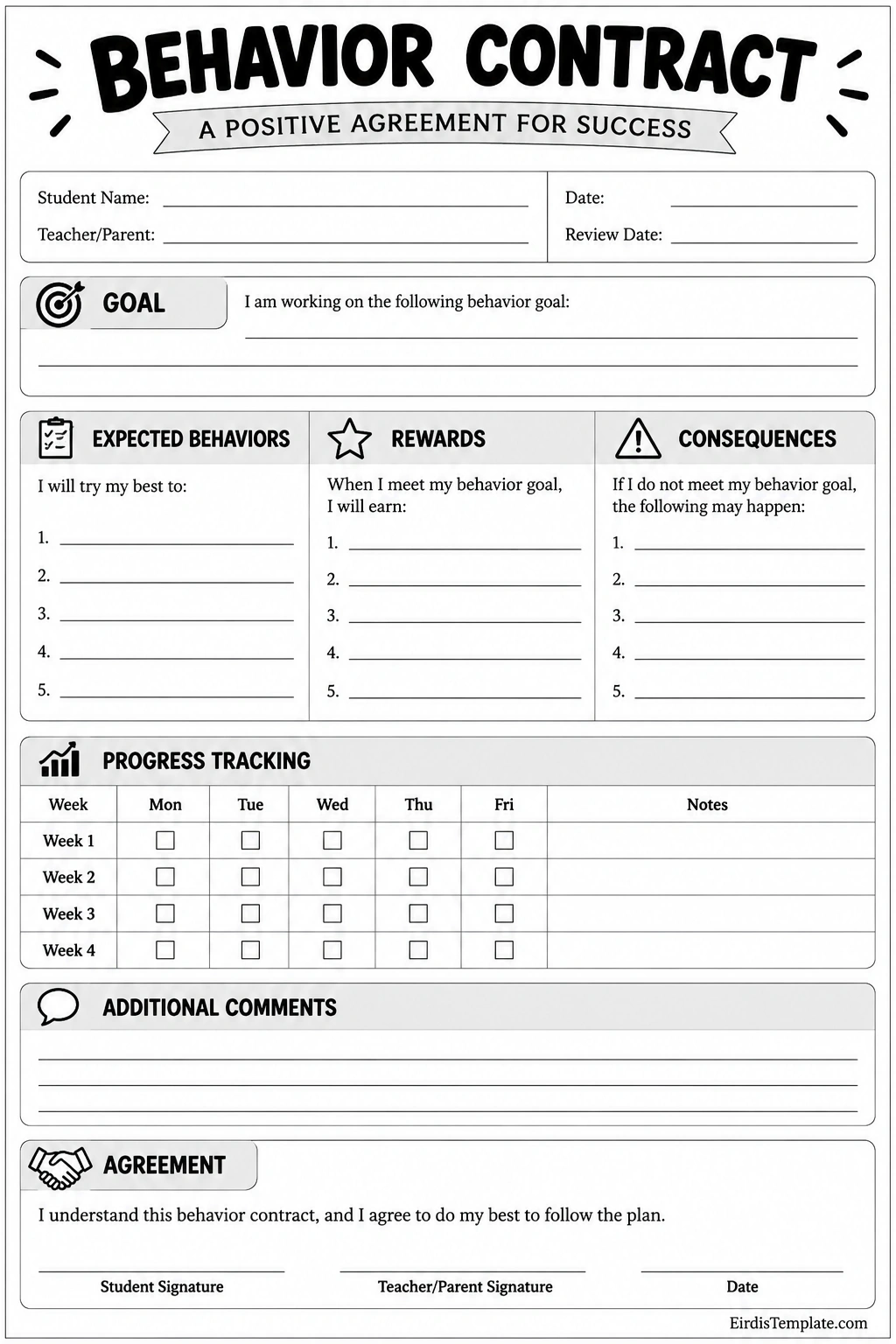
- Participant information: Name and relevant identifying information.
- Target behaviors: Specific behaviors that need to improve or continue.
- Behavioral goals: Clear and measurable goals.
- Expected behaviors: Specific actions that demonstrate success.
- Support strategies: Assistance that will be provided to help meet the goals.
- Rewards: Positive reinforcement for meeting expectations.
- Consequences: Predetermined responses when expectations are not met, when appropriate.
- Tracking method: A way to record progress.
- Review date: A scheduled time to evaluate the agreement.
- Signatures: Confirmation that the involved parties understand and agree to the plan.
How to Create a Behavior Contract
Creating an effective behavior contract starts with identifying one or more specific behaviors that can realistically be changed or improved. The agreement should then translate those behaviors into measurable expectations.
1. Identify the Target Behavior
Begin by identifying the behavior that needs attention. Focus on observable actions rather than personality traits or broad descriptions.
For example, instead of writing “be responsible,” a contract could state, “bring required classroom materials to class each day.”
2. Define the Expected Behavior
Describe exactly what successful behavior looks like. The participant should be able to understand the expectation without needing additional interpretation.
3. Set a Realistic Goal
Choose a goal that is challenging but achievable. Unrealistic expectations can discourage progress and make the contract less effective.
For younger students, the goal may involve one or two behaviors at a time. More complex goals can be introduced as the person becomes comfortable with the system.
4. Decide How Progress Will Be Measured
Determine how the behavior will be tracked. Depending on the situation, progress might be measured daily, weekly, by class period, or by another appropriate interval.
5. Choose Positive Rewards
Rewards should be meaningful and appropriate for the individual. A reward does not always need to be material. Extra activity time, recognition, choosing an activity, or another preferred privilege may work well.
6. Establish Appropriate Consequences
If consequences are included, they should be reasonable, clearly explained, and related to the behavior when possible. The purpose should be to provide a predictable response rather than to shame or intimidate the participant.
7. Review the Agreement Together
Before using the contract, make sure everyone understands the expectations. Give the participant an opportunity to ask questions and provide input when appropriate.
Behavior Contract for Students
A student behavior contract can be useful when a student needs additional structure around classroom conduct, participation, organization, or school routines.
The contract should be age-appropriate and focus on a small number of behaviors. A long list of rules can make the document difficult to understand and difficult to monitor.
Possible student behavior goals include:
- Arriving to class on time.
- Completing assigned work.
- Following classroom instructions.
- Raising a hand before speaking.
- Using respectful language.
- Keeping hands and objects to oneself.
- Staying in the assigned area.
- Bringing required materials to class.
- Following classroom routines.
Behavior Contract for Home
Parents and caregivers can also use a behavior contract to establish clear household expectations. The agreement may address chores, routines, respectful communication, homework, screen time, or other age-appropriate responsibilities.
When used at home, the contract should encourage cooperation rather than create an overly rigid system. Children and caregivers can discuss the expectations together and agree on realistic rewards for consistent progress.
Examples of Home Behavior Goals
- Complete a designated chore before recreational screen time.
- Use respectful language when discussing disagreements.
- Complete a bedtime routine by an agreed time.
- Put personal belongings away after use.
- Complete homework before participating in preferred activities.
How to Make Behavior Goals Measurable
One of the most important parts of a behavior contract is making goals measurable. A measurable goal provides a clear way to determine whether progress has occurred.
Compare these two examples:
- Vague: “The student will behave better in class.”
- Specific: “The student will remain in the assigned seat during independent work unless permission is given to leave.”
The second statement describes an observable action. This makes it easier for both the student and the adult to understand what success looks like.
Using Rewards in a Behavior Contract
Positive reinforcement can be an important part of a behavior improvement plan. Rewards should be appropriate for the person’s age and should clearly connect to the agreed behavior.
Examples of Appropriate Rewards
- Extra recreational time.
- Choosing a preferred classroom activity.
- Positive recognition.
- Additional break time when appropriate.
- Choosing a family activity.
- Working toward a larger privilege after consistent progress.
Rewards should be realistic for the adult responsible for providing them. A complicated reward system can become difficult to maintain consistently.
Tracking Behavior Progress
Tracking helps determine whether the behavior contract is working. The tracking method should be simple enough to use consistently.
A behavior tracking sheet may record whether the participant met the expectation during each relevant period. For example, a teacher might record progress during morning, afternoon, and final class periods.
Other methods may include daily checklists, point systems, rating scales, or weekly summaries. The best method depends on the behavior being measured and the person’s age.
Reviewing and Updating a Behavior Contract
A behavior contract should not necessarily remain unchanged indefinitely. Regular reviews can help determine whether the goals are still appropriate.
When Goals Are Being Met
If the participant consistently meets the expectations, the adults involved may gradually increase the level of independence or reduce the amount of monitoring.
When Progress Is Limited
If the desired behavior is not improving, review the contract before simply adding more consequences. The goal may be unrealistic, unclear, difficult to measure, or missing an appropriate support strategy.
When Circumstances Change
A change in classroom expectations, family routines, school placement, or other circumstances may require the contract to be updated.
Tips for an Effective Behavior Contract
A behavior contract works best when it is practical and consistently applied. Keep the agreement focused on behaviors that can reasonably be observed and supported.
- Keep expectations specific: Use observable actions rather than vague descriptions.
- Start small: Focus on a manageable number of behaviors.
- Use positive language: Explain what the person should do whenever possible.
- Make goals realistic: Consider the individual’s age, abilities, and circumstances.
- Be consistent: Apply the agreed system in a predictable manner.
- Review progress regularly: Use tracking information to guide decisions.
- Allow appropriate input: Involve the participant in setting goals when possible.
- Adjust when necessary: Modify ineffective or outdated goals.
- Protect dignity: Use the agreement as a supportive tool rather than a source of embarrassment.
Common Mistakes to Avoid
Even a well-intentioned behavior contract can become ineffective if it is too complicated or focuses primarily on punishment.
Using Too Many Goals
Trying to change many behaviors at once can make the contract difficult to follow. Start with the behaviors that have the greatest impact.
Writing Vague Expectations
Statements such as “be good” or “make better choices” do not clearly explain what the participant needs to do. Use specific and observable behaviors instead.
Using Inconsistent Consequences
If agreed consequences or rewards are applied inconsistently, the participant may have difficulty understanding the system. Adults involved should communicate regularly and follow the agreement as consistently as possible.
Ignoring Positive Progress
A behavior contract should not focus only on mistakes. Recognizing progress can encourage continued effort and reinforce the behaviors the contract is designed to develop.
Using a Behavior Contract Template
A behavior contract template provides a structured starting point for creating an individualized behavior agreement. Instead of designing the document from scratch, teachers, parents, caregivers, or counselors can customize the sections to match their specific goals.
A printable behavior contract template may include spaces for participant information, target behaviors, goals, rewards, consequences, progress tracking, review dates, and signatures.
The template should be treated as a planning tool rather than a one-size-fits-all solution. Each behavior plan should be adapted to the person’s needs, environment, age, and circumstances.
Frequently Asked Questions About Behavior Contracts
What is a behavior contract?
A behavior contract is a written agreement that defines specific behavioral expectations, goals, rewards, responsibilities, and sometimes consequences. It is commonly used to support positive behavior change in schools, homes, and other structured environments.
What is the purpose of a behavior contract?
The purpose is to make behavioral expectations clear, encourage accountability, provide positive reinforcement, and create consistency between the people responsible for supporting the behavior plan.
What should be included in a behavior contract?
A behavior contract can include the participant’s name, target behaviors, measurable goals, expected actions, support strategies, rewards, consequences when appropriate, progress tracking, review dates, and signatures.
How does a behavior contract work in school?
In a school setting, a teacher or school team may work with a student to identify specific behaviors and establish measurable goals. Progress can then be tracked over an agreed period and reviewed regularly.
Can parents use a behavior contract at home?
Yes. Parents and caregivers can adapt a behavior contract for household routines, chores, homework, respectful communication, bedtime, or other age-appropriate expectations.
Should a behavior contract include consequences?
It can, but consequences should be reasonable, clearly explained, and appropriate for the situation. A behavior contract can also focus primarily on positive reinforcement and supportive strategies.
How many behaviors should be included in a behavior contract?
There is no universal number, but keeping the initial agreement focused on a small number of specific behaviors can make it easier to understand, track, and maintain consistently.
How long should a behavior contract last?
The duration depends on the goals and circumstances. Some contracts may be reviewed weekly, while others may continue for several weeks or longer. Regular reviews help determine whether the agreement should be continued, modified, or gradually reduced.
Conclusion
A behavior contract can provide a clear and structured way to support positive behavior change. By defining specific expectations, measurable goals, rewards, responsibilities, and appropriate responses, it gives everyone involved a shared framework for accountability and progress.
The most effective behavior contracts are realistic, simple, consistent, and respectful. Whether used by teachers, parents, caregivers, counselors, or other support professionals, a well-designed agreement can make behavioral expectations easier to understand and provide a practical foundation for ongoing improvement.
Download: Behavior Contract Template

- Printable Bill of Lading Form Template - October 8, 2026
- Free Behavior Contract Template (Word) - October 8, 2026
- Free Printable Baseball Schedule Template - October 8, 2026
