A commercial rental agreement is an essential document when a landlord rents property to a business tenant. Whether the property is an office, retail store, warehouse, or other commercial space, a written agreement helps establish clear expectations and protect both parties throughout the rental period.
Unlike residential leases, commercial lease agreements are generally more flexible and can be customized to accommodate different business operations. They outline important details such as rental payments, lease duration, permitted business activities, maintenance responsibilities, and security deposits.
Having a properly prepared commercial rental agreement can help prevent misunderstandings, reduce potential disputes, and provide a reliable record of the arrangement. In this guide, you will learn what to include, how these agreements work, and how to use a commercial rental agreement template to organize the essential terms.
What Is a Commercial Rental Agreement?
A commercial rental agreement is a legally binding contract between a property owner (landlord) and a business tenant. It gives the tenant the right to occupy and use a commercial property for an agreed business purpose in exchange for rent.
The agreement establishes the rights and responsibilities of both parties. It also explains the financial arrangements, property conditions, and rules that apply during the rental period.
Commercial rental agreements are commonly used for:
- Office spaces: Properties used for administrative work, professional services, and corporate operations.
- Retail spaces: Shops, boutiques, restaurants, and other customer-facing businesses.
- Warehouses: Buildings used for inventory storage, distribution, and logistics.
- Industrial properties: Facilities used for manufacturing, production, and related commercial activities.
- Mixed-use properties: Buildings containing commercial units alongside other types of spaces.
Because different businesses have different requirements, the agreement should reflect the property’s intended use and the specific terms negotiated by the landlord and tenant.
Why Is a Commercial Rental Agreement Important?
A written commercial lease provides a clear framework for the rental relationship. Without documented terms, disagreements about payments, repairs, property use, or lease termination can become difficult to resolve.
Here are several reasons why a commercial rental agreement is important.
1. Protects Both Parties
The agreement documents the responsibilities of the landlord and tenant. It helps the landlord protect the property while giving the tenant clearly defined occupancy and usage rights.
2. Establishes Rental Obligations
The document specifies the amount of rent, payment deadlines, security deposit, and any additional charges. These details help both parties understand their financial commitments.
3. Clarifies Maintenance Responsibilities
Commercial properties may require regular maintenance, repairs, and improvements. The agreement can explain which responsibilities belong to the landlord and which belong to the tenant.
4. Reduces Potential Disputes
Written provisions provide a reference when disagreements arise. Instead of relying on verbal promises, both parties can review the terms they previously accepted.
What Should Be Included in a Commercial Rental Agreement?
A well-structured commercial rental agreement should cover the essential details of the rental arrangement. Although the exact provisions depend on the property and applicable laws, the following sections are commonly included.
1. Landlord and Tenant Information
Begin by identifying both parties involved in the agreement. Include their full legal names, business names where applicable, mailing addresses, and contact information.
If a company is renting the property, identify the legal business entity and the authorized representative signing on its behalf.
2. Commercial Property Description
Clearly identify the property being rented. Include its complete address, unit number, approximate rental area, and description of the premises.
For larger properties, it may also be helpful to attach a floor plan or property description as an additional document.
3. Lease Duration and Renewal Terms
Specify when the rental arrangement begins and ends. The agreement should also explain whether the lease can be renewed and what notice is required before renewal or termination.
Common commercial lease arrangements include:
- Short-term leases: Rental arrangements lasting several months or a relatively short period.
- Long-term leases: Agreements lasting multiple years.
- Renewable leases: Contracts that allow the tenant to extend the rental period under specified conditions.
- Month-to-month arrangements: Rental agreements that continue monthly until properly terminated.
4. Rent and Payment Conditions
Clearly state the rental amount and payment schedule. Include the due date, accepted payment methods, and payment instructions.
Other financial provisions may include:
- Monthly or annual base rent.
- Security deposit requirements.
- Late payment charges, where legally permitted.
- Rent increases and adjustment schedules.
- Property taxes, utilities, and other additional expenses.
- Common area maintenance charges, if applicable.
Both parties should understand which expenses are included in the rent and which must be paid separately.
5. Permitted Business Use
Explain how the tenant is allowed to use the commercial property. For example, a space may be designated for retail operations, office administration, food services, or warehouse storage.
Clearly defining permitted use helps prevent activities that could violate building regulations, zoning requirements, insurance conditions, or the landlord’s property policies.
6. Maintenance and Repairs
Maintenance provisions explain how the property should be maintained during the rental period. The agreement should identify which party is responsible for routine maintenance, structural repairs, plumbing, electrical systems, and other building components.
It is also useful to establish procedures for reporting damage, requesting repairs, and handling emergency maintenance situations.
7. Insurance and Liability
Commercial tenants may need business liability insurance, property insurance, or other coverage depending on their activities and lease requirements.
The agreement should identify the insurance obligations of each party and explain how liability is handled when property damage, accidents, or other unexpected events occur.
8. Alterations and Improvements
Some businesses need to modify commercial spaces to accommodate their operations. Examples include installing shelves, partitions, signage, equipment, or specialized fixtures.
The agreement should explain whether the tenant needs written approval before making alterations and who owns or must remove improvements when the lease ends.
9. Default and Termination
This section explains what happens when either party fails to meet their contractual obligations.
Common default situations include unpaid rent, unauthorized property use, significant property damage, or failure to comply with important lease provisions.
Include applicable notice requirements, opportunities to correct violations, and procedures for ending the agreement. These provisions must comply with applicable commercial tenancy laws.
10. Signatures of Both Parties
Conclude the agreement with signature sections for the landlord and tenant. Include printed names, signing dates, and representative titles when a business entity is involved.
Both parties should receive a complete signed copy for their records.
Free Commercial Rental Agreement Template
Using a commercial rental agreement template can make the preparation process easier. Instead of creating a document from scratch, landlords and business tenants can start with an organized layout and customize the terms according to their arrangement.
The following printable template provides a convenient starting point for documenting the essential rental information.
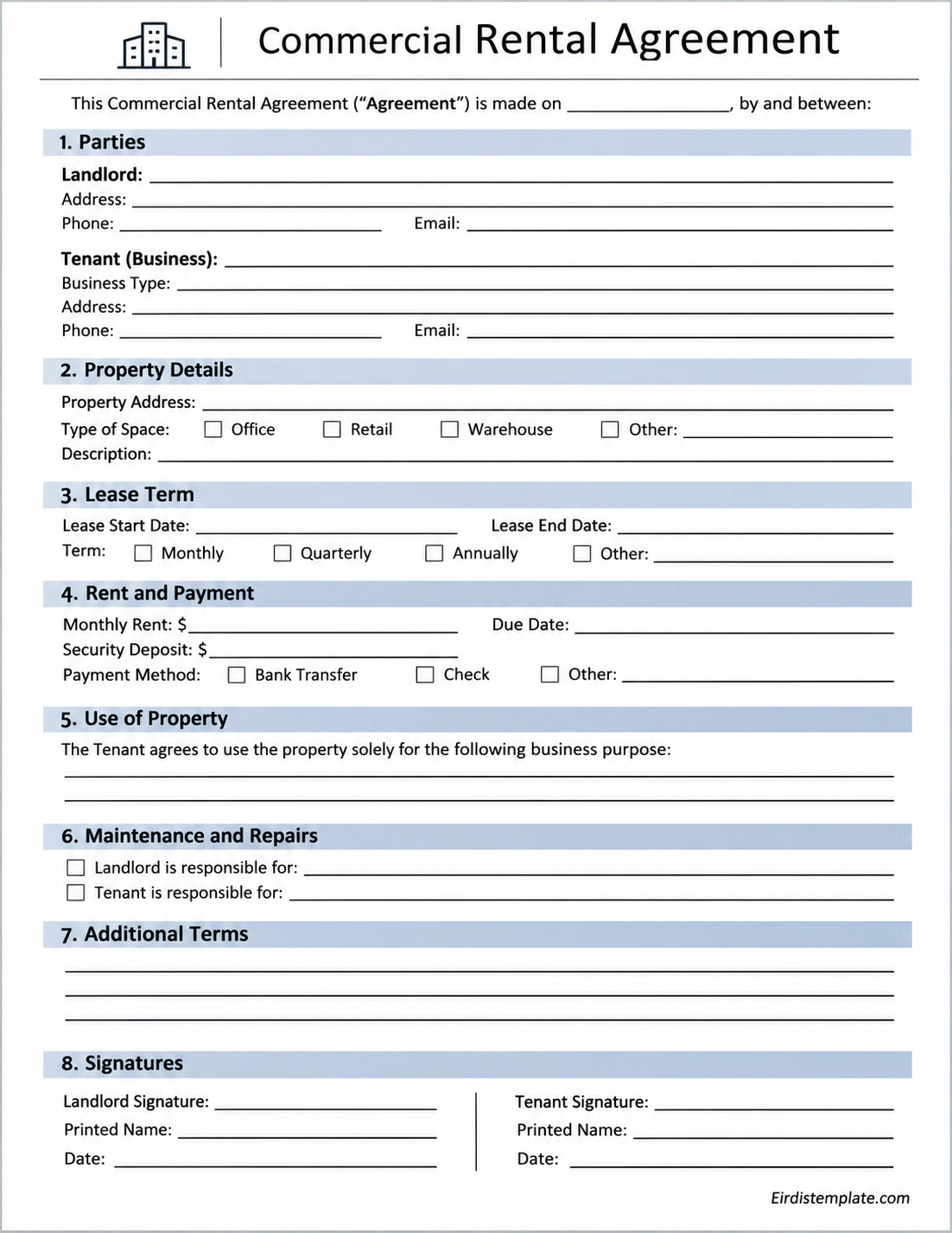
The template includes the following sections:
- Landlord and tenant details.
- Commercial property information.
- Lease start and end dates.
- Rental amount and payment details.
- Permitted business activities.
- Maintenance and repair responsibilities.
- Additional rental conditions.
- Landlord and tenant signatures.
You can use the layout as a starting point and add provisions that reflect the specific property, business activities, and negotiated rental conditions. However, this basic printable form is not a substitute for a comprehensive commercial lease when more detailed legal protections are necessary.
How to Create a Commercial Rental Agreement
Preparing a commercial rental contract requires careful consideration of the property’s condition, business requirements, and financial arrangements. Follow these steps to organize the process.
Step 1: Identify the Parties and Property
Collect the legal names and contact details of the landlord and tenant. Confirm the property’s address, boundaries, and the specific space being rented.
Step 2: Negotiate the Rental Terms
Discuss the rental price, security deposit, lease duration, payment schedule, and any additional expenses. Make sure both parties agree before including the terms in the contract.
Step 3: Define Responsibilities
Determine who handles repairs, maintenance, utilities, insurance, property improvements, and other ongoing responsibilities. Clear provisions help avoid confusion after the tenant moves in.
Step 4: Include Legal Provisions
Add appropriate clauses covering permitted use, default, termination, dispute resolution, and other relevant matters. Check local laws and regulations before finalizing these provisions.
Step 5: Review and Sign the Agreement
Carefully review the completed document with both parties. Consider having a qualified commercial real estate attorney review the agreement, particularly for long-term leases or significant financial commitments.
Once all terms are approved, the landlord and tenant should sign and retain copies of the final agreement.
Common Mistakes to Avoid When Renting Commercial Property
Even a detailed commercial lease can create problems when important information is overlooked. Avoid these common mistakes when preparing or reviewing a rental agreement.
- Leaving terms unclear: Avoid vague descriptions of rent, maintenance duties, or permitted business activities.
- Ignoring additional costs: Confirm whether utilities, property taxes, insurance, and maintenance charges are included or billed separately.
- Overlooking renewal conditions: Make sure renewal options and notice deadlines are clearly documented.
- Failing to inspect the property: Record the property’s condition before occupancy and document any existing damage.
- Ignoring local regulations: Confirm that the intended business activities are permitted under applicable zoning, licensing, and building requirements.
- Signing without reviewing: Read every provision carefully and obtain professional legal advice when necessary.
Frequently Asked Questions About Commercial Rental Agreements
1. Is a commercial rental agreement legally binding?
Yes. A commercial rental agreement can be legally binding when it meets the applicable legal requirements for contract formation and commercial property leasing. The specific requirements vary by jurisdiction and may include particular formalities, disclosures, or execution rules.
2. What is the difference between a commercial lease and a residential lease?
A commercial lease covers property rented for business activities, such as offices, retail stores, and warehouses. A residential lease covers property rented primarily as a place to live. Different legal rules, protections, and responsibilities may apply to each arrangement.
3. How long does a commercial rental agreement last?
The duration depends on the terms negotiated by the landlord and tenant. Some commercial leases last several months, while others extend for multiple years. The agreement should clearly state the start date, expiration date, and renewal conditions.
4. Can a commercial rental agreement be modified?
Yes. Both parties can generally agree to modify the rental terms. Changes should be documented in writing, signed by the appropriate parties, and handled according to the original agreement and applicable law.
5. Who is responsible for repairs in a commercial rental property?
Responsibility depends on the lease terms and applicable law. The landlord may handle structural repairs and major building systems, while the tenant may be responsible for routine maintenance and damage caused by business operations. The contract should clearly define these obligations.
6. Is a security deposit required for a commercial rental agreement?
A security deposit is commonly requested but is not necessarily mandatory in every jurisdiction or rental arrangement. The agreement should specify the deposit amount, permitted deductions, and conditions for its return.
7. Can a tenant terminate a commercial lease early?
Early termination depends on the contract and applicable law. Some agreements provide early termination options, negotiated exit provisions, or specific circumstances that allow either party to end the lease before its expiration.
8. Should a commercial rental agreement be notarized?
Notarization requirements vary depending on the jurisdiction, lease duration, property type, and applicable recording rules. Check local requirements or consult a qualified attorney to determine whether notarization or additional formalities are necessary.
9. Can a business sublease commercial rental space?
Subleasing may be permitted if the original agreement allows it or the landlord provides the required consent. Tenants should review the subleasing clause before allowing another business to occupy any part of the property.
10. Can I use a free commercial rental agreement template?
Yes. A free template can provide a useful starting point for organizing rental information and documenting basic terms. However, it should be customized to the specific property and transaction. Have a qualified legal professional review the final agreement when appropriate.
Conclusion
A commercial rental agreement is an important document for establishing a clear rental relationship between a landlord and a business tenant. It outlines essential terms such as property details, lease duration, rent, permitted business activities, maintenance responsibilities, and termination conditions.
Using a commercial rental agreement template can simplify the preparation process and help ensure that important information is documented. However, every commercial property arrangement is different, so the agreement should be customized to reflect the parties’ actual needs and applicable legal requirements.
Before signing, both parties should carefully review the terms and seek professional legal advice when necessary. A clear and properly prepared agreement provides a stronger foundation for a successful commercial rental arrangement.
Download: Commercial Rental Agreement Template
