An account plan is a strategic document used to organize how a business will manage, grow, and strengthen relationships with an important client or customer account. It brings together information about the client’s business, goals, challenges, stakeholders, opportunities, solutions, and planned actions in one structured document.
A well-developed account plan helps sales and account management teams move beyond individual transactions and build a long-term strategy around the client’s needs. Instead of focusing only on the next sale, the team can identify opportunities to create value, improve customer relationships, expand the partnership, and support mutual business goals.
Whether you manage a single strategic customer or a portfolio of key accounts, an account planning process can provide a clear roadmap for building stronger and more productive client relationships.
What Is an Account Plan?
An account plan is a structured roadmap for managing a specific customer account. It documents what the account team knows about the client, what the client is trying to achieve, where challenges and opportunities exist, and what actions the team will take to develop the relationship.
An account plan is commonly used in strategic account management, B2B sales, customer success, and business development. It can help teams coordinate their activities and make better decisions about where to invest time and resources.
A typical account plan may include:
- Account information and company background
- Client business goals and priorities
- Customer needs and challenges
- Potential business opportunities
- Products or services that can provide value
- Key stakeholders and decision-makers
- Relationship and engagement strategies
- Specific action items and owners
- Success metrics and targets
- Notes, assumptions, and follow-up information
Why Is an Account Plan Important?
Strategic customers often involve multiple stakeholders, complex purchasing processes, and changing business priorities. Without a clear account strategy, important information can become scattered across emails, meetings, CRM records, and individual team members.
An account plan creates a central reference point for the account team.
- Improves account visibility: Teams can see important customer information in one place.
- Strengthens customer relationships: Account teams can focus conversations around the client’s goals and challenges.
- Identifies growth opportunities: A structured review can reveal potential areas for expansion or additional solutions.
- Coordinates team activities: Sales, customer success, marketing, and other functions can work from the same strategy.
- Clarifies priorities: The team can distinguish important opportunities from lower-priority activities.
- Supports retention: Understanding customer needs can help teams address issues before they become larger problems.
- Creates accountability: Action items can be assigned to specific owners with target dates.
What Should an Account Plan Include?
A useful account plan should provide enough information to guide decisions without becoming unnecessarily complicated. The exact structure can vary depending on the customer, industry, sales cycle, and size of the account.
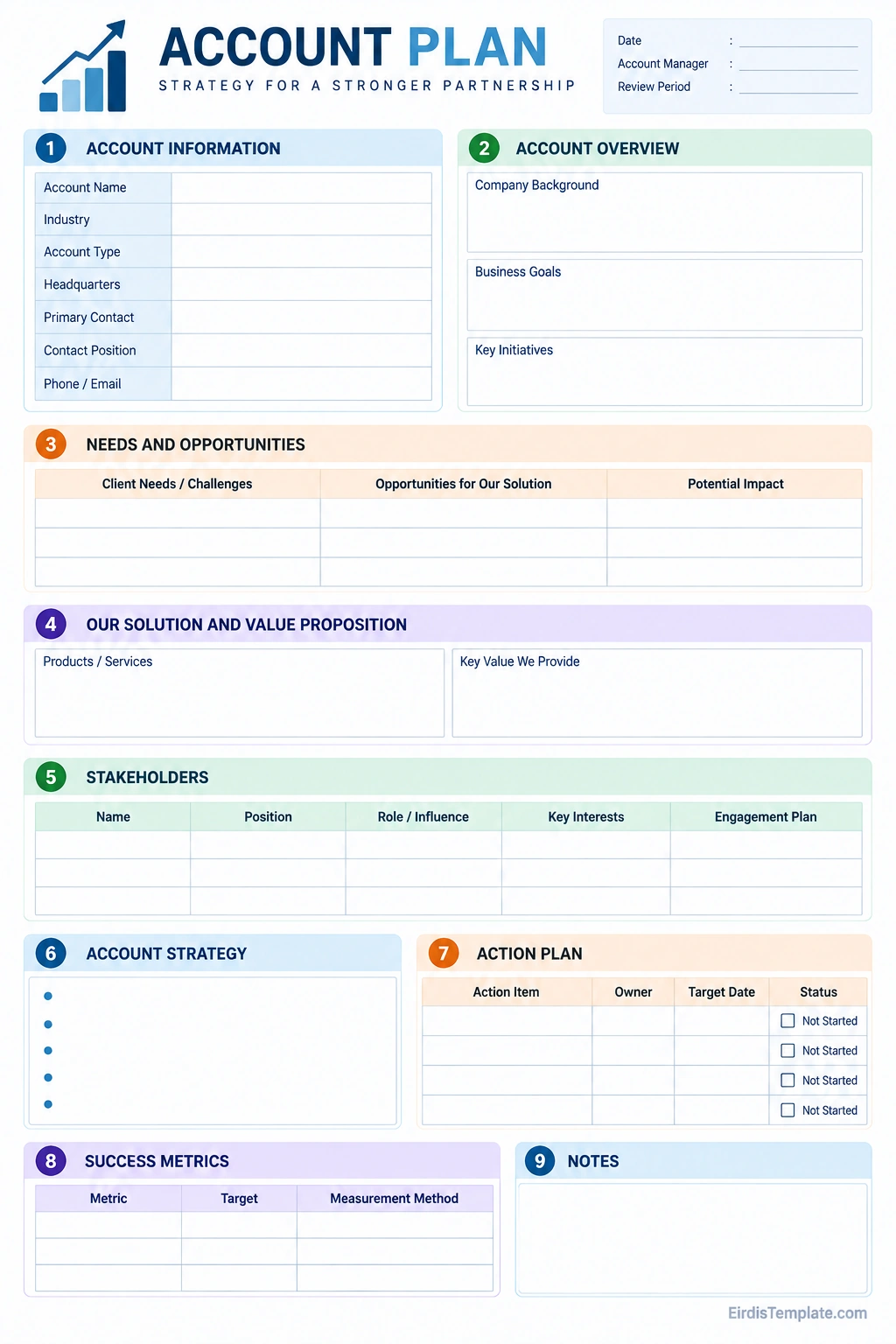
Account Information
Start with basic information about the customer. This section provides context for everyone who works on the account.
- Account or company name
- Industry
- Account type
- Headquarters or primary location
- Primary contact
- Contact position
- Phone and email information
- Account manager
- Review period
Account Overview
The account overview summarizes the customer’s business, current situation, strategic priorities, and important initiatives. It should help a new team member understand the account without reviewing every historical interaction.
Customer Goals and Priorities
Document what the client is trying to accomplish. These goals may involve operational efficiency, customer experience, growth, digital transformation, cost reduction, market expansion, or other business priorities.
Customer Needs and Challenges
Identify the problems, obstacles, or unmet needs that the client is experiencing. This section should be based on actual customer conversations and available business information rather than unsupported assumptions.
Opportunities
Connect identified customer needs with potential opportunities. The objective is not simply to list products to sell, but to determine where your organization can provide meaningful value.
How to Create an Account Plan
1. Research the Account
Begin by gathering relevant information about the client. Review existing CRM records, previous conversations, customer feedback, public company information, current products or services, and known business priorities.
The goal is to understand the customer’s business context rather than relying only on sales history.
2. Understand the Customer’s Goals
Identify the outcomes that matter most to the client. When possible, validate these goals directly with customer stakeholders.
A useful account plan should connect your activities to customer priorities. For example, instead of simply planning to introduce a new service, identify the business problem that the service is intended to address.
3. Map Key Stakeholders
Strategic accounts may involve executives, budget owners, technical users, procurement teams, operational managers, and other stakeholders. Record the people who influence the relationship and understand their roles, interests, and priorities.
4. Identify Needs and Opportunities
Compare the customer’s goals and challenges with the solutions your organization can provide. Look for opportunities where there is a clear connection between customer needs and potential business value.
5. Develop the Account Strategy
Define the strategic approach for the account. Your strategy might focus on strengthening executive relationships, improving adoption, expanding into another department, addressing customer concerns, or supporting a major client initiative.
6. Create an Action Plan
Turn the strategy into specific actions. Each action should have a clear owner and, when appropriate, a target date.
For example, an action plan might include:
- Schedule a quarterly business review.
- Arrange a technical workshop with the client’s operations team.
- Introduce an additional solution that addresses an identified business need.
- Connect an executive sponsor with the client’s leadership team.
- Follow up on an unresolved customer issue.
7. Define Success Metrics
Determine how progress will be measured. Depending on the account, metrics may include revenue growth, retention, product adoption, customer satisfaction, renewal rate, expansion opportunities, or completion of strategic initiatives.
8. Review and Update the Plan
An account plan should not be treated as a static document. Customer priorities, stakeholders, budgets, market conditions, and business needs can change. Review the plan regularly and update it when important information changes.
Account Plan for Strategic Accounts
Strategic accounts often require more detailed planning because they may represent significant business relationships or involve multiple departments and stakeholders.
A strategic account plan can help teams understand the broader relationship and coordinate activities across the organization.
Focus on the Customer’s Business
Learn how the client operates, what drives its business, and what challenges affect its performance. This creates a stronger foundation for meaningful business conversations.
Build Multiple Relationships
Depending on the account structure, relying on a single contact can create unnecessary relationship risk. Developing appropriate relationships across relevant departments can provide broader visibility into customer needs and priorities.
Connect Solutions to Outcomes
Focus conversations on the business outcomes the customer wants to achieve. A solution becomes more meaningful when its potential value is connected to a clearly identified customer objective.
Account Plan vs. Sales Plan
An account plan and a sales plan are related, but they do not necessarily serve the same purpose.
A sales plan generally focuses on sales objectives, pipeline activity, targets, territories, prospects, and revenue generation. An account plan focuses more specifically on developing an existing customer relationship and creating a strategy around that account.
An account plan can include sales opportunities, but it also considers customer goals, stakeholder relationships, current challenges, service experience, retention, and long-term partnership development.
Account Plan vs. Account Strategy
An account strategy describes the overall approach for developing a customer relationship, while an account plan typically translates that strategy into a more structured set of information, priorities, and actions.
In practice, the terms may be used differently across organizations. Some companies treat the account strategy as one section within a broader account plan.
How to Make an Account Plan More Effective
- Use customer-centered information: Start with the client’s goals and challenges rather than your product catalog.
- Keep information current: Update the plan when stakeholders, priorities, or business conditions change.
- Use measurable objectives: Define outcomes that can be tracked over time.
- Assign clear ownership: Every important action should have someone responsible for moving it forward.
- Prioritize opportunities: Focus resources on opportunities with a clear customer need and realistic potential.
- Coordinate internally: Make sure relevant sales, marketing, customer success, product, and leadership teams understand their roles.
- Review the relationship regularly: Use account reviews to evaluate progress, risks, opportunities, and next steps.
- Document risks: Record important relationship, competitive, operational, or renewal risks so the team can plan appropriate responses.
Common Account Planning Mistakes
Even a detailed account plan may provide limited value if it is not connected to actual customer needs or ongoing team activity.
- Creating the plan once and never updating it.
- Focusing only on revenue instead of customer outcomes.
- Listing generic information that does not support decision-making.
- Failing to identify important stakeholders.
- Recording opportunities without understanding the customer’s need.
- Creating actions without assigning owners or dates.
- Using unrealistic or poorly defined success metrics.
- Keeping the account plan separate from the team’s regular account review process.
The most useful account plans are living documents. They should help the team make decisions, coordinate activities, and respond to changes in the customer relationship.
Using an Account Plan Template
An account plan template provides a repeatable structure for organizing customer information and developing an account strategy. A template can be particularly useful when a sales or account management team manages multiple strategic customers.
A practical template can include sections for account information, company background, business goals, customer needs, opportunities, value propositions, stakeholders, account strategy, action items, success metrics, and notes.
Using a consistent account planning format makes it easier to compare plans, conduct account reviews, identify missing information, and maintain a common planning process across a team.
Frequently Asked Questions About Account Plans
What is an account plan in sales?
An account plan in sales is a structured strategy for developing a specific customer relationship. It typically covers the customer’s goals, needs, stakeholders, opportunities, solutions, planned activities, and measures of success.
Who uses an account plan?
Account plans are commonly used by account managers, sales representatives, strategic account managers, customer success teams, business development professionals, and sales leadership. Other teams may contribute information when the customer relationship involves multiple functions.
What is the main goal of an account plan?
The main goal is to create a clear strategy for developing a customer relationship while aligning the organization’s activities with the customer’s needs and business objectives.
How often should an account plan be updated?
The appropriate review frequency depends on the account. Strategic accounts may benefit from regular monthly or quarterly reviews, while less complex accounts may require less frequent updates. The plan should always be updated when significant customer or business changes occur.
What is included in a strategic account plan?
A strategic account plan may include account information, customer goals, business challenges, stakeholder mapping, opportunities, value propositions, relationship strategy, action plans, risks, and success metrics.
Can an account plan be used for customer retention?
Yes. An account plan can support retention by helping teams understand customer priorities, monitor relationship health, identify potential risks, and plan activities that strengthen the overall customer relationship.
What is an account plan template?
An account plan template is a predefined framework for organizing information about a customer account and documenting the strategy for developing that relationship. It can help teams create consistent and repeatable account plans.
Conclusion
An account plan provides a practical roadmap for managing and developing important customer relationships. By documenting the client’s business context, goals, needs, stakeholders, opportunities, strategy, action items, and success metrics, an account plan helps teams coordinate their efforts around meaningful customer outcomes.
The strongest account plans are not simply sales documents. They are living strategic tools that help teams understand customers, identify opportunities, manage risks, and build long-term relationships. Whether you manage one strategic account or a portfolio of key clients, using a clear account plan template can make the planning process more organized, consistent, and actionable.
Download: Account Plan Template

- Printable Acknowledgement Receipt Template - October 1, 2026
- Free Acknowledgement Letter Template (Word) - October 1, 2026
- Free Printable Accounting Ledger Template - October 1, 2026
