A cash flow forecast helps businesses predict how much money will come in and go out over a future period. By estimating expected cash receipts and payments, business owners can determine whether they will have enough cash to cover operating expenses, pay employees, meet loan obligations, and fund future growth.
Even a profitable business can experience financial difficulties when customers pay late or expenses become due before cash is received. A cash flow forecast helps identify these potential shortfalls early, giving business owners time to adjust spending, collect outstanding invoices, arrange financing, or revise investment plans.
Whether you run a small business, manage a growing company, or work as a freelancer, a cash flow forecast template can help you organize financial expectations and make better decisions. This guide explains what a cash flow forecast is, what information to include, how to prepare one, and how to use the results to manage business finances more effectively.
What Is a Cash Flow Forecast?
A cash flow forecast is a financial planning document that estimates the cash a business expects to receive and pay out during a specific period. It typically includes projected cash inflows, projected cash outflows, and the expected cash balance at the end of each period.
Businesses may prepare a weekly, monthly, quarterly, or annual forecast depending on their size, cash position, and planning needs. A short-term forecast can help manage immediate bills and payroll, while a longer-term forecast can support decisions about hiring, expansion, equipment purchases, and financing.
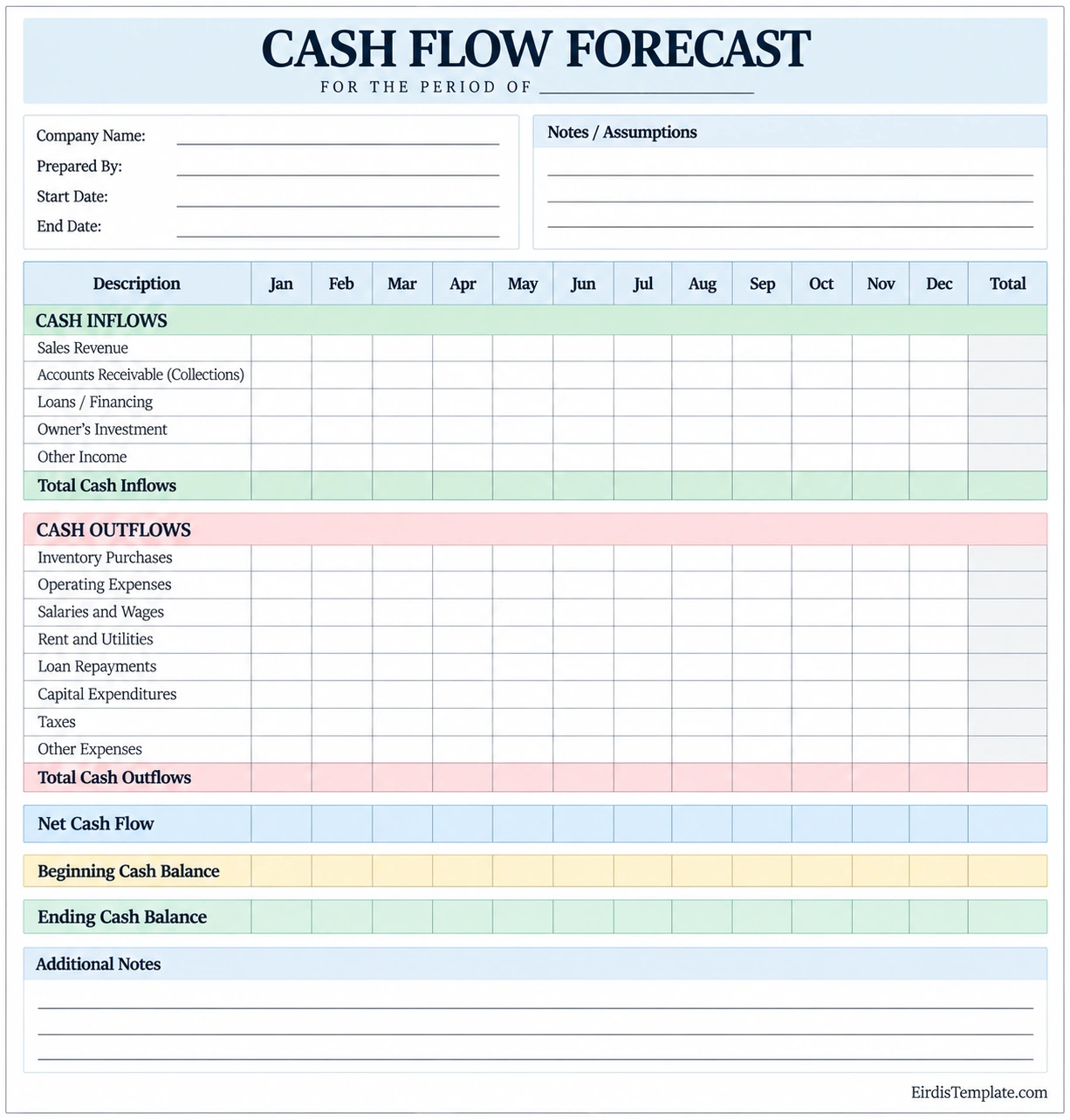
A typical cash flow forecast includes:
- Opening cash balance: The cash available at the beginning of the forecast period.
- Cash inflows: Expected customer payments, sales receipts, financing, investments, and other cash received.
- Cash outflows: Expected payments for suppliers, payroll, rent, taxes, loan repayments, and other expenses.
- Net cash flow: The difference between total cash inflows and total cash outflows.
- Closing cash balance: The projected cash remaining at the end of the period.
- Forecast assumptions: The estimates and conditions used to calculate expected receipts and payments.
The forecast should focus on when cash is expected to move, not simply when revenue or expenses are recorded in accounting records. This timing distinction is essential for understanding whether the business can meet its financial commitments.
Why Is a Cash Flow Forecast Important?
A cash flow forecast provides an early view of a business’s expected liquidity. It helps owners understand when cash may become tight and which financial decisions could improve the company’s position.
1. Helps Prevent Cash Shortfalls
By estimating future receipts and payments, a forecast can reveal periods when available cash may not cover upcoming obligations. Businesses can then take action before a shortfall occurs, such as following up on overdue invoices, negotiating supplier terms, or postponing nonessential purchases.
2. Supports Better Spending Decisions
A cash flow projection helps business owners decide whether they can afford new equipment, additional employees, marketing campaigns, or other planned expenses. It also helps distinguish between purchases that are necessary now and those that can wait until cash availability improves.
3. Improves Budgeting and Financial Planning
A forecast complements the business budget by showing when money is expected to be received and paid. While a budget focuses on planned financial performance, a cash flow forecast emphasizes the timing of cash movements and the resulting cash balance.
4. Helps Prepare for Growth
Growth can require cash before the related revenue arrives. A business may need to purchase inventory, pay staff, or invest in equipment before receiving customer payments. Forecasting these costs helps owners plan for the funding required to support expansion.
5. Supports Financing Discussions
Lenders, investors, and business partners may ask for cash flow projections when evaluating a company’s financial plans. A realistic forecast can help explain expected funding needs, repayment capacity, and the assumptions behind a proposed investment or financing request.
What to Include in a Cash Flow Forecast Template
A useful cash flow forecast template organizes expected receipts and payments into clear categories. The exact layout depends on the business, but the following sections provide a practical starting point.
Opening Cash Balance
Enter the cash available at the start of the first forecast period. Use a reconciled current balance rather than an estimate when actual records are available. The opening balance for each later period should generally equal the previous period’s closing balance.
Expected Cash Inflows
List the sources of cash the business expects to receive. Common examples include:
- Cash sales and customer payments.
- Collections from accounts receivable.
- Customer deposits and advance payments.
- Loan proceeds and other financing received.
- Owner contributions or new investment.
- Other cash receipts, refunds, or applicable income.
Estimate when the money will actually arrive. For example, if a customer invoice is due in 30 days, do not automatically treat the sale as cash received in the current week or month.
Expected Cash Outflows
Record the payments the business expects to make during each period. Typical categories include:
- Inventory purchases and supplier payments.
- Employee wages, salaries, and related payroll costs.
- Rent, utilities, internet, and other operating costs.
- Marketing, software, insurance, and professional fees.
- Taxes and statutory payments.
- Loan principal and interest payments.
- Equipment purchases and other capital expenditures.
- Owner withdrawals, dividends, or other applicable cash distributions.
Include irregular expenses that may not occur every month, such as annual insurance premiums, tax payments, equipment replacement, or seasonal inventory purchases.
Net Cash Flow
Net cash flow shows whether more cash is expected to enter or leave the business during a period.
Net Cash Flow = Total Cash Inflows − Total Cash Outflows
A positive result means projected cash inflows exceed projected outflows for that period. A negative result means the business expects to pay out more cash than it receives during that period.
Closing Cash Balance
The closing cash balance shows the expected cash remaining at the end of each period.
Closing Cash Balance = Opening Cash Balance + Net Cash Flow
For example, if the opening balance is $12,000, expected cash inflows are $20,000, and expected cash outflows are $25,000, the projected closing balance is $7,000. This calculation helps you assess whether the remaining cash is sufficient for upcoming obligations.
Notes and Forecast Assumptions
Document the assumptions behind important estimates. These may include expected sales growth, customer payment delays, seasonal demand, supplier price changes, planned borrowing, or the timing of a large purchase. Recording assumptions makes the forecast easier to review and update.
How to Prepare a Cash Flow Forecast Step by Step
Step 1: Choose the Forecast Period
Decide how far ahead you need to plan. A weekly forecast can be useful when cash is tight or payment timing is unpredictable. Monthly forecasts often work well for routine business planning, while quarterly or annual projections can help evaluate longer-term investments and growth.
Step 2: Establish the Current Cash Position
Record the current cash balance using reliable financial records. Reconcile bank accounts and identify any payments or deposits that have been initiated but have not yet cleared. A reliable starting balance makes the forecast more useful.
Step 3: Estimate Cash Inflows
Review sales forecasts, outstanding invoices, customer payment histories, subscription receipts, and expected financing. Estimate when each receipt is likely to reach the business rather than relying only on invoice dates or sales targets.
Step 4: Estimate Cash Outflows
List recurring and one-time payments, including payroll, rent, supplier invoices, taxes, loan repayments, and planned purchases. Check payment due dates and include expenses that may be easy to overlook because they occur only occasionally.
Step 5: Calculate Net Cash Flow and Closing Balances
For each period, subtract expected outflows from expected inflows. Add the resulting net cash flow to the opening cash balance to calculate the closing balance. Carry that closing balance forward as the opening balance for the next period.
Step 6: Identify Potential Shortfalls
Review the forecast for periods when the projected cash balance falls below the minimum level your business needs. Consider whether you can improve collections, negotiate payment schedules, reduce discretionary spending, or arrange suitable financing before the shortfall occurs.
Step 7: Update the Forecast Regularly
Compare actual receipts and payments with your estimates. Replace outdated assumptions with current information and revise future periods when sales, costs, or payment dates change. A cash flow forecast is most useful when it reflects the latest available information.
Cash Flow Forecast Example
Consider a small business that begins the month with $10,000 in cash. It expects to receive $18,000 from customers and pay $12,000 in operating expenses, $5,000 to suppliers, and $1,000 in loan payments.
- Opening cash balance: $10,000
- Expected cash inflows: $18,000
- Operating expenses: $12,000
- Supplier payments: $5,000
- Loan payments: $1,000
- Total cash outflows: $18,000
- Net cash flow: $18,000 − $18,000 = $0
- Closing cash balance: $10,000 + $0 = $10,000
Although the projected closing balance remains unchanged, the timing of receipts and payments still matters. If supplier payments and payroll are due before customer invoices are collected, the business may experience a temporary cash shortage even when the monthly totals appear balanced.
Tips for Creating a More Accurate Cash Flow Forecast
- Use realistic sales assumptions: Base expected receipts on reliable sales information and customer payment behavior.
- Separate confirmed and uncertain receipts: Distinguish contracted or scheduled payments from sales that have not yet been secured.
- Include irregular costs: Account for annual fees, taxes, seasonal purchases, maintenance, and other occasional payments.
- Review payment timing: Record when cash is expected to arrive or leave the account, not just when a transaction is recorded.
- Compare forecasts with actual results: Investigate significant differences and improve future estimates.
- Prepare alternative scenarios: Model what happens if sales decline, customers pay late, or costs increase.
- Maintain a cash reserve target: Decide what minimum balance is appropriate for your business and monitor periods when the forecast falls below it.
- Assign responsibility: Identify who updates the forecast, verifies assumptions, and reports significant changes.
Common Cash Flow Forecasting Mistakes to Avoid
- Confusing profit with cash: Revenue may be recorded before the customer pays, while loan principal and equipment purchases can affect cash without being ordinary operating expenses.
- Overestimating collections: Assuming every customer will pay on time can make projected balances look stronger than they are.
- Forgetting one-time payments: Tax bills, insurance renewals, and major purchases can create unexpected cash pressure.
- Using outdated figures: A forecast based on old sales or expense assumptions may no longer reflect current conditions.
- Ignoring timing differences: Monthly totals can hide a short-term cash shortage if payments fall due before receipts arrive.
- Failing to plan for uncertainty: A single forecast may not capture the effects of changing sales, costs, or customer behavior.
Cash Flow Forecast vs. Cash Flow Statement vs. Budget
These financial tools serve related but different purposes. Understanding the differences helps you use each one appropriately.
Cash Flow Forecast
A cash flow forecast estimates future cash receipts, payments, and balances. It is primarily used for planning and anticipating liquidity needs.
Cash Flow Statement
A cash flow statement reports actual cash movements during a past period, commonly grouped into operating, investing, and financing activities. It helps explain how the company’s cash position changed.
Business Budget
A business budget sets financial targets for revenue, costs, expenses, and other results over a future period. A cash flow forecast focuses more specifically on when money is expected to be received and paid. A company can be profitable on its budget and still face cash pressure if receipts arrive too late to cover obligations.
Frequently Asked Questions
What is the main purpose of a cash flow forecast?
The main purpose is to estimate future cash receipts and payments so a business can anticipate its cash position. It helps identify potential shortfalls, plan payments, manage liquidity, and make informed financial decisions.
How often should a business prepare a cash flow forecast?
The frequency depends on the business’s needs. Weekly forecasts may be useful when cash is tight or payments are unpredictable, while monthly forecasts suit many routine planning activities. Update the forecast whenever important financial assumptions change.
What is the difference between cash flow and profit?
Profit measures income minus expenses under the applicable accounting method, while cash flow tracks money actually received and paid. A business can report a profit but experience a cash shortage because customers have not paid invoices or because major payments are due.
Can a cash flow forecast be used by a small business?
Yes. A cash flow forecast is valuable for small businesses, freelancers, startups, and established companies. Even a simple spreadsheet that tracks opening balances, expected receipts, payments, and closing balances can improve financial planning.
What should I do if my forecast shows a cash shortfall?
First, confirm the timing and accuracy of the estimates. Then consider accelerating collections, following up on overdue invoices, negotiating supplier terms, delaying nonessential spending, or arranging suitable financing. Assess the cost and risks of each option before making a decision.
How far ahead should a cash flow forecast cover?
Choose a period that matches your business’s planning needs. A short-term forecast can help manage immediate obligations, while a longer forecast can support expansion, investment, and financing decisions. Many businesses use more than one forecast horizon.
Can I use a cash flow forecast template in Excel?
Yes. A spreadsheet template can organize monthly or weekly cash inflows, outflows, net cash flow, and projected balances. Check formulas carefully and update the estimates regularly using current financial records.
Does a cash flow forecast guarantee that a business will avoid cash problems?
No. A forecast depends on estimates and cannot predict every unexpected event. However, regularly updating it and preparing alternative scenarios can help a business recognize risks earlier and respond more effectively.
Conclusion
A cash flow forecast is an essential planning tool for understanding how cash is expected to move through a business. By estimating receipts, payments, net cash flow, and closing balances, business owners can identify potential shortfalls, plan expenses, and make more informed decisions about financing and growth.
Use a cash flow forecast template to organize financial estimates, document assumptions, and compare projected results with actual cash movements. Review the forecast regularly and adjust it as conditions change. With realistic assumptions and consistent monitoring, you can improve visibility into future liquidity and manage business finances with greater confidence.
Disclaimer: This article is for general informational purposes only and does not constitute accounting, tax, investment, or financial advice. Forecasting methods and reporting requirements may vary by business and jurisdiction. Consult a qualified financial professional when necessary.
Download: Cash Flow Forecast Template

- Cash Flow Statement Template - October 15, 2026
- Cash Flow Forecast Template - October 15, 2026
- Free Printable Caregiver Schedule Template - October 15, 2026
