A capability statement is a concise business document that highlights a company’s core competencies, experience, services, and competitive advantages. It helps potential clients, business partners, and government agencies understand what a company offers and why it may be the right choice for a specific opportunity. Often designed as a one-page business profile, it serves as a professional introduction that supports networking, sales, and contract opportunities.
Whether you run a small business, a consulting firm, a construction company, or a government contracting business, a well-written capability statement can help communicate your strengths quickly. It brings essential business information together in a clear format, making it easier for decision-makers to evaluate your qualifications.
A capability statement template provides a practical starting point. It helps you organize your company overview, core competencies, past performance, differentiators, certifications, and contact information without designing the document from scratch. This guide explains what a capability statement is, what to include, and how to create one that presents your business professionally.
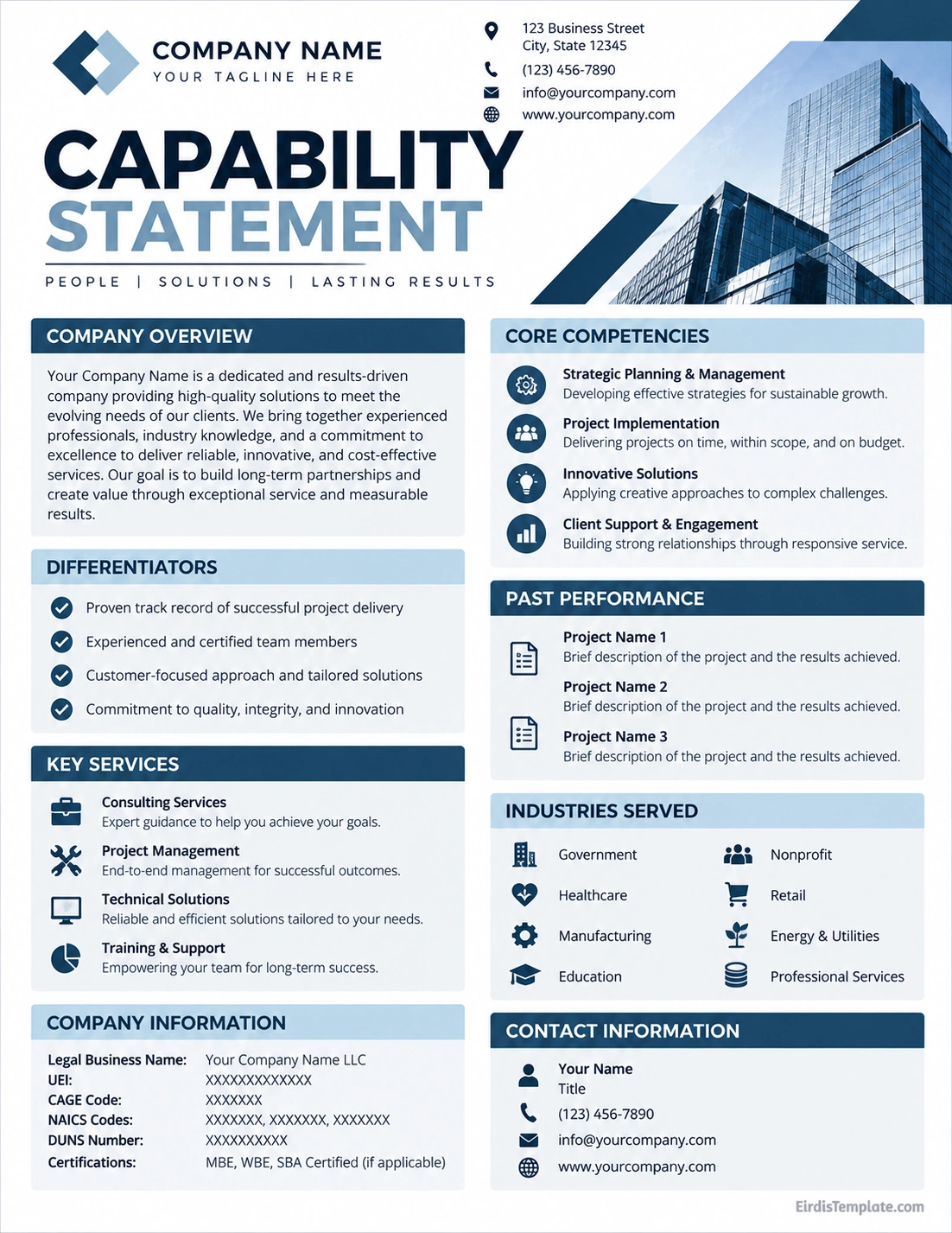
What Is a Capability Statement?
A capability statement is a business marketing document that summarizes a company’s ability to deliver specific products or services. It highlights relevant expertise, successful projects, qualifications, and information that helps prospective customers determine whether the business meets their needs.
Unlike a general company brochure, a capability statement is usually focused on a particular industry, customer group, or contracting opportunity. It emphasizes the capabilities and evidence most relevant to the intended audience rather than describing every aspect of the business.
Businesses commonly use capability statements to:
- Introduce their services: Explain what the company does and which problems it solves.
- Support government contracting: Present relevant qualifications and experience to government buyers and procurement teams.
- Build business partnerships: Demonstrate expertise to prime contractors, suppliers, and potential partners.
- Strengthen sales outreach: Give prospective clients a concise overview of the company’s value.
- Prepare for networking events: Provide a useful follow-up document after meetings, conferences, or industry events.
A strong capability statement combines clear writing with relevant evidence. It should make it easy for a reader to understand your business, recognize its strengths, and find the right person to contact.
Why Is a Capability Statement Important?
Decision-makers often review many companies before choosing a supplier or service provider. A focused capability statement helps your business communicate its qualifications without requiring the reader to navigate a lengthy presentation or website.
Creates a Professional First Impression
A well-organized document demonstrates that your business can present information clearly. Consistent branding, concise descriptions, and accurate company details help build confidence during the initial evaluation process.
Highlights Your Competitive Advantages
Your company may offer specialized expertise, faster delivery, industry-specific experience, unique technology, or a strong quality-control process. A capability statement gives you space to explain these strengths and show how they benefit potential customers.
Supports Government and Corporate Procurement
Government agencies and larger organizations may work with established procurement processes to identify qualified suppliers. A capability statement can help buyers quickly review your services, business classifications, relevant codes, certifications, and past performance.
However, submitting a capability statement does not guarantee a contract or replace formal registration, qualification, or bidding requirements. Always follow the specific instructions provided for the opportunity.
Improves Business Development
A reusable capability statement can support outreach to prospective clients, teaming partners, and referral sources. By tailoring the document to each audience, you can focus attention on the experience and services that matter most to the opportunity.
What to Include in a Capability Statement
The most effective capability statements prioritize relevant information and avoid unnecessary detail. Although the exact format varies by industry, the following sections provide a useful foundation.
Company Overview
Begin with your business name and a short description of what your company does. Explain your primary services, target market, and the value you provide. Aim for a concise introduction that helps readers understand your business within a few sentences.
For example, a commercial cleaning company might describe its focus on office buildings, healthcare facilities, and industrial spaces, emphasizing documented quality procedures and reliable service coverage.
Core Competencies
Core competencies are the principal skills, services, and capabilities your business performs particularly well. List the areas most relevant to your target customers rather than every service you have ever provided.
Depending on your industry, core competencies might include:
- Project management and implementation.
- Construction, renovation, or facility maintenance.
- Information technology and software development.
- Professional consulting and technical support.
- Logistics, distribution, or supply services.
- Specialized manufacturing or equipment installation.
Use specific descriptions whenever possible. Clear service categories are more useful than broad claims such as “excellent solutions” or “complete customer satisfaction.”
Differentiators
Differentiators explain why a prospective client should consider your company instead of another provider. Focus on advantages that are relevant, credible, and supported by evidence.
Examples include specialized certifications, industry experience, proprietary methods, geographic coverage, qualified personnel, documented quality processes, or a demonstrated ability to meet demanding schedules.
Avoid unsupported statements such as “the best company in the industry.” Instead, explain what makes your business distinctive and provide evidence where possible.
Past Performance and Relevant Experience
Past performance shows how your company has delivered work in real situations. Include selected projects, clients where disclosure is permitted, service descriptions, and measurable results when available.
Useful details may include project scope, completion dates, delivery performance, cost savings, or improvements achieved. Keep each example brief and relevant to the opportunity you are pursuing.
If your business is new, you can highlight relevant experience gained by team members, comparable commercial projects, completed pilot work, or other legitimate evidence of capability. Clearly distinguish individual experience from contracts performed by the current business.
Company Data and Certifications
Depending on your industry and target audience, include relevant business information such as:
- Legal business name and business structure.
- Business address, website, and general contact details.
- Relevant industry classification codes, where applicable.
- Government supplier or registration identifiers, when required.
- Verified certifications and applicable small-business classifications.
- Geographic service area and important operating details.
For United States federal contracting, businesses may include applicable identifiers or classification codes requested by their target buyers. Confirm that every identifier, registration, and certification is current and accurate before publishing the document.
Contact Information
End with the name and contact details of the person who can respond to inquiries. Include a professional email address, phone number, and website where appropriate. Make sure the contact information is easy to locate and remains current.
How to Create a Capability Statement Step by Step
Creating a capability statement begins with understanding the audience. A document aimed at a government procurement officer may need different information from one prepared for a private-sector client.
Define Your Target Audience
Identify the organizations, buyers, industries, or contracting opportunities you want to reach. Review their requirements and determine which qualifications, services, and results are most relevant to their needs.
Gather Accurate Business Information
Collect your company description, service list, certifications, business identifiers, project examples, and contact details. Verify dates, project results, and credentials before using them. Obtain permission before naming clients or disclosing confidential project information.
Write a Focused Company Summary
Explain what your business does, whom it serves, and the value it delivers. Keep the introduction short enough that readers can quickly understand your primary offering. Use plain language and avoid unnecessary jargon.
Select Your Strongest Evidence
Choose competencies, differentiators, and past-performance examples that support your intended message. Whenever possible, replace general claims with specific results, verified credentials, or relevant examples.
Design a Clear One-Page Layout
Organize the information using clear headings, short paragraphs, and concise bullet lists. Use your brand colors and logo consistently, but keep the design readable. A capability statement should communicate substance first and visual style second.
Choose a readable font, maintain adequate spacing, and make sure the document remains clear when printed or viewed as a PDF. Avoid cramming every available detail onto one page.
Review and Tailor the Document
Proofread the content, confirm the accuracy of business information, and test all contact details. Before sending the document, adjust the emphasis to match the specific client, industry, or opportunity.
Save a master version for future updates and create tailored copies when necessary. Review the document periodically so certifications, company data, project examples, and contact information do not become outdated.
Capability Statement vs. Company Profile
A capability statement and a company profile both introduce a business, but they serve different purposes. A company profile often provides a broader overview of the organization’s history, mission, products, services, and structure. A capability statement is more focused on the specific strengths and qualifications that make a business suitable for an opportunity.
For example, a company profile might explain how a construction business was established and describe its full range of services. Its capability statement would emphasize relevant construction expertise, safety practices, project experience, certifications, service areas, and qualifications for a particular contract.
Use a company profile when readers need a general introduction to your organization. Choose a capability statement when you want to demonstrate why your business is qualified for a specific client, partnership, or contracting opportunity.
Tips for Making Your Capability Statement More Effective
A capability statement should be concise, credible, and relevant. Apply these practical tips to improve its effectiveness:
- Focus on the reader: Highlight the services and qualifications that matter most to your intended audience.
- Use specific language: Replace vague descriptions with concrete competencies and clearly defined services.
- Include measurable results: Use verified figures and outcomes to demonstrate your experience when available.
- Keep information accurate: Verify business identifiers, certifications, project details, and contact information.
- Prioritize readability: Use clear headings, concise bullets, consistent spacing, and a professional layout.
- Make it easy to contact you: Ensure your primary contact details are visible and correct.
- Tailor it to opportunities: Adjust your core competencies and experience to match the needs of the prospective client.
- Use a professional file format: A well-formatted PDF is convenient for email, printing, and sharing.
- Update it regularly: Add relevant projects, renew outdated information, and remove claims that are no longer accurate.
Remember that a capability statement is a supporting business development tool, not a substitute for a detailed proposal, bid submission, contract, or required supplier registration. Use it to create interest and make the next conversation easier.
Frequently Asked Questions About Capability Statements
What is the main purpose of a capability statement?
The main purpose of a capability statement is to demonstrate a company’s core competencies, relevant experience, and competitive advantages. It helps potential clients, procurement teams, and business partners assess whether the company may be suitable for an opportunity.
How long should a capability statement be?
A capability statement is commonly presented as a one-page document. This format encourages concise writing and makes the information easy to review. More complex businesses may need supporting materials, but the primary statement should remain focused on the most relevant qualifications.
Who needs a capability statement?
Small businesses, government contractors, construction companies, consultants, technology providers, professional service firms, and other businesses seeking new clients or partnerships can benefit from a capability statement. It is particularly useful when buyers need a quick overview of a supplier’s qualifications.
What is the difference between a capability statement and a proposal?
A capability statement summarizes what a business can do and why it is qualified. A proposal responds to a specific request by explaining how the business intends to meet the requested requirements, often including a work plan, schedule, pricing, and other details.
Should a capability statement include past performance?
Yes, when relevant experience is available and can be shared appropriately. Brief project examples and verified results help demonstrate that your company can deliver its stated services. New businesses can highlight relevant team experience and other legitimate evidence of capability without misrepresenting company-level performance.
What information should a government contractor include?
A government contractor may include core competencies, differentiators, relevant past performance, business contact information, applicable industry codes, verified certifications, and requested registration identifiers. Requirements vary by agency and opportunity, so review the buyer’s instructions before submitting the document.
Can I use a capability statement template?
Yes. A capability statement template provides a consistent layout for presenting company information, services, experience, differentiators, and contact details. Customize the content and design to match your brand and the specific audience you want to reach.
How often should I update my capability statement?
Review your capability statement whenever important business information changes, such as contact details, certifications, service offerings, or completed projects. A periodic review also helps ensure the document reflects your current strengths and target opportunities.
Conclusion
A capability statement is a valuable business document for presenting your company’s strengths, services, experience, and qualifications in a concise, professional format. It helps prospective clients, government agencies, and business partners understand what your company offers and why it may be a good fit for their needs.
Using a capability statement template makes it easier to organize the essential information and create a consistent presentation. Focus on relevant competencies, support your claims with credible evidence, and keep company information accurate. By tailoring the document to each opportunity and updating it regularly, you can make your capability statement a useful part of your business development strategy.
Download: Capability Statement Template

- Car-Buying Agreement Template - October 13, 2026
- Car Sale Agreement Template - October 13, 2026
- Car Repair Invoice Template - October 13, 2026
