A cash flow statement is an essential financial report that shows how cash enters and leaves a business during a specific period. It helps business owners understand whether their company generates enough actual cash to pay bills, cover operating expenses, repay debts, and support future growth.
A business may report a profit but still struggle to pay its obligations if customers have not paid their invoices or significant expenses are due. A cash flow statement reveals these movements by tracking cash received and cash paid, providing a clearer picture of the company’s liquidity and financial position.
Whether you manage a small business, run a startup, or oversee an established company, a cash flow statement template can help you organize financial information and monitor changes in cash. This guide explains what the report includes, how to prepare one, how to interpret its results, and how to use a printable template for better financial management.
What Is a Cash Flow Statement?
A cash flow statement is a financial report that summarizes the actual cash inflows and outflows of a business over a defined period. It explains how the company’s cash balance changed between the beginning and end of that period.
Unlike an income statement, which measures revenue and expenses under the applicable accounting method, a cash flow statement focuses on cash movements. It helps owners understand whether the business generates cash from its operations and how it uses cash for investments and financing.
A standard cash flow statement divides transactions into three main categories:
- Operating activities: Cash received from customers and cash paid for regular business operations.
- Investing activities: Cash used to purchase long-term assets or investments and cash received from their sale.
- Financing activities: Cash received from borrowing or issuing shares and cash used for loan repayments, dividends, or other financing transactions.
The report also shows the net increase or decrease in cash and reconciles that change with the cash balance at the beginning and end of the period.
Why Is a Cash Flow Statement Important?
Cash is necessary to keep a business operating. A cash flow statement helps owners understand where money comes from, where it goes, and whether the company can meet its financial commitments.
1. Evaluates Liquidity
Liquidity refers to a business’s ability to meet its short-term financial obligations. Reviewing cash inflows and outflows helps management understand whether the company has sufficient cash to pay suppliers, employees, and other creditors when payments are due.
2. Measures Cash Generated by Operations
Positive operating cash flow indicates that the business generated more cash from its operating activities than it used during the reporting period. This can be an encouraging sign, although results should be reviewed over time and alongside other financial indicators.
3. Supports Better Financial Decisions
The report helps management evaluate whether the business can afford equipment purchases, expansion, additional employees, or other major commitments. It also helps identify situations where spending may need to be delayed or financing arranged.
4. Helps Identify Cash Flow Problems
A cash flow statement can reveal patterns such as increasing payments to suppliers, slower customer collections, or significant investment spending. Understanding these movements helps business owners investigate potential problems before they become more difficult to manage.
5. Provides Information for Lenders and Investors
Lenders and investors often review cash flow information to understand how a company generates and uses cash. Operating cash flow, investing decisions, and financing obligations can provide useful context when assessing financial performance and the ability to meet commitments.
What Are the Three Sections of a Cash Flow Statement?
Cash Flow from Operating Activities
Operating activities relate to the company’s principal revenue-producing activities and other activities that are not classified as investing or financing. This section commonly includes cash received from customers and cash paid to suppliers, employees, landlords, and tax authorities.
For example, a retail business may receive cash from sales and pay for inventory, wages, utilities, and rent. The difference between its operating cash receipts and payments contributes to its operating cash flow.
Operating cash flow is important because it helps show whether normal business activities generate cash. However, one period of positive or negative cash flow does not necessarily establish whether a company is financially healthy. Seasonal patterns, payment timing, and unusual transactions can affect the result.
Cash Flow from Investing Activities
Investing activities generally involve purchasing or selling long-term assets and certain investments. These transactions help explain how a business uses cash to maintain or expand its operations.
Common examples include:
- Purchasing equipment, vehicles, or property.
- Receiving cash from selling business assets.
- Purchasing certain investments.
- Receiving proceeds from selling investments.
- Other qualifying investing transactions.
Negative investing cash flow is not automatically a warning sign. It may indicate that a business is investing in equipment, technology, or facilities to support future growth. The purpose and expected benefits of those investments should be considered when interpreting the figures.
Cash Flow from Financing Activities
Financing activities show cash movements involving the company’s owners and lenders. They help explain how the business obtains capital and returns funds to investors or repays borrowing.
Examples may include:
- Cash received from new loans.
- Repayment of loan principal.
- Cash received from issuing shares.
- Dividends paid to shareholders.
- Other qualifying financing transactions.
Positive financing cash flow may result from obtaining a loan or raising investment. Negative financing cash flow may reflect debt repayment or distributions to owners. Neither result should be evaluated in isolation; the underlying reason matters.
What to Include in a Cash Flow Statement Template
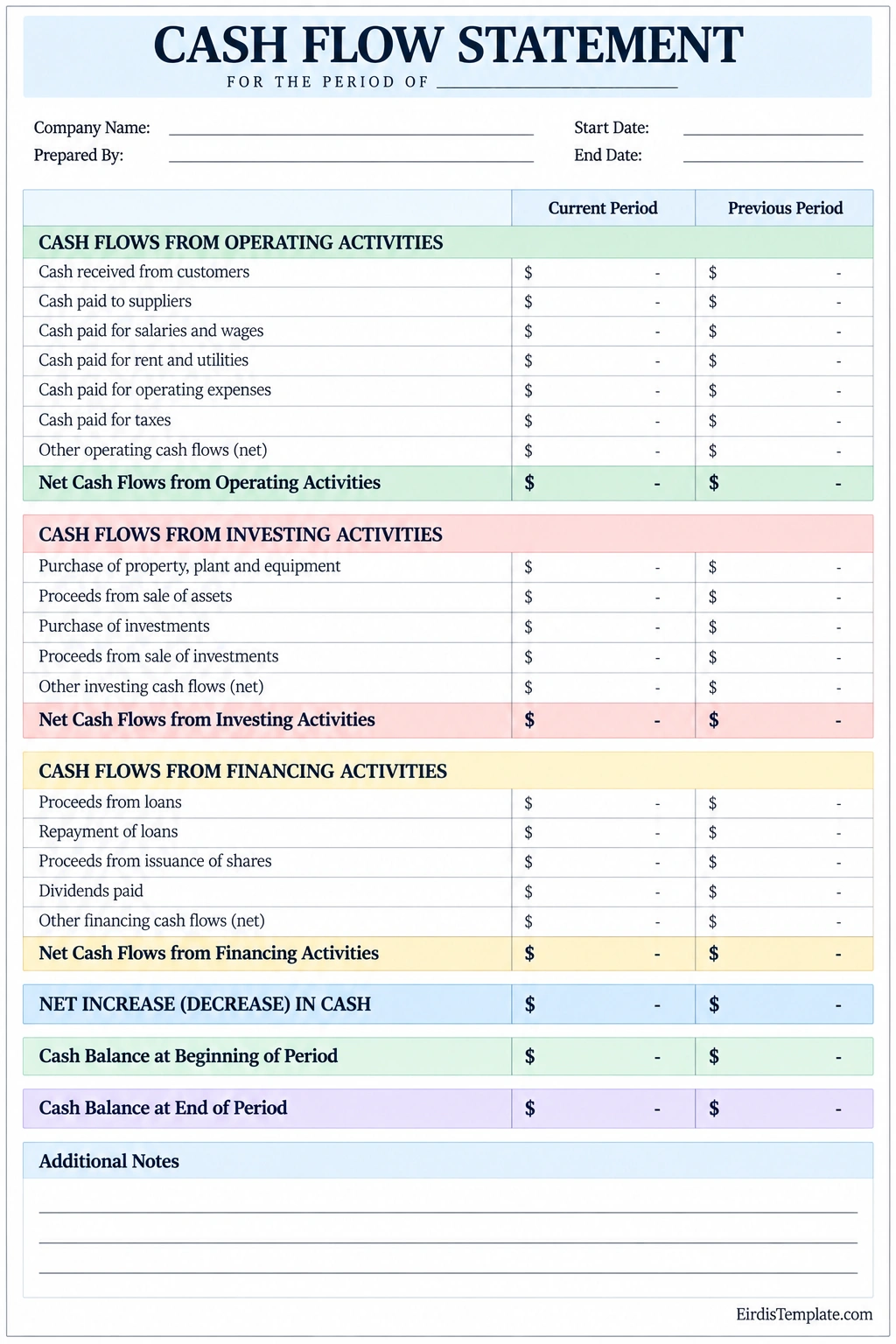
A practical cash flow statement template should organize transactions into the three main activity categories and summarize the resulting change in cash. Depending on the reporting requirements, the document may include the following sections.
Company and Reporting Details
Include the company name, reporting period, preparation date, and the person responsible for preparing the report. A comparison column for the previous period can help readers identify changes in cash movements.
Operating Cash Flows
Record cash received from customers and cash paid for suppliers, salaries, rent, utilities, taxes, and other operating expenses. The presentation may differ depending on whether the company uses the direct or indirect method of reporting operating cash flow.
Investing and Financing Cash Flows
List qualifying cash receipts and payments from asset purchases and sales, investments, borrowing, repayments, share issuance, and distributions. Classify each transaction according to the applicable accounting framework rather than relying only on the transaction’s description.
Net Change in Cash
Combine the net cash flows from operating, investing, and financing activities to calculate the net increase or decrease in cash and cash equivalents, subject to the applicable reporting rules.
Beginning and Ending Cash Balances
Show the cash and cash equivalents at the beginning and end of the reporting period. The ending balance should reconcile with the beginning balance and the net change in cash, after accounting for any required adjustments.
How to Prepare a Cash Flow Statement Step by Step
Step 1: Choose the Reporting Period
Determine whether the statement will cover a month, quarter, or financial year. Use consistent reporting periods when comparing results so that changes can be interpreted more accurately.
Step 2: Gather Financial Records
Collect bank statements, accounting records, cash receipts, payment confirmations, loan documents, and information about asset purchases and sales. Reconcile relevant accounts and investigate discrepancies before preparing the statement.
Step 3: Identify Operating Cash Transactions
Record cash received from customers and cash paid for operating activities. If using the indirect method, start with net income and make the adjustments required to reconcile accounting profit to operating cash flow, including relevant noncash items and changes in operating assets and liabilities.
Step 4: Record Investing Transactions
Identify cash payments for qualifying asset purchases and investments, along with proceeds from relevant sales. Check supporting documents to confirm the amounts, dates, and appropriate classification.
Step 5: Record Financing Transactions
Include cash received from borrowing or issuing shares and cash payments for loan principal, dividends, or other qualifying financing activities. Follow the applicable accounting rules when classifying interest and dividend cash flows.
Step 6: Calculate the Net Change in Cash
Add the net cash flows from operating, investing, and financing activities. Then reconcile the result with the beginning cash balance to determine the ending cash balance, applying any required adjustments for the reporting framework.
Step 7: Review and Verify the Statement
Compare the calculated ending balance with the relevant accounting records. Review unusual transactions, check classifications, and compare the results with previous periods. Keep supporting documentation so that the figures can be traced and verified.
How to Analyze a Cash Flow Statement
Preparing the report is only the first step. Reviewing its figures helps business owners understand how cash is generated, how it is used, and whether financial practices need to change.
Review Operating Cash Flow
Look at whether operating activities consistently generate cash. If operating cash flow declines while sales increase, investigate customer payment timing, inventory purchases, and other changes in working capital.
Understand Investing Cash Flow
Review major purchases and sales of assets. A negative figure may reflect a planned expansion, while a positive figure may result from selling assets. Consider the business purpose behind each significant transaction.
Monitor Financing Activities
Check whether the business relies heavily on new borrowing or outside investment to support its cash position. Review debt repayments and distributions alongside operating cash generation to understand whether financing commitments are sustainable.
Compare Multiple Periods
Compare monthly, quarterly, or annual statements to identify recurring patterns. Seasonal businesses may experience substantial changes throughout the year, so a longer comparison can provide more useful context than a single reporting period.
Cash Flow Statement vs. Income Statement vs. Cash Flow Forecast
These financial tools provide different perspectives and should not be treated as interchangeable.
- Cash flow statement: Reports actual cash inflows and outflows during a past period.
- Income statement: Reports revenue, expenses, and profit or loss under the applicable accounting method.
- Cash flow forecast: Estimates future cash receipts, payments, and balances to help plan for upcoming financial needs.
A business may report a profit while experiencing a cash shortage because customers have not yet paid their invoices. Similarly, a company may have negative cash flow in a period because it purchased equipment or repaid debt. Reviewing all three reports provides a more complete picture of financial performance and liquidity.
Common Cash Flow Statement Mistakes to Avoid
- Confusing profit with cash: Revenue and expenses do not always occur at the same time as cash receipts and payments.
- Misclassifying transactions: Incorrectly categorizing investing or financing activities can make the statement misleading.
- Forgetting noncash adjustments: The indirect method requires appropriate adjustments to reconcile net income with operating cash flow.
- Ignoring reconciliation differences: The ending cash balance should be checked against relevant financial records.
- Comparing inconsistent periods: Differences in reporting periods can make trends harder to interpret.
- Using incomplete records: Missing transactions can distort the statement and lead to poor decisions.
Frequently Asked Questions
What is the main purpose of a cash flow statement?
The main purpose is to show how cash enters and leaves a business during a specific period. It helps users evaluate cash generation, understand major cash uses, and assess the company’s ability to meet financial obligations.
What are the three main sections of a cash flow statement?
The three main sections are operating activities, investing activities, and financing activities. Together, they explain the sources and uses of cash during the reporting period.
How often should a cash flow statement be prepared?
Businesses commonly prepare cash flow statements monthly, quarterly, or annually, depending on their reporting needs. Internal cash monitoring may be more frequent, especially when liquidity is tight.
Can a profitable business have negative cash flow?
Yes. A profitable business may have negative cash flow if customers have not paid their invoices, inventory purchases increase, the company makes major investments, or debt repayments require substantial cash. The cause and duration of the negative cash flow are important.
What is the difference between the direct and indirect methods?
The direct method presents major classes of actual operating cash receipts and payments. The indirect method starts with net income and adjusts for noncash items and changes in relevant assets and liabilities to calculate operating cash flow.
Can I use a cash flow statement template in Excel?
Yes. A spreadsheet template can organize cash transactions, calculate totals, and compare reporting periods. Check the formulas and classifications carefully, and reconcile the final balances with the underlying accounting records.
Does a cash flow statement show the company’s total profit?
No. A cash flow statement shows cash movements, not total accounting profit. An income statement is used to review revenue, expenses, and profit or loss.
Conclusion
A cash flow statement helps businesses understand how cash is generated and used throughout a reporting period. By separating operating, investing, and financing activities, it provides valuable insight into liquidity, financial commitments, and the movement of cash.
Use a cash flow statement template to organize financial transactions, compare periods, and reconcile beginning and ending balances. For stronger financial oversight, review the statement alongside the income statement, balance sheet, and cash flow forecast. Accurate records and regular reviews can help you make better-informed business decisions.
Disclaimer: This article and template are for general informational purposes only and do not constitute accounting, tax, investment, or financial advice. Accounting classifications and reporting requirements may vary by jurisdiction and applicable standards. Consult a qualified accounting professional for advice specific to your business.
Download: Cash Flow Statement Template

- Cash Flow Statement Template - October 15, 2026
- Cash Flow Forecast Template - October 15, 2026
- Free Printable Caregiver Schedule Template - October 15, 2026
