A certificate of destruction is a formal document used to confirm that specific data, electronic devices, records, or other materials have been securely destroyed or rendered unusable. Businesses, IT departments, healthcare providers, and data destruction companies may use this document to maintain records, demonstrate accountability, and support their data protection and disposal procedures.
Whether your organization needs to document hard drive destruction, secure data erasure, confidential paper disposal, or the removal of retired equipment, a certificate of destruction template can help standardize the process. This guide explains what the document should contain, how to complete it, and what to consider when documenting the destruction of sensitive information.
What Is a Certificate of Destruction?
A certificate of destruction is a written record confirming that specified items or information have undergone a defined destruction or disposal process. It commonly identifies the items, the date and method of destruction, the organization responsible, and the person authorizing or verifying the process.
For information technology equipment, the certificate may document secure data erasure or physical destruction of storage media. For other materials, it may record the disposal of confidential documents, products, records, or assets. The exact information depends on what is being destroyed and the organization’s recordkeeping requirements.
A certificate of destruction can help organizations:
- Document the disposal of computers, hard drives, and other storage devices.
- Maintain records of confidential information destruction.
- Track retired equipment and other assets.
- Record the destruction date, method, and responsible party.
- Support internal audits and information security procedures.
- Maintain evidence of disposal activities for applicable contractual or regulatory requirements.
Free Printable Certificate of Destruction Template
A printable certificate of destruction template provides a structured way to record what was destroyed and how the process was completed. It can include organization details, item descriptions, serial numbers, destruction methods, dates, and authorized signatures.
Before using a template, identify the purpose of the document. A certificate for electronic storage media may require device identifiers and data sanitization details, while a certificate for confidential paper records may need the record category, quantity, and disposal method. Customize the form to match the actual process and the requirements that apply to your organization.
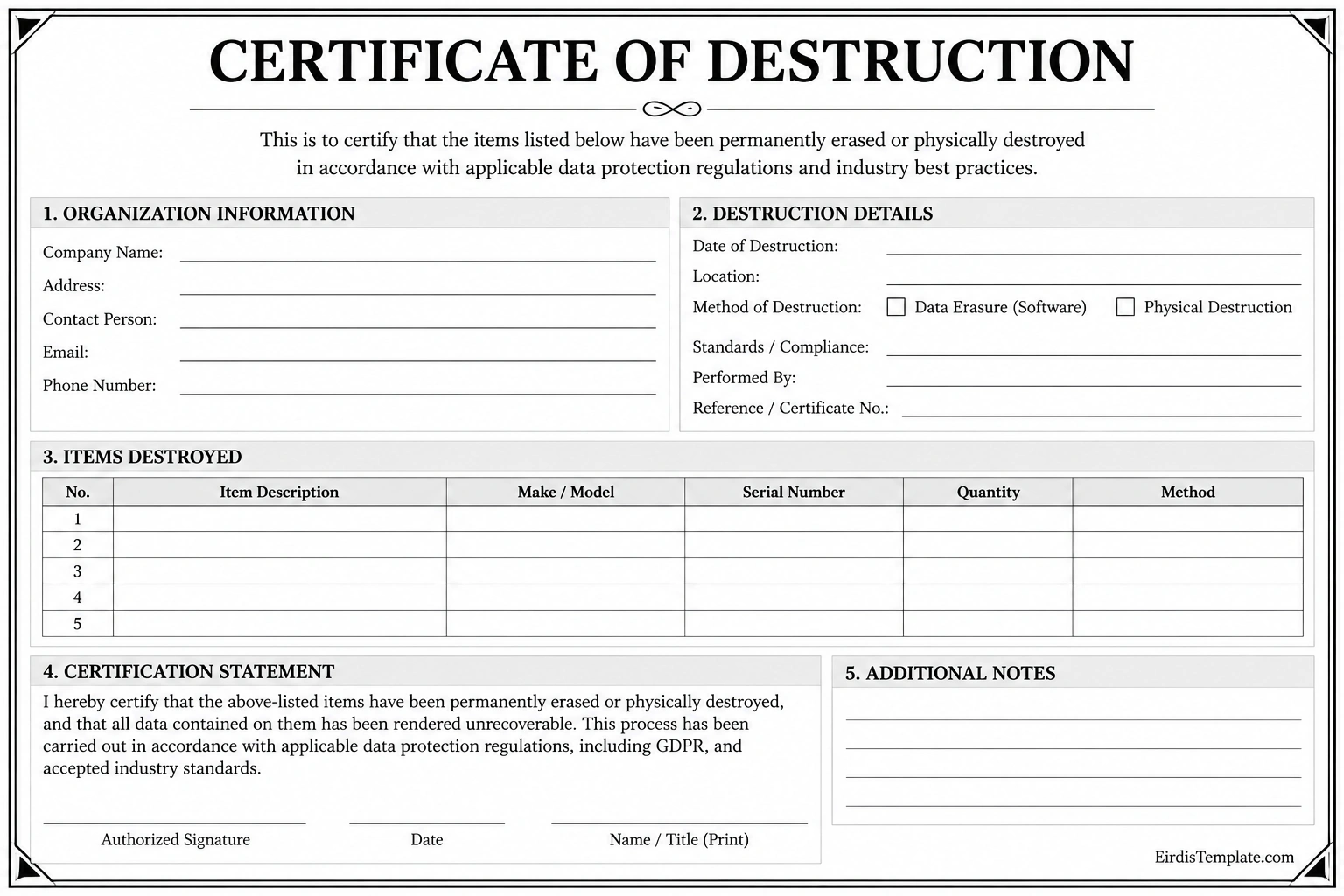
What Should a Certificate of Destruction Include?
A useful certificate should provide enough detail for another person to understand what was destroyed, when the process occurred, and who was responsible. The following sections are commonly included.
1. Organization Information
Record the name and contact information of the organization requesting or managing the destruction. If a third-party service provider performs the work, identify that provider as well. Clear identification helps establish which parties were involved in the process.
2. Item Description and Inventory
Describe the materials or devices being destroyed. For electronic equipment, include relevant identifiers such as device type, make, model, serial number, asset tag, or storage media identifier. For paper records or other materials, record the category and quantity where appropriate.
Accurate inventory information is particularly important when a batch contains multiple devices or different categories of confidential material. If the certificate covers a large quantity of items, attach an inventory list and reference it in the document.
3. Date and Location of Destruction
Include the date the destruction occurred and, where relevant, the location or facility where it was performed. If the items were collected on one date and destroyed on another, distinguish the collection date from the actual destruction date.
4. Destruction Method
State the method used, such as an appropriate data sanitization process, physical destruction of storage media, or secure shredding of confidential paper records. The method should accurately describe the work performed and should be appropriate for the type of material and sensitivity of the information.
For electronic media, distinguish between logical data erasure and physical destruction. These methods are not interchangeable, and the suitable approach depends on the device, the data, and the organization’s security requirements.
5. Responsible Person or Service Provider
Identify the individual, department, or service provider responsible for performing or verifying the destruction. Depending on the organization’s process, the certificate may also include a technician’s name, an authorization reference, or a service ticket number.
6. Certification Statement and Signature
Include a statement describing what the issuer is certifying. The wording should be limited to what can be supported by the process and available records. An authorized representative can then sign and date the document according to the organization’s procedures.
How to Complete a Certificate of Destruction
Using a certificate of destruction template is straightforward when the inventory and destruction details have been verified. Follow these steps to create a clear and reliable record.
Step 1: Identify the Items
Prepare an inventory of the devices, records, or materials scheduled for destruction. Use serial numbers, asset tags, record categories, or other identifiers to distinguish individual items where necessary.
Step 2: Confirm Authorization
Verify that the destruction has been approved by the appropriate person or department. Organizations should follow their retention schedules, legal hold procedures, contractual obligations, and internal policies before destroying records or equipment.
Step 3: Record the Destruction Process
Document the method, date, location, and responsible party. For electronic media, record the relevant sanitization or destruction procedure and any verification results available. Do not state that data is permanently unrecoverable unless the method and verification support that claim.
Step 4: Complete the Certification Statement
Use wording that accurately reflects the work performed. If the certificate confirms physical destruction, identify the media or materials that were physically destroyed. If it confirms data erasure, specify the sanitization process and its verified outcome when those details are available.
Step 5: Sign, Store, and Retain the Record
Have an authorized representative sign the certificate according to organizational procedures. Store the document with relevant inventory records, service tickets, destruction logs, or audit evidence. Restrict access when the certificate contains sensitive asset or operational information.
Types of Certificates of Destruction
The information required in a certificate varies depending on the material being destroyed. These are some common applications.
Hard Drive and Data Storage Destruction Certificate
Organizations use this type of certificate to document the sanitization or physical destruction of hard disk drives, solid-state drives, USB drives, backup media, and other storage devices. Useful details may include device identifiers, the destruction method, the service provider, and any verification records.
For electronic media, a documented process should follow an appropriate sanitization standard or organizational policy. The certificate itself is evidence of the reported process; it does not independently prove that every possible method of data recovery has been eliminated.
IT Asset Destruction Certificate
An IT asset destruction certificate can document the disposal of retired computers, servers, mobile devices, and other equipment. The certificate may reference an asset inventory and indicate whether storage media was removed, sanitized, or physically destroyed.
Confidential Document Destruction Certificate
Businesses and professional service providers may use a document destruction certificate to record the secure shredding or disposal of confidential paper records. The record can include the document category, collection date, destruction date, quantity, service provider, and relevant tracking number.
Product or Material Destruction Certificate
Some organizations need records confirming the destruction of defective products, expired materials, rejected inventory, or other items that must not be reused or distributed. In these cases, the certificate should identify the relevant products, quantities, destruction method, and responsible party.
Certificate of Destruction and Data Protection Compliance
Organizations handling personal or confidential information may need to demonstrate that data was disposed of according to applicable laws, contracts, and internal policies. A certificate of destruction can support that documentation, but it does not automatically establish compliance with every legal requirement.
For example, the General Data Protection Regulation (GDPR) includes requirements concerning the processing, retention, and erasure of personal data in applicable circumstances. Whether a particular destruction process satisfies those requirements depends on the facts, the organization’s role, the data involved, and other relevant obligations.
To improve accountability, organizations should:
- Maintain a documented data retention and disposal policy.
- Confirm that records are eligible for destruction before disposal.
- Use destruction or sanitization methods appropriate to the data and media.
- Keep accurate inventories and destruction records.
- Evaluate service providers and document their responsibilities.
- Retain supporting evidence when required by policy, contract, or applicable law.
- Consult a qualified privacy or legal professional when regulatory requirements are unclear.
Tips for Creating a Reliable Certificate of Destruction
A certificate is most useful when it is accurate, specific, and consistent with the actual destruction process. Use these practical tips to improve your documentation.
- Be specific: Identify the items destroyed and avoid vague descriptions when unique identifiers are available.
- Record the actual method: Do not use generic language that could misrepresent whether data was erased or media was physically destroyed.
- Verify inventory details: Reconcile device identifiers or item quantities before signing.
- Avoid unsupported claims: Certify only the results supported by the method and verification performed.
- Identify the responsible party: Include the organization or service provider that carried out the work.
- Maintain supporting records: Link the certificate to relevant inventory lists, work orders, or service reports.
- Use controlled document storage: Protect certificates and associated records from unauthorized access or alteration.
Common Mistakes to Avoid
Small documentation errors can make a certificate less useful during an audit or internal review. Avoid these common problems:
- Leaving out device identifiers or important inventory details.
- Recording a collection date instead of the actual destruction date without clarification.
- Claiming complete data recovery prevention without suitable verification.
- Failing to distinguish secure erasure from physical destruction.
- Destroying records before confirming retention requirements or legal holds.
- Leaving the responsible organization or authorized signature unidentified.
- Assuming a certificate alone proves compliance with all applicable regulations.
Frequently Asked Questions
What is a certificate of destruction used for?
A certificate of destruction documents the destruction or disposal of specified data, devices, records, or materials. It can help organizations maintain an audit trail and demonstrate that a documented disposal process took place.
Does a certificate of destruction prove that data cannot be recovered?
Not by itself. The certificate records the destruction or sanitization process reported by the issuer. Whether data recovery is infeasible depends on the media, the method used, the implementation, and any verification performed. The certificate should not make claims beyond the available evidence.
What information should a certificate of destruction include?
Common details include the issuing organization, item descriptions or identifiers, date and location of destruction, destruction method, responsible party, certification statement, and authorized signature. Additional fields may be needed for specific industries or contractual requirements.
Is a certificate of destruction required by GDPR?
The GDPR does not impose one universal certificate format for every destruction activity. A certificate may help document a disposal process, but an organization’s obligations depend on the circumstances and applicable data protection requirements. Seek qualified advice when determining what records must be maintained.
What is the difference between data erasure and physical destruction?
Data erasure uses an appropriate process to sanitize storage media so that the targeted information cannot feasibly be recovered under the relevant standard or threat model. Physical destruction damages the media itself. The appropriate method depends on the device, sensitivity of the data, reuse requirements, and organizational policy.
Who can issue a certificate of destruction?
A certificate may be issued by an organization, an authorized employee, or a third-party destruction service provider, depending on the process and applicable requirements. The issuer should be able to substantiate the details stated in the document.
How long should a certificate of destruction be kept?
Retention periods vary by industry, contract, internal policy, and applicable law. Establish a retention schedule that covers the certificate and any supporting inventory or service records. Do not assume that one retention period applies to every organization.
Can I use a printable certificate of destruction template?
Yes. A printable template can help standardize documentation for electronic media, confidential documents, or other materials. Customize the fields to suit the process, verify all details, and ensure the wording accurately describes the destruction performed.
Conclusion
A certificate of destruction is a practical record for documenting the secure disposal of electronic media, confidential records, and other materials. By identifying the items, recording the destruction method and date, and naming the responsible party, an organization can maintain a clearer record of its disposal activities.
A printable certificate of destruction template can make documentation more consistent and easier to manage. Customize the form to match the materials and process involved, retain supporting evidence, and avoid claims that cannot be verified. For data protection or regulatory matters, make sure the destruction procedure and recordkeeping practices meet the requirements that apply to your organization.
Download: Certificate of Destruction Template

- Certificate of Employment Template - October 21, 2026
- Certificate of Destruction Template - October 21, 2026
- Certificate of Completion Template - October 21, 2026
