A weekly lesson plan gives teachers a clear framework for organizing what students need to learn, how lessons will be taught, and how learning will be assessed throughout the week. Instead of planning each class period in isolation, a weekly lesson plan helps connect individual lessons into a logical sequence that supports broader learning goals.
Effective weekly lesson planning can make classroom instruction more organized and purposeful. It allows teachers to identify learning objectives, prepare instructional activities, gather materials, schedule assessments, and make adjustments based on student progress. A well-designed plan can also help teachers balance direct instruction, practice, discussion, projects, review, and assessment.
Whether you teach elementary students, middle school, high school, or adult learners, a weekly lesson plan can provide a practical overview of the instructional week. It can also serve as a flexible working document that changes as teachers learn more about what their students understand and where additional support is needed.
What Is a Weekly Lesson Plan?
A weekly lesson plan is a teaching schedule that outlines the lessons, learning objectives, activities, materials, and assessments planned for an entire week. It provides teachers with an organized view of what will be taught during each class period or instructional day.
Unlike a single lesson plan that focuses on one class session, a weekly lesson plan looks at the bigger picture. It helps teachers see how Monday’s lesson connects with Tuesday’s activities, how practice leads to assessment, and whether the week’s instruction provides enough time to meet the intended learning objectives.
A weekly lesson plan can be as detailed or simple as necessary. Some teachers prefer a detailed schedule for every class period, while others use a broader weekly overview with additional notes for individual lessons.
Why Is a Weekly Lesson Plan Important?
Planning an entire week in advance can help teachers use instructional time more effectively. Rather than deciding what to teach immediately before each class, teachers can prepare a connected sequence of activities that supports the desired learning outcomes.
A weekly lesson plan can help teachers:
- Organize instruction across multiple days.
- Set clear learning objectives.
- Connect lessons to curriculum goals or standards.
- Prepare teaching materials ahead of time.
- Balance different instructional activities.
- Schedule quizzes, projects, and other assessments.
- Plan homework and independent practice.
- Identify opportunities for review and reinforcement.
- Track student progress throughout the week.
- Adjust instruction when students need additional support.
Planning does not mean that every minute of the week must be fixed. A useful lesson plan provides structure while still allowing teachers to respond to student questions, unexpected events, and differences in learning pace.
Key Components of a Weekly Lesson Plan
A weekly lesson plan can include different sections depending on the teacher’s needs. However, several components are particularly useful for organizing effective instruction.
Learning Objectives
Learning objectives describe what students should know, understand, or be able to do by the end of a lesson or week. Clear objectives help teachers select appropriate activities and assessments.
For example, instead of writing a broad objective such as “learn fractions,” a more specific objective might state that students will be able to compare fractions with different denominators using appropriate strategies.
Subjects and Topics
List the subjects, units, or topics that will be covered during the week. This provides a quick overview of the instructional focus and helps prevent important curriculum areas from being overlooked.
Daily Activities
Describe the main activities planned for each day. These may include mini-lessons, demonstrations, guided practice, group work, discussions, experiments, independent assignments, projects, or review activities.
Materials and Resources
Record the resources needed for instruction, such as textbooks, worksheets, presentation materials, manipulatives, laboratory equipment, digital resources, or classroom supplies.
Assessment
Include methods for determining whether students are meeting the learning objectives. Assessments can include questions, observation, classwork, quizzes, exit tickets, projects, presentations, or other appropriate measures of learning.
Homework or Independent Practice
If homework is part of the instructional approach, identify assignments and due dates. Connecting homework to the week’s objectives can make independent practice more purposeful.
Teacher Notes
A notes section gives teachers space to record observations, reminders, modifications, student needs, unfinished activities, or ideas for improving the next lesson.
How to Create a Weekly Lesson Plan
Creating a weekly lesson plan becomes easier when teachers start with the desired learning outcomes and work backward toward the individual activities.
Step 1: Identify the Weekly Learning Goals
Start by determining what students should learn by the end of the week. Review the curriculum, course objectives, academic standards, or unit plan to identify the most important concepts and skills.
Keep the number of major objectives realistic. A long list of objectives may make it difficult to provide enough instructional time and meaningful practice for each one.
Step 2: Break the Goals Into Daily Lessons
Divide the weekly objectives into smaller daily targets. Consider which concepts should be introduced first, which require guided practice, and which can be reinforced through independent work.
A common progression might involve introducing a concept, modeling a skill, practicing with teacher support, completing independent practice, and assessing understanding.
Step 3: Choose Instructional Activities
Select activities that directly support the learning objectives. Consider using a variety of approaches so students have opportunities to listen, discuss, practice, apply, create, and demonstrate what they know.
Step 4: Plan Assessments
Determine how you will know whether students have understood the material. Assessment does not always need to be a formal test. Short checks for understanding can provide useful information during the week.
Step 5: Prepare Materials
Review the week’s activities and identify everything you need before each lesson. Preparing resources in advance can reduce interruptions and make classroom transitions smoother.
Step 6: Add Flexibility
Leave room for adjustments. Students may need additional practice, a discussion may take longer than expected, or an activity may need to be modified. A flexible weekly lesson plan can accommodate these changes without disrupting the entire instructional sequence.
Sample Weekly Lesson Plan Structure
A weekly lesson plan can use a simple Monday-through-Friday structure. The following example demonstrates how a teacher might organize instruction across a week.
- Monday: Introduce the week’s topic, explain key concepts, establish learning objectives, and complete an introductory activity.
- Tuesday: Provide direct instruction and guided practice related to the main skill or concept.
- Wednesday: Use collaborative activities, problem-solving, experiments, or applied practice to reinforce learning.
- Thursday: Provide independent practice, review common difficulties, and offer targeted support.
- Friday: Review the week’s learning, complete an assessment or project, and reflect on student progress.
This structure is only an example. The sequence should be adapted to the subject, grade level, curriculum, class schedule, and needs of the students.
Weekly Lesson Plan for Different Grade Levels
Elementary School
Elementary lesson plans often benefit from a clear structure and a variety of activities. Teachers may need to include transitions, hands-on learning, reading practice, mathematics activities, classroom routines, and opportunities for movement.
Middle School
Middle school lesson plans can incorporate more subject-specific instruction, collaborative activities, independent work, projects, and formative assessments. Teachers may also need to account for different class periods and varying student needs.
High School
High school weekly lesson plans may focus on more complex concepts, extended projects, laboratory activities, writing assignments, discussions, research, and formal assessments. Teachers can use the weekly overview to ensure that major assignments are distributed appropriately.
Homeschooling
A weekly lesson plan can also help homeschooling families organize multiple subjects. It can provide a flexible framework for academic instruction while leaving room for field trips, independent study, extracurricular activities, and changes based on the student’s progress.
Weekly Lesson Plan vs. Daily Lesson Plan
A daily lesson plan focuses on the details of a specific instructional session, while a weekly lesson plan provides a broader overview of several lessons.
A daily plan may include detailed teaching procedures, discussion questions, instructional steps, differentiation strategies, and specific assessment activities. A weekly plan, by comparison, helps teachers see how those individual lessons fit together.
Using both can be useful. The weekly plan provides the overall roadmap, while individual daily lesson plans provide the detailed instructions needed for each class.
Tips for Creating an Effective Weekly Lesson Plan
A good lesson plan should be useful in practice, not simply look organized on paper. Keep the format easy to read and focus on information that helps you teach effectively.
- Start with objectives: Decide what students need to learn before selecting activities.
- Keep activities aligned: Make sure classroom activities support the stated learning goals.
- Estimate realistic timing: Avoid planning more activities than students can reasonably complete.
- Include formative assessment: Check student understanding throughout the week.
- Plan for different learners: Consider accommodations, additional support, enrichment, and alternative learning approaches when appropriate.
- Prepare materials early: Gather resources before they are needed.
- Build in review: Give students opportunities to revisit important concepts.
- Leave room for changes: Be prepared to adjust the plan based on student progress.
- Review the week afterward: Note what worked well and what should be changed in future lessons.
Common Weekly Lesson Planning Mistakes
Even experienced teachers can encounter problems when a weekly plan becomes too ambitious or disconnected from actual classroom needs.
- Planning too much content: Cramming too many topics into one week can reduce meaningful practice.
- Using activities without clear objectives: An activity should have a purpose related to student learning.
- Forgetting assessment: Teachers need ways to determine whether students understood the material.
- Ignoring transition time: Moving between activities can take longer than expected.
- Not preparing materials: Missing resources can interrupt an otherwise effective lesson.
- Making the plan too rigid: Students may need additional instruction or practice.
- Failing to reflect: Reviewing the week’s results can help improve future lesson planning.
Using a Weekly Lesson Plan Template
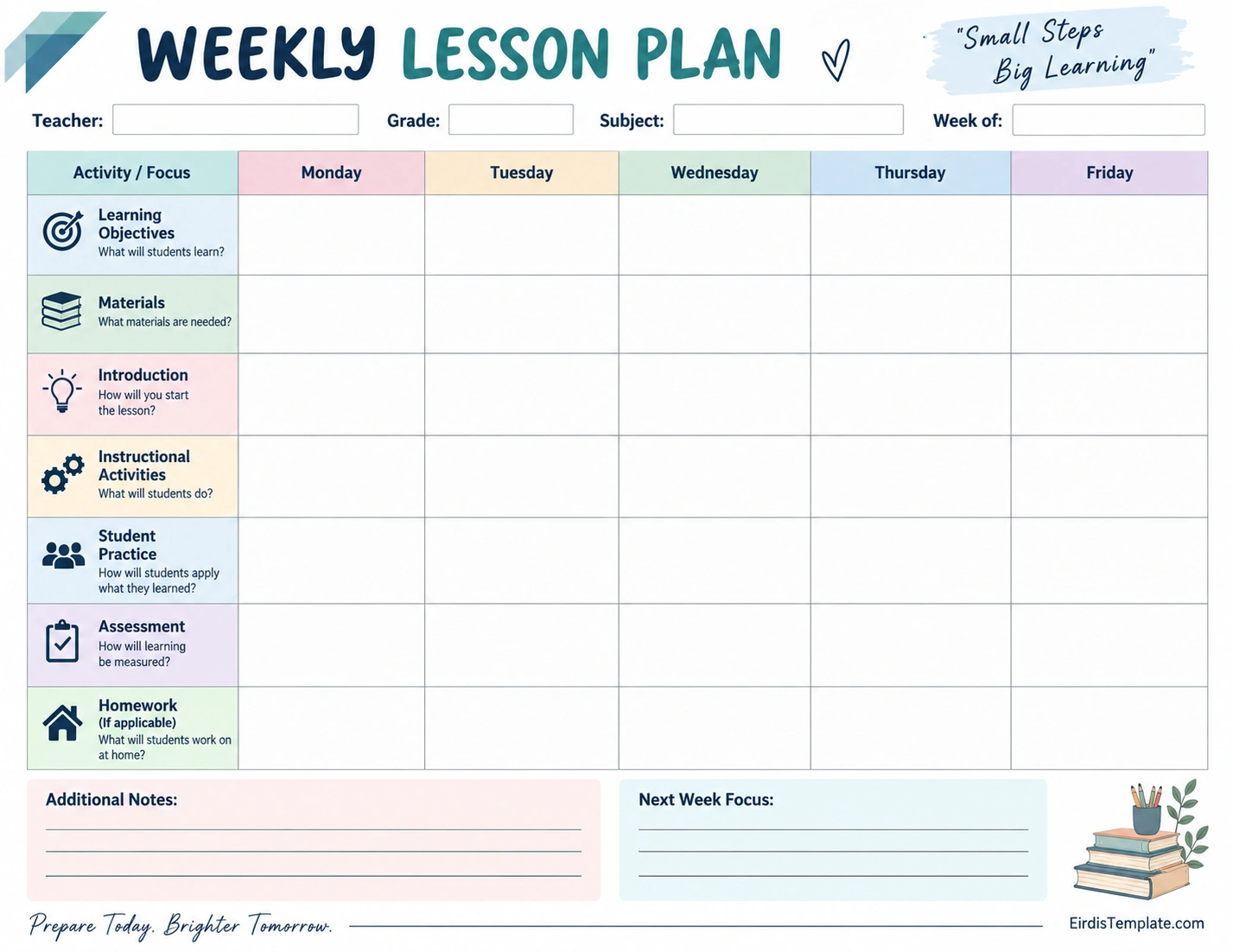
A weekly lesson plan template provides a structured format for organizing the instructional week. Instead of creating a new planning document each week, teachers can reuse a consistent layout and update the information as needed.
A useful template may include columns for each day of the week and rows or sections for subjects, objectives, activities, materials, assessments, homework, and notes. The format can be customized for different grade levels, subjects, teaching styles, and classroom schedules.
Teachers can also use a printable weekly lesson plan alongside digital planning tools. A printed copy can be kept in a lesson planning binder or teaching folder and used for quick notes during the school week.
Weekly Lesson Plan Checklist
Before beginning the week, review your lesson plan and make sure it includes the essential information.
- Weekly learning objectives
- Daily subjects and topics
- Lesson activities
- Instructional materials
- Learning resources
- Assessment methods
- Homework or independent practice
- Student support or differentiation needs
- Important deadlines or projects
- Teacher notes and reminders
- Time for review and reinforcement
- Flexibility for schedule changes
Conclusion
A weekly lesson plan helps teachers organize instruction around clear learning goals while providing a practical overview of what needs to happen throughout the week. By connecting daily lessons, activities, materials, and assessments, teachers can create a more purposeful and manageable instructional sequence.
The most effective weekly lesson plan is not necessarily the most detailed one. It is the one that helps the teacher prepare, teach, assess, reflect, and adjust. Start with the learning objectives, divide them into manageable daily lessons, choose purposeful activities, prepare the necessary materials, and leave enough flexibility to respond to student needs.
Whether used in a traditional classroom, homeschool setting, tutoring environment, or other educational setting, a well-organized weekly lesson plan can serve as a practical roadmap for effective teaching and meaningful student learning.
Download: Weekly Lesson Planner Template

- Free Printable Weekly Lesson Planner Template - September 23, 2026
- Free Printable Wedding Day Timeline Template - September 23, 2026
- Free Printable Stakeholder Analysis Template - September 23, 2026
