A travel itinerary is a detailed plan that organizes the important parts of a trip, including destinations, activities, transportation, accommodation, and travel times. It acts as a roadmap for the journey, helping travelers understand where they need to go, what they plan to do, and how they will move between locations.
A well-prepared itinerary can make travel easier and more organized without requiring every minute of the trip to be planned. By putting essential information in one place, travelers can manage their time more effectively, keep track of reservations, reduce unnecessary stress, and make better use of the time available at each destination.
Whether you are planning a family vacation, business trip, road trip, international adventure, or weekend getaway, a travel itinerary can provide a useful structure while still leaving room for flexibility.
What Is a Travel Itinerary?
A travel itinerary is an organized plan that outlines the details of a journey. It typically includes information about where you are going, when you will travel, where you will stay, how you will get around, and what activities you want to complete.
A basic itinerary might contain only a few essential details, while a more comprehensive travel itinerary can include:
- Destination and travel dates
- Daily activities
- Flight and transportation information
- Hotel or accommodation details
- Tour and activity reservations
- Locations and addresses
- Important contacts
- Confirmation numbers
- Travel notes and reminders
- Places you want to visit
The purpose is not to create a rigid schedule. Instead, an itinerary gives travelers a clear overview of their plans so they can spend less time managing logistics and more time enjoying the trip.
Why Is a Travel Itinerary Important?
Travel often involves coordinating several different elements at the same time. Flights have departure times, hotels have check-in and check-out periods, activities may require reservations, and transportation between locations can take longer than expected.
A travel itinerary brings these details together so they are easier to understand and manage.
Better Time Management
An itinerary helps travelers see how much time is available each day. This makes it easier to organize activities and avoid scheduling too many things too close together.
Improved Organization
Instead of searching through multiple emails, booking confirmations, notes, and messages, travelers can keep important information in one central document.
Less Travel Stress
Knowing where you need to be and when can reduce uncertainty, particularly during complicated trips involving multiple destinations or transportation connections.
Better Use of Available Time
A well-planned itinerary can help travelers identify which attractions and activities are located near one another, making it easier to organize each day efficiently.
Easier Group Coordination
When several people are traveling together, a shared itinerary helps everyone understand the general schedule, meeting points, transportation arrangements, and planned activities.
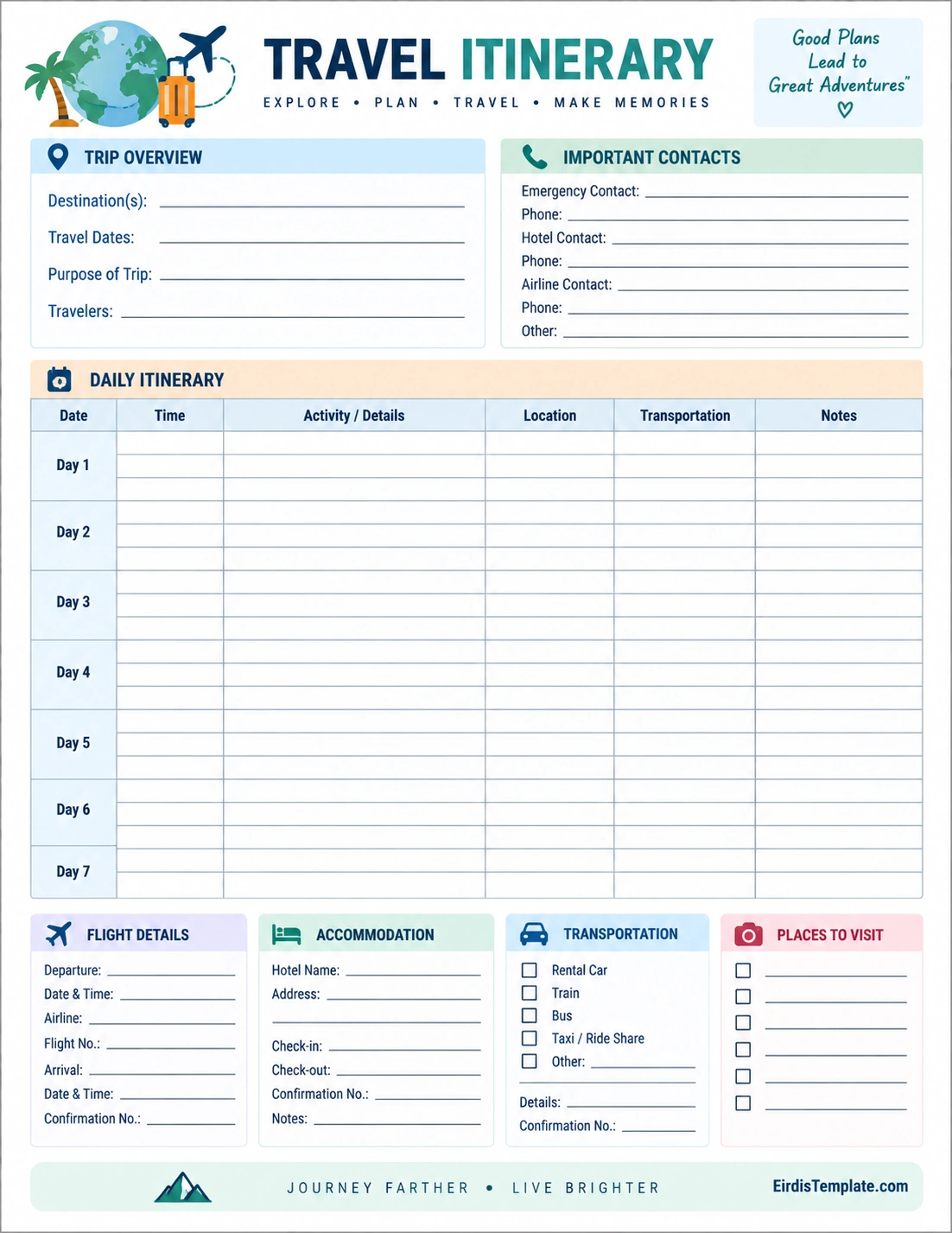
What Should a Travel Itinerary Include?
The exact contents of an itinerary depend on the type and length of the trip. However, several sections are useful for most travel plans.
Trip Overview
Start with the basic information about the journey. This section can include the destination, travel dates, purpose of the trip, and names of the travelers.
For a multi-destination trip, list the major locations in the order they will be visited.
Daily Schedule
The daily itinerary is the main part of the travel plan. It organizes activities by date and, when necessary, by time.
A daily schedule may include:
- Departure and arrival times
- Morning activities
- Lunch plans
- Afternoon activities
- Dinner reservations
- Evening activities
- Travel between locations
- Free time
Not every activity needs an exact time. For flexible plans, it may be better to organize activities by morning, afternoon, and evening.
Transportation Details
Record how you will travel between destinations. Depending on the trip, this may include flights, trains, buses, rental cars, taxis, rideshare services, or other transportation.
For flights, useful details can include the airline, flight number, departure airport, arrival airport, departure time, and arrival time.
Accommodation
Include the name and address of each hotel or other accommodation. You can also record check-in and check-out times, reservation numbers, and contact information.
Important Contacts
An itinerary can include important contact information that may be useful during the trip. Depending on the situation, this might include hotel contacts, transportation providers, tour operators, travel companions, or emergency contacts.
Places to Visit
Make a list of attractions, landmarks, restaurants, museums, parks, shops, or other places you would like to visit. This list can be kept separate from the fixed schedule so you can choose activities based on available time.
How to Create a Travel Itinerary
Creating an itinerary becomes easier when you build it in stages. Start with the information that is already fixed and then add flexible activities around it.
1. Choose Your Destinations
Determine where you want to go and how long you plan to stay in each location. If you are visiting multiple cities or regions, arrange them in a logical travel sequence.
2. Set Your Travel Dates
Record the departure and return dates, then determine the dates for each destination if the trip involves multiple stops.
3. Add Transportation
Enter flights, trains, rental cars, transfers, or other transportation arrangements. These are usually the fixed points around which the rest of the itinerary should be organized.
4. Book Accommodation
Add your hotel or accommodation information, including addresses and reservation details. Make sure the accommodation dates match your transportation and overall trip schedule.
5. Choose Priority Activities
Identify the activities and attractions that are most important to you. Add these to the appropriate days before filling the remaining time with optional activities.
6. Group Activities by Location
When possible, organize activities that are geographically close to one another on the same day. This can reduce unnecessary travel and give you more time to enjoy each destination.
7. Add Free Time
Leave gaps between major activities. Free time gives you an opportunity to rest, explore spontaneously, handle delays, or change plans when necessary.
8. Review the Complete Itinerary
Look at the itinerary as a whole. Check whether travel times are realistic, whether activities overlap, and whether any day contains more activities than can reasonably be completed.
Travel Itinerary Example
A simple travel itinerary for a city vacation might look like this:
- Day 1 Morning: Arrive at destination and travel to hotel.
- Day 1 Afternoon: Check in and explore the nearby area.
- Day 1 Evening: Dinner and free time.
- Day 2 Morning: Visit a major attraction.
- Day 2 Afternoon: Lunch and explore nearby landmarks.
- Day 2 Evening: Dinner reservation.
- Day 3 Morning: Visit another attraction or museum.
- Day 3 Afternoon: Shopping or flexible activities.
- Day 3 Evening: Prepare for departure.
This type of itinerary provides structure without requiring every minute to be scheduled.
Travel Itinerary for Different Types of Trips
Different types of travel may require different levels of planning. The basic structure can be adapted to match the purpose of the journey.
Family Vacation Itinerary
A family itinerary may include attractions, meal times, transportation, hotel information, and periods for rest. Keeping the schedule realistic is especially useful when traveling with children or larger groups.
Business Travel Itinerary
A business travel itinerary may focus on meetings, conferences, flights, hotel reservations, transportation, and scheduled appointments.
Road Trip Itinerary
A road trip itinerary can include driving routes, estimated travel times, planned stops, overnight accommodations, attractions, restaurants, and fuel stops.
International Travel Itinerary
International travel often requires additional organization because it may involve connecting flights, border procedures, multiple currencies, transportation changes, and different local schedules.
Group Travel Itinerary
A group itinerary can help coordinate activities and meeting points. It may also be useful to include contact information for other travelers and important reservations.
How Detailed Should a Travel Itinerary Be?
There is no single correct level of detail. The ideal itinerary depends on the traveler, destination, and complexity of the trip.
A simple weekend getaway might only require transportation, hotel information, and a few planned activities. A two-week international trip involving several cities may benefit from a much more detailed itinerary.
A useful approach is to document information that is important, difficult to remember, or difficult to find quickly during the trip.
Avoid turning the itinerary into a minute-by-minute schedule unless that level of precision is genuinely necessary. Too much detail can make an itinerary difficult to follow and leave little room for unexpected opportunities.
Tips for Creating a Better Travel Itinerary
A good itinerary should make travel easier rather than create additional pressure. These practical tips can help you create a useful and flexible travel plan.
- Start with fixed plans: Add flights, hotel reservations, tours, and appointments first.
- Prioritize important activities: Identify the experiences you do not want to miss.
- Group nearby destinations: Plan activities in the same area together whenever practical.
- Allow buffer time: Give yourself extra time for transportation and unexpected delays.
- Leave open periods: Avoid filling every available hour.
- Keep confirmation details accessible: Record reservation numbers and important contact information.
- Consider transportation realistically: Account for traffic, transfers, parking, security, and waiting time.
- Review the schedule before leaving: Check important reservations and transportation details.
- Keep a backup: Save a digital copy and consider carrying a printed version.
Travel Itinerary vs. Trip Schedule
The terms travel itinerary and trip schedule are closely related and are often used interchangeably. Both can organize the dates, times, activities, and logistics of a journey.
A trip schedule may focus more heavily on when activities happen, while a travel itinerary often includes a broader range of travel information such as accommodation, transportation, addresses, reservations, and important contacts.
In practice, a comprehensive travel itinerary can serve as both a schedule and a central reference document for the entire trip.
Using a Printable Travel Itinerary Template
A printable travel itinerary template gives travelers a ready-made structure for organizing their plans. Instead of creating a travel plan from a blank page, you can fill in predefined sections for trip information, daily activities, transportation, accommodation, and other details.
A printable format can be particularly useful as a physical reference during travel. It can also serve as a backup when internet access is unavailable or when you prefer to keep important information on paper.
The template can be customized to suit the journey. You may add reservation numbers, additional destinations, restaurant bookings, emergency contacts, packing reminders, or other information relevant to your trip.
Digital and Printable Travel Itineraries
Travel itineraries can be created in many formats, including spreadsheets, mobile notes, travel applications, documents, and printable worksheets.
Digital itineraries are convenient when information needs to be updated frequently. They can also make it easy to store booking confirmations and other electronic documents.
A printable itinerary, on the other hand, provides a simple physical reference. Some travelers prefer having a paper copy available alongside their digital information, particularly for important schedules and addresses.
The best format is the one that makes important information easy for you to access when you need it.
Common Travel Itinerary Mistakes to Avoid
A detailed itinerary can still become difficult to use if the plan is unrealistic. Avoid these common mistakes when organizing your trip.
- Overplanning: Scheduling too many activities can make the trip exhausting.
- Ignoring travel time: Attractions may be farther apart than they appear.
- Creating tight connections: Insufficient transfer time can make a schedule vulnerable to delays.
- Forgetting rest periods: Travelers need time to relax and recover.
- Ignoring opening hours: Check whether attractions and businesses are actually available when you plan to visit.
- Keeping information scattered: Consolidate important details into one primary itinerary.
- Not preparing alternatives: Weather, transportation delays, closures, or other unexpected events may require a backup plan.
Travel Itinerary Checklist
Before finalizing your itinerary, use this checklist to review the most important details.
- Destination and travel dates are confirmed.
- Flights or other major transportation are documented.
- Accommodation information is included.
- Major activities and reservations are listed.
- Transportation between destinations is considered.
- Important addresses are available.
- Important contacts are recorded.
- Travel times are realistic.
- Free time and buffer periods are included.
- Reservation or confirmation numbers are accessible.
- A backup plan exists for important outdoor or time-sensitive activities.
- A copy of the itinerary is available for easy reference.
Conclusion
A travel itinerary is more than a list of places to visit. It is a practical roadmap that brings together the essential details of a journey, including destinations, activities, transportation, accommodation, reservations, and important contacts.
By organizing these details in advance, travelers can manage their time more effectively, reduce unnecessary stress, and make better use of the time available at each destination. At the same time, a good itinerary should remain flexible enough to accommodate delays, changes, rest, and spontaneous experiences.
Whether you are planning a family vacation, business trip, road trip, group adventure, or international journey, a well-designed travel itinerary template can simplify the planning process. With a clear structure and realistic schedule, your itinerary becomes a useful companion that helps keep your trip organized from departure to return.
Download: Travel Itinerary Template

- Free Student Resume Template (Word) - September 21, 2026
- Free Printable Travel Itinerary Template - September 21, 2026
- Free Printable Trip Schedule Template - September 21, 2026
