A wedding schedule is the hour-by-hour blueprint that helps organize everything that happens on the big day. From getting ready in the morning to the final send-off at night, a well-planned timeline gives the couple, wedding party, vendors, and family members a clear understanding of where they need to be and when.
A detailed wedding day timeline can reduce stress, prevent unnecessary delays, and create enough time for photography, meals, transportation, and guest activities. It also gives vendors a shared reference point so everyone can coordinate their responsibilities more effectively.
While every wedding is different, creating a practical schedule makes it easier to balance important events with enough breathing room. The goal is not to make every minute rigid, but to create a realistic framework that keeps the celebration moving smoothly.
What Is a Wedding Schedule?
A wedding schedule, also called a wedding day timeline, is a chronological plan showing when important wedding activities will take place. It can cover the entire day or focus on specific parts such as getting ready, the ceremony, photography, reception, and departure.
A typical timeline may include hair and makeup, getting dressed, detail photographs, first-look photographs, wedding party portraits, transportation, guest arrival, the ceremony, cocktail hour, reception entrance, dinner, speeches, dancing, special traditions, and the final exit.
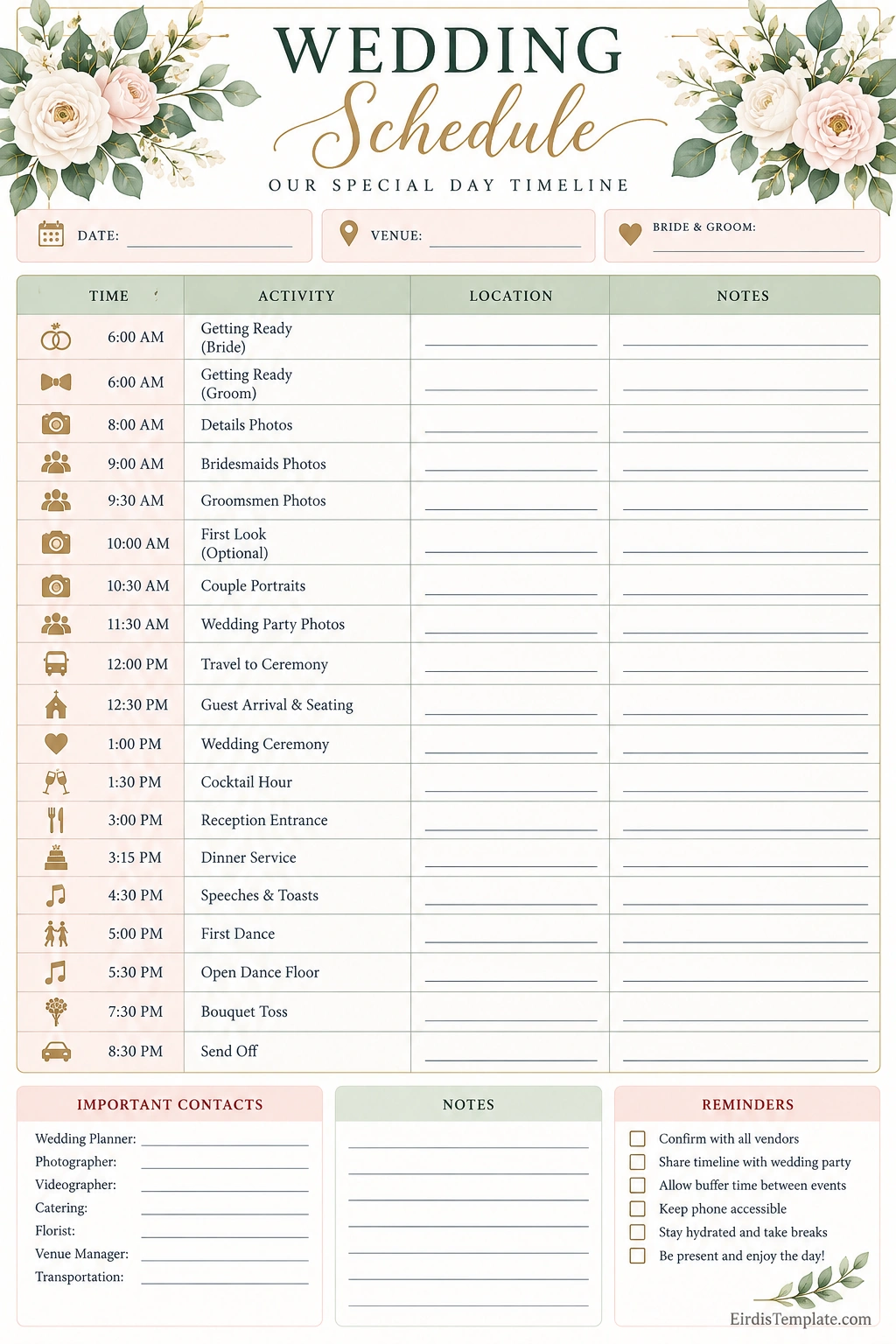
The schedule can be created as a simple list or as a detailed worksheet with columns for time, activity, location, notes, contacts, and reminders.
Why Is a Wedding Day Timeline Important?
Wedding days involve many moving parts. Multiple vendors may arrive at different times, members of the wedding party may have separate responsibilities, and some events depend on other activities happening first.
A clear timeline helps bring these details together in one place.
- Reduces stress: Everyone knows what is happening and when.
- Coordinates vendors: Vendors can plan setup, service, photography, transportation, and cleanup around the same timeline.
- Prevents delays: Potential scheduling problems can be identified before the wedding day.
- Protects photography time: Important portraits and wedding details can be given dedicated time.
- Improves guest experience: Guests are less likely to experience unnecessary waiting between events.
- Coordinates the wedding party: Members of the wedding party know when and where they are expected to participate.
- Creates breathing room: Buffer periods can be added between major activities.
What to Include in a Wedding Schedule
A useful wedding schedule should contain enough information to be practical without becoming unnecessarily complicated. The exact sections will depend on the size and style of the wedding.
Time
Every major activity should have a planned start time. For detailed schedules, you may also include an expected end time or approximate duration.
Activity
Clearly identify what is happening at each point in the day. Examples include getting ready, first look, family portraits, ceremony, cocktail hour, dinner, speeches, first dance, and send-off.
Location
Including the location is especially useful when the wedding involves multiple rooms, buildings, or venues. It prevents confusion when people need to move from one area to another.
Notes
A notes section can contain special instructions, vendor details, photography priorities, transportation information, setup requirements, or reminders about specific activities.
How to Create a Wedding Schedule
Creating a wedding timeline is easier when you begin with the events that have fixed times and work backward or forward from them.
1. Start With the Ceremony
Begin by identifying the scheduled ceremony start time. This is often one of the most important fixed points in the day.
Once the ceremony time is established, work backward to determine when guests should arrive, when the wedding party needs to be ready, and when transportation should begin.
2. Add the Reception
Next, determine when the reception begins and estimate how long each major reception activity will take. Include the reception entrance, meal service, speeches, dances, cake cutting, entertainment, and other planned traditions.
3. Schedule Getting Ready
Work backward from the ceremony to establish when hair, makeup, dressing, and other preparation activities should begin. Give the wedding party enough time to get ready without creating an unnecessarily early start.
4. Add Photography
Photography often requires several separate time blocks. Consider scheduling detail photographs, getting-ready photos, first-look photographs, couple portraits, wedding party portraits, and family portraits.
Discuss the photography plan with the photographer in advance. They can help estimate how much time is needed for different groups and locations.
5. Add Transportation Time
Transportation should be treated as an actual part of the schedule rather than an afterthought. Include travel between preparation locations, the ceremony venue, photo locations, reception venue, and final departure.
Allow additional time when traffic, parking, weather, venue access, or group transportation could affect travel.
Sample Wedding Day Timeline
A sample schedule can provide a starting point, but it should always be customized to the actual wedding. The following example illustrates how a typical day might be organized.
- 6:00 AM: Wedding party begins getting ready.
- 8:00 AM: Detail photographs begin.
- 9:00 AM: Bridesmaids and groomsmen photographs.
- 10:00 AM: Optional first look.
- 10:30 AM: Couple portraits.
- 11:30 AM: Wedding party portraits.
- 12:00 PM: Travel to the ceremony venue.
- 12:30 PM: Guest arrival and seating.
- 1:00 PM: Wedding ceremony.
- 1:30 PM: Cocktail hour.
- 3:00 PM: Reception entrance.
- 3:15 PM: Dinner service.
- 4:30 PM: Speeches and toasts.
- 5:00 PM: First dance and other special dances.
- 5:30 PM: Open dance floor.
- 7:30 PM: Bouquet toss or other traditions.
- 8:30 PM: Wedding send-off.
This example is only a framework. A wedding with a morning ceremony, evening ceremony, destination venue, religious service, or multiple reception activities may require a very different timeline.
How to Schedule Wedding Photography
Photography is one of the areas that can easily become rushed when a wedding schedule does not include enough time. Important photographs should be planned rather than squeezed into whatever time happens to remain.
Getting-Ready Photos
Allow enough time for the photographer to capture details such as wedding attire, rings, invitations, flowers, accessories, and preparation moments.
First Look
If the couple chooses to have a first look, schedule it before the ceremony and allow enough time afterward for couple and wedding party portraits.
Family Portraits
Prepare a list of important family groupings before the wedding. This can make formal portraits more efficient and reduce the chance of forgetting an important combination.
Golden Hour Portraits
If outdoor evening photographs are important, check the expected sunset time and reserve a short block in the reception schedule. Coordinate the timing with the photographer so the couple knows when to step away from the celebration.
Building Buffer Time Into the Schedule
One of the most useful wedding planning strategies is to avoid scheduling every event back-to-back. Real wedding days rarely happen with perfect precision.
Hair and makeup may take longer than expected. A family member may arrive late for photographs. Transportation may encounter traffic. Guests may take longer to move between spaces.
Adding reasonable buffer time gives the schedule flexibility. Instead of treating every delay as a crisis, the timeline can absorb small changes without affecting the rest of the day.
Wedding Schedule for Vendors
Important vendors should have access to the parts of the timeline that affect their responsibilities. Depending on the wedding, this may include the wedding planner, photographer, videographer, caterer, florist, DJ or band, venue manager, transportation provider, and officiant.
Vendor-specific information can include arrival times, setup deadlines, meal service, equipment requirements, photography sessions, announcements, and departure times.
A master timeline can be shared with everyone, while individual vendors can receive a version containing only the information relevant to their role.
Wedding Schedule for the Wedding Party
The wedding party does not necessarily need every operational detail, but members should know the times and locations that directly affect them.
- Getting-ready location and arrival time
- Hair and makeup schedule
- First-look or pre-ceremony photographs
- Family and wedding party portraits
- Transportation departure time
- Ceremony lineup time
- Reception entrance
- Special dances or announcements
- Departure or send-off details
Sharing the timeline ahead of the wedding can reduce last-minute questions and help everyone arrive prepared.
Common Wedding Schedule Mistakes
Scheduling Too Much
A packed timeline may look efficient on paper but can become stressful in practice. Give important activities enough time and remove events that are not necessary.
Forgetting Travel Time
Travel between locations takes time. Include loading, parking, walking, and transition time rather than calculating only the driving distance.
Leaving Out Setup and Cleanup
Vendors may need significant time before guests arrive and after the reception ends. Make sure setup, breakdown, and venue requirements are included in the overall plan.
Not Sharing the Final Version
A timeline is most useful when the people who need it actually receive it. Distribute the final version to the appropriate vendors, wedding party members, family members, and coordinator before the wedding day.
Failing to Update Changes
Wedding plans can change during the weeks leading up to the event. If a ceremony time, vendor arrival, transportation plan, or reception activity changes, update the master timeline and share the revised version.
Tips for a Stress-Free Wedding Timeline
- Start early: Begin building the timeline several weeks before the wedding.
- Confirm fixed times: Verify ceremony, venue, transportation, and vendor schedules.
- Work backward: Use the ceremony and reception times to determine earlier activities.
- Add buffers: Leave room for unexpected delays.
- Coordinate with vendors: Ask professionals for realistic timing recommendations.
- Prioritize photography: Reserve dedicated time for important photographs.
- Keep transitions realistic: Allow time for people to move between locations.
- Share the timeline: Give key participants the information they need before the wedding.
- Keep one master copy: Make sure the coordinator or designated person has the latest version.
- Leave room to enjoy the day: The timeline should support the celebration rather than control every moment.
Wedding Schedule Checklist
Before finalizing the timeline, review these important areas:
- Wedding date and venue
- Ceremony start and end time
- Reception start and end time
- Getting-ready schedule
- Hair and makeup appointments
- Photography schedule
- First look, if applicable
- Family and wedding party portraits
- Transportation arrangements
- Guest arrival and seating
- Cocktail hour
- Dinner service
- Speeches and toasts
- First dance and special dances
- Cake cutting or dessert service
- Entertainment and dancing
- Special traditions
- Final send-off
- Vendor contacts
- Buffer time between major activities
- Setup and cleanup requirements
Conclusion
A wedding schedule provides a practical framework for coordinating the many activities that take place on the wedding day. By organizing preparation, photography, transportation, the ceremony, reception, vendor responsibilities, and the final send-off into a clear timeline, couples can reduce confusion and create a smoother experience for everyone involved.
The most effective wedding day timeline is not necessarily the most detailed or rigid one. It is a realistic plan that gives important events enough time while leaving room for transitions and unexpected changes. Building in buffer time, communicating with vendors, and sharing the final schedule with key participants can make the day easier to manage.
Most importantly, the schedule should support the celebration rather than become another source of pressure. With thoughtful planning and enough flexibility, couples can stay organized while still having time to enjoy the people, moments, and memories that make their wedding day special.
Download: Wedding Schedule Template

- Free Roommate Agreement Template (Word) - September 28, 2026
- Free Printable Wedding Card Template - September 28, 2026
- Free Printable Wedding Schedule Template - September 28, 2026
