A business agreement is a written document that defines the terms of a business relationship between two or more parties. It explains each party’s responsibilities, rights, obligations, and expectations. By putting important terms in writing, businesses can reduce misunderstandings, manage risks, and establish a clear framework for working together.
Whether you are partnering with another entrepreneur, hiring a service provider, supplying products, or entering a commercial arrangement, a business agreement helps everyone understand what has been agreed upon. It can cover payment terms, project requirements, deadlines, confidentiality, ownership rights, and procedures for resolving disputes.
A business agreement template provides a convenient starting point for documenting these arrangements. However, every business relationship has different requirements, so the document should be adapted to the transaction and applicable law. This guide explains the purpose of a business agreement, the clauses to consider, and how to prepare a clear agreement before signing.
What Is a Business Agreement?
A business agreement is an arrangement between individuals, companies, or other organizations concerning a commercial activity. It may describe the services to be provided, products to be delivered, payments to be made, or responsibilities each party must fulfill.
Business agreements can be written, electronic, or, in some circumstances, verbal. A written agreement is often preferable because it creates a record of the agreed terms and makes responsibilities easier to verify. Depending on the jurisdiction and transaction, certain agreements must satisfy specific legal formalities.
Examples include partnership agreements, service agreements, supplier agreements, sales contracts, confidentiality agreements, and independent contractor agreements. Each type serves a different purpose, so the document should match the actual business relationship.
Why Is a Business Agreement Important?
A clear business agreement helps establish expectations before the parties begin working together. It also provides a reference point if questions arise during the relationship.
- Defines responsibilities: Explains what each party must provide, complete, or maintain.
- Clarifies payment terms: Records fees, payment dates, billing procedures, and any agreed expenses.
- Reduces misunderstandings: Documents the scope of work and important conditions in clear language.
- Helps manage risks: Addresses confidentiality, delays, liability, termination, and other relevant concerns.
- Supports accountability: Gives both parties a reference for checking whether obligations have been fulfilled.
- Provides a dispute framework: Explains the agreed process for addressing disagreements.
- Builds professional trust: Demonstrates that the parties have considered their responsibilities and expectations.
A signed document does not automatically guarantee that every clause will be enforceable. The agreement must meet the relevant legal requirements, and its terms should be appropriate for the transaction.
Printable Business Agreement Template
A printable business agreement template helps organize the key terms of a commercial arrangement in one document. It provides a structured format for identifying the parties, describing the purpose of the agreement, defining responsibilities, and recording payment and signature details.
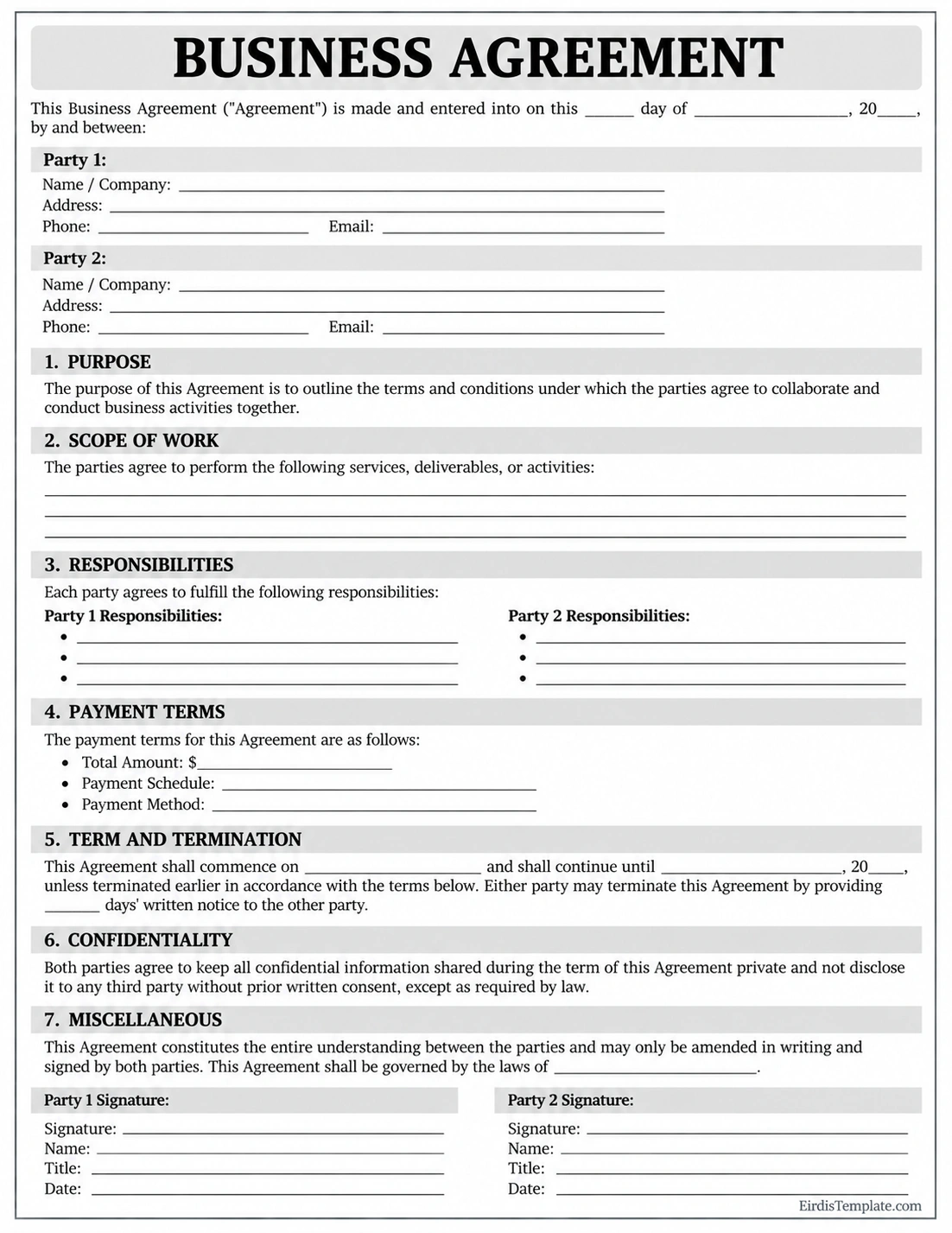
The template includes fields for the names and contact information of both parties, the purpose of the agreement, the scope of work, individual responsibilities, payment terms, the agreement period, confidentiality, and signatures.
Use the document as a starting point rather than a universal legal contract. Add details specific to your transaction, remove irrelevant provisions, and obtain legal advice when the arrangement involves substantial financial commitments, intellectual property, sensitive information, or significant liability.
What Should a Business Agreement Include?
The appropriate clauses depend on the type of transaction and the risks involved. However, many business agreements benefit from the following sections.
Names and Details of the Parties
Identify every party by the correct legal name. For a company, this may include its registered name, business address, and registration details where appropriate. Also identify the individuals authorized to sign on its behalf.
Purpose and Scope of Work
Explain why the agreement exists and what the parties intend to accomplish. Describe the products, services, deliverables, or activities covered by the arrangement.
Specific descriptions reduce uncertainty. If a service provider must complete several tasks, list the deliverables and any applicable standards rather than relying on general statements such as “provide business support.”
Roles and Responsibilities
State what each party must do. Responsibilities may include supplying materials, providing information, meeting deadlines, approving deliverables, maintaining records, or obtaining necessary permissions.
Where possible, assign responsibility for each task to a specific party. This makes it easier to monitor progress and address delays.
Payment Terms
Explain how the financial arrangement will work. Include the agreed price or fee, payment schedule, invoicing requirements, accepted payment methods, and any applicable taxes or reimbursable expenses.
If payments depend on milestones, define each milestone and explain when payment becomes due. Any late-payment charges or interest provisions should be clearly stated and checked against applicable law.
Timeline and Agreement Duration
Specify the start date, important deadlines, delivery dates, and expected completion date. For an ongoing relationship, state how long the agreement will remain in effect and whether it renews automatically.
If the schedule depends on approvals or information supplied by the other party, explain how those dependencies affect the timeline.
Confidentiality and Information Protection
A confidentiality clause may be necessary when the parties exchange business plans, customer details, pricing information, technical materials, or other nonpublic information.
Define what information is confidential, how it may be used, who may access it, and any applicable exceptions. Consider whether a separate nondisclosure agreement is more appropriate for the arrangement.
Intellectual Property and Ownership
If the agreement involves creative work, software, designs, written materials, inventions, or other intellectual property, explain who owns the existing materials and who will own newly created work.
Where necessary, specify whether the receiving party obtains a license or a transfer of ownership. These provisions should reflect the parties’ intentions and comply with applicable law.
Termination and Breach
Explain when and how either party can end the agreement. The document may address written notice, failure to perform, missed payments, material breaches, and opportunities to correct certain problems before termination.
Also describe what happens when the relationship ends, including outstanding payments, the return of property, access to confidential information, and any obligations that continue after termination.
Dispute Resolution and Governing Law
Consider including a process for handling disagreements. Depending on the transaction, this may involve good-faith discussions, mediation, arbitration, or court proceedings.
The agreement may also identify the governing law and appropriate jurisdiction. These provisions can have significant consequences, so obtain qualified legal advice when the parties operate in different locations or countries.
Signatures and Amendments
Include signature lines for all required parties, along with printed names, titles, and dates. Confirm that each signer has authority to enter into the agreement.
Explain how changes must be approved. Requiring written amendments signed or otherwise formally accepted by the relevant parties helps prevent disagreements about later modifications.
How to Write a Business Agreement Step by Step
Preparing an agreement is easier when you identify the main business terms before drafting the document. Follow these steps to create a useful first draft.
- Step 1: Identify the parties. Confirm the correct legal names and contact details of everyone involved.
- Step 2: Define the objective. Describe the transaction, service, partnership, or commercial activity covered by the agreement.
- Step 3: Document the scope. List deliverables, responsibilities, performance standards, and important exclusions.
- Step 4: Agree on financial terms. Specify fees, payment dates, invoicing procedures, taxes, and approved expenses.
- Step 5: Establish the timeline. Record the effective date, deadlines, duration, and renewal conditions.
- Step 6: Address important risks. Consider confidentiality, intellectual property, liability, termination, and dispute resolution.
- Step 7: Review applicable requirements. Check whether the transaction requires particular clauses, licenses, disclosures, witnesses, or other formalities.
- Step 8: Review the wording. Make sure the terms are clear, consistent, and free of unresolved blanks or contradictions.
- Step 9: Obtain appropriate review. Ask a qualified lawyer to review complex or high-value arrangements when necessary.
- Step 10: Sign and retain copies. Complete the signing process, distribute copies to the parties, and store the final agreement securely.
Tips for Creating a Clear and Effective Agreement
A business agreement should be understandable to the people who must follow it. Clear wording and consistent documentation can make the relationship easier to manage.
- Use specific language: Define deliverables, deadlines, payment amounts, and acceptance criteria wherever possible.
- Avoid vague promises: Replace unclear terms with measurable requirements and agreed procedures.
- Check every cross-reference: Ensure that clause numbers, dates, names, and defined terms are consistent.
- Document assumptions: Identify what each party must supply and which conditions could affect performance.
- Discuss difficult scenarios: Consider how the parties will handle delays, incomplete work, payment problems, or unexpected changes.
- Keep supporting records: Retain quotations, statements of work, approvals, invoices, and amendments where relevant.
- Use the right agreement type: A general template may not be suitable for partnerships, employment, property transactions, or regulated activities.
- Protect sensitive information: Limit access to signed agreements and any confidential attachments.
Common Business Agreement Mistakes to Avoid
Even a well-intentioned arrangement can become difficult when the written terms are incomplete. Watch for these common mistakes before signing.
- Leaving the scope unclear: Unspecified deliverables can create disagreements about what the parties must provide.
- Omitting payment details: Missing amounts, due dates, or invoicing rules can delay payment.
- Ignoring termination procedures: Without clear exit terms, ending the relationship may become complicated.
- Using an unsuitable template: A generic agreement may not address the legal and commercial risks of a specialized transaction.
- Overlooking intellectual property: Unclear ownership terms can cause disputes over work created during the relationship.
- Failing to document changes: Informal modifications may lead to conflicting expectations.
- Signing without authority: Confirm that each signatory is authorized to bind the relevant individual or organization.
- Assuming every clause is enforceable: Contract terms may be limited by mandatory law or other legal requirements.
Business Agreement vs. Business Contract
The terms business agreement and business contract are often used interchangeably, but their legal meanings can depend on context and jurisdiction. An agreement generally refers to an understanding between parties. A contract is commonly understood as an agreement that satisfies the legal requirements for enforceability.
A written business agreement may become a binding contract when the relevant legal elements are present. These can include mutual assent, consideration where required, capacity, lawful purpose, and any applicable formalities. The precise requirements vary by jurisdiction and transaction type.
For this reason, businesses should not assume that a document is legally enforceable simply because both parties have signed it. The terms, circumstances, and applicable law all matter.
Frequently Asked Questions About Business Agreements
Is a business agreement legally binding?
A business agreement can be legally binding if it meets the requirements of the applicable law. Enforceability depends on factors such as the parties’ intentions, the terms, legal capacity, and any required formalities. Seek legal advice if enforceability is uncertain.
Can I use a business agreement template?
Yes. A template can help organize common terms and reduce drafting time. However, you should customize it for the specific transaction and check whether additional clauses or legal formalities are required.
Does a business agreement need to be notarized?
Not every business agreement requires notarization. Requirements depend on the jurisdiction and the type of transaction. Some arrangements may require witnesses, notarization, registration, or other formalities.
What is the difference between a business agreement and a partnership agreement?
A business agreement is a broad term for an arrangement involving commercial activities. A partnership agreement specifically addresses the relationship between business partners, including ownership interests, contributions, profit sharing, decision-making, and exit procedures.
Can a business agreement be changed after signing?
It may be possible to amend an agreement if the parties follow the applicable law and the amendment procedure in the original document. Record changes clearly and obtain the required approvals or signatures.
What happens if one party breaches a business agreement?
The consequences depend on the contract terms and applicable law. Possible responses may include requesting corrective action, negotiating a resolution, terminating the agreement, or pursuing legal remedies. Professional legal advice can help determine the appropriate next step.
Should a lawyer review a business agreement?
Legal review is particularly valuable for high-value transactions, long-term commitments, complex liability provisions, intellectual property transfers, international dealings, or agreements involving regulated activities. A lawyer can help identify risks and tailor the terms to the circumstances.
Conclusion
A business agreement helps establish clear expectations, define responsibilities, and document the terms of a commercial relationship. By addressing the scope of work, payment, timelines, confidentiality, termination, and dispute resolution, the parties can reduce uncertainty and manage risks more effectively.
Use a printable business agreement template as a starting point, then adapt it to the transaction and applicable legal requirements. Review the terms carefully, confirm that authorized parties sign the document, and keep complete copies of the agreement and any amendments. For complex or high-value arrangements, obtain qualified legal advice before signing.
Download: Business Agreement Template

- Free Printable Call Sheet Template - October 12, 2026
- Free Printable Business Hours Template - October 12, 2026
- Business Expense Template - October 12, 2026
