An asset purchase agreement is a legal contract used when a buyer purchases specific assets from a seller. Instead of purchasing the entire business entity, the buyer and seller identify the particular assets included in the transaction, along with the purchase price, payment terms, closing requirements, representations, warranties, and other obligations.
This type of agreement can be useful when a buyer wants to acquire selected business assets while leaving other assets, liabilities, or obligations with the seller. Depending on the transaction, the assets may include equipment, inventory, intellectual property, customer contracts, furniture, fixtures, licenses, or other business property.
Because an asset acquisition can have significant legal, tax, and financial consequences, the final agreement should be reviewed by qualified legal and tax professionals. The appropriate terms can vary considerably depending on the assets involved, the parties, the jurisdiction, and the structure of the transaction.
Important: This article provides general educational information and is not legal, tax, or financial advice. An asset purchase agreement should be customized and reviewed by qualified professionals before it is signed.
What Is an Asset Purchase Agreement?
An asset purchase agreement, often abbreviated as APA, is a contract under which a seller transfers some or all of its business assets to a buyer. The agreement identifies what is being sold, what is excluded, how much the buyer will pay, and the responsibilities of each party.
Unlike a transaction in which the buyer acquires ownership interests in the seller’s company, an asset purchase transaction focuses on the specific assets being transferred.
For example, a buyer might purchase a company’s equipment, inventory, trademarks, website, customer contracts, and certain intellectual property without purchasing every asset or assuming every obligation of the existing business.
The exact structure depends on the transaction and applicable law. A carefully drafted agreement helps the parties establish a clear record of what the buyer is acquiring and what remains with the seller.
Asset Purchase Agreement Template
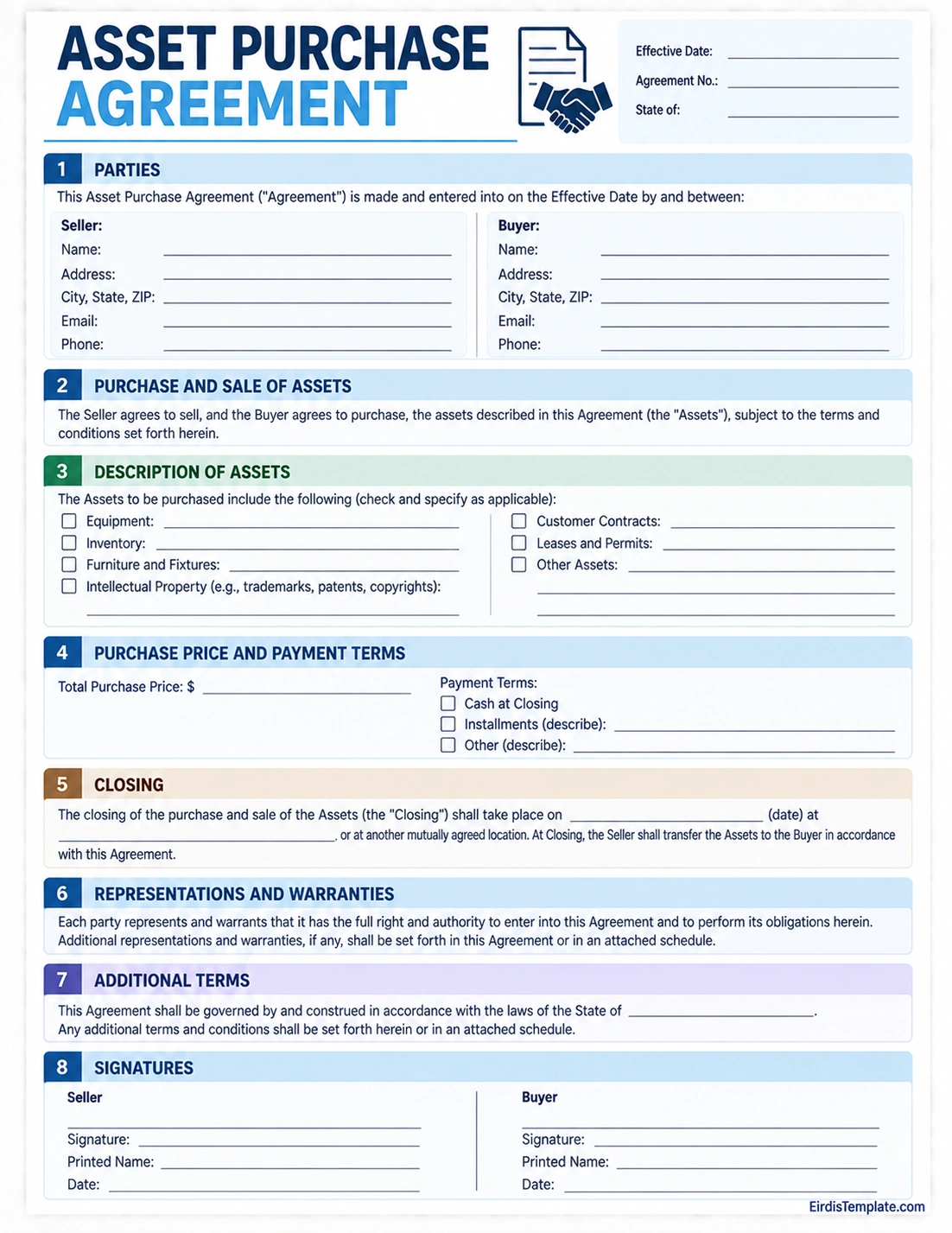
An asset purchase agreement template provides a structured starting point for documenting an asset sale. A typical template can organize information about the parties, assets, purchase price, closing date, representations and warranties, additional terms, and signatures.
A template can make it easier to identify the major components of the transaction, but it should not be treated as a substitute for transaction-specific legal drafting. Complex acquisitions may require schedules, exhibits, third-party consents, intellectual property assignments, lease documents, bills of sale, or other supporting documents.
Why Use an Asset Purchase Agreement?
An asset purchase agreement provides a written framework for a business asset transaction. It helps the buyer and seller define their expectations before ownership of the specified assets changes hands.
Some important purposes include:
- Defining the assets: The agreement identifies which assets are being transferred.
- Defining excluded assets: Items that remain with the seller can be specifically identified.
- Establishing the purchase price: The agreement states the total consideration and payment terms.
- Setting closing requirements: The parties can establish when and how the transaction will close.
- Allocating responsibilities: The agreement can identify obligations before and after closing.
- Addressing representations and warranties: Each party can make specified statements about the transaction and its authority to enter into the agreement.
- Managing risk: Indemnification and other provisions can allocate certain risks between the parties.
- Creating a written record: A signed agreement provides documentation of the parties’ negotiated terms.
What Assets Can Be Included?
The assets included in an asset acquisition depend on what the buyer wants to purchase and what the seller has the legal right to transfer.
Equipment and Physical Property
Physical assets may include machinery, computers, vehicles, tools, furniture, fixtures, office equipment, and other tangible business property.
The agreement should identify important assets clearly. For larger transactions, an attached schedule with asset descriptions, serial numbers, locations, or other identifying information may be appropriate.
Inventory
Inventory can include finished products, raw materials, supplies, merchandise, and other items held for business purposes.
The parties may need to establish how inventory will be counted and valued at closing, particularly when the amount of inventory changes between signing and closing.
Intellectual Property
Depending on the transaction, intellectual property may include trademarks, trade names, copyrights, patents, software, domain names, business content, designs, or other intellectual property rights.
Because different intellectual property rights have different transfer requirements, the agreement should identify the rights being transferred and include appropriate assignment documents when necessary.
Contracts and Business Relationships
A buyer may want to acquire selected customer contracts, supplier agreements, licenses, leases, or other contractual rights. However, some contracts may restrict assignment or require consent from another party.
These requirements should be identified during due diligence and addressed before closing where necessary.
Included Assets vs. Excluded Assets
One of the most important parts of an asset purchase transaction is distinguishing between assets that are being purchased and assets that are not.
An agreement can use separate schedules or detailed lists to identify:
- Purchased equipment.
- Purchased inventory.
- Transferred intellectual property.
- Assigned contracts.
- Transferred licenses or permits where legally transferable.
- Excluded cash and cash equivalents.
- Excluded personal or unrelated property.
- Excluded contracts or liabilities.
Clear asset descriptions can reduce confusion about what the buyer is actually acquiring. Broad or ambiguous descriptions may create disputes later, particularly when an asset is important to the operation of the acquired business.
What Should an Asset Purchase Agreement Include?
The contents of an APA depend on the transaction. However, many agreements contain several core sections.
1. Parties
The agreement should identify the seller and buyer using their correct legal names and relevant business information.
2. Description of the Transaction
This section explains that the seller agrees to sell and the buyer agrees to purchase the specified assets subject to the agreement’s terms and conditions.
3. Description of Assets
The agreement should clearly identify the assets being transferred. Detailed schedules can be attached when a simple description is not sufficient.
4. Purchase Price and Payment Terms
The purchase price section identifies the consideration being paid for the assets. It may also address deposits, installments, financing, adjustments, assumed liabilities, or other forms of consideration when applicable.
5. Closing
The closing section establishes when ownership transfers and what documents or actions must be completed at closing.
6. Representations and Warranties
Representations and warranties are statements made by the parties concerning matters relevant to the transaction. Depending on the agreement, these may address authority to enter into the contract, ownership of assets, absence of certain liens, accuracy of information, and other transaction-specific matters.
7. Assumed and Excluded Liabilities
Liability allocation is a critical part of an asset purchase transaction. The agreement should clearly state which liabilities, if any, the buyer is assuming and which remain the seller’s responsibility.
8. Indemnification
Indemnification provisions may establish when one party must compensate the other for specified losses, claims, damages, or expenses. These provisions can include limitations, procedures, notice requirements, and time periods.
9. Governing Law and Dispute Resolution
The agreement may specify the governing law and how disputes will be handled. Depending on the transaction, this could include court proceedings, arbitration, mediation, or another agreed process.
10. Signatures
The final agreement should include appropriate signature blocks for the parties or their authorized representatives. The execution requirements can vary depending on the entities involved and applicable law.
Asset Purchase Agreement and Liabilities
One reason buyers may choose an asset purchase structure is the ability to identify which assets and obligations are part of the transaction. However, it is important not to assume that an asset purchase automatically eliminates every possible liability.
Some liabilities may be expressly assumed by contract, while others may arise from applicable law, the nature of the assets, existing contracts, taxes, employment matters, successor-liability principles, or other circumstances.
For this reason, the assumed liabilities and excluded liabilities should be reviewed carefully during negotiations and due diligence.
Purchase Price and Tax Considerations
The purchase price is more than simply a single number in many asset acquisition transactions. The parties may need to determine how the consideration is allocated among the acquired assets.
For certain U.S. asset acquisitions, federal tax rules can require the buyer and seller to report information about the allocation of consideration among acquired assets. The IRS uses Form 8594 for certain applicable asset acquisitions, and the allocation can affect the buyer’s tax basis and the seller’s tax treatment.
Because tax treatment can be complex, buyers and sellers should consult qualified tax professionals when determining purchase-price allocation and reporting obligations.
Due Diligence Before Signing
Before signing an asset purchase agreement, the buyer should perform appropriate due diligence on the assets and the transaction.
Depending on the deal, due diligence may include reviewing:
- Ownership records for important assets.
- Existing liens and security interests.
- Equipment condition and maintenance records.
- Inventory records and valuation.
- Intellectual property ownership and registrations.
- Customer and supplier contracts.
- Leases and assignment restrictions.
- Licenses and permits.
- Relevant tax records.
- Pending or potential disputes.
- Environmental or regulatory issues where applicable.
Due diligence can help identify problems before the transaction closes and can influence the purchase price, representations, warranties, conditions to closing, and indemnification provisions.
Asset Purchase Agreement vs. Stock Purchase Agreement
An asset purchase agreement and a stock purchase agreement use different transaction structures.
In an asset purchase, the buyer purchases specified assets from the seller. In a stock purchase, the buyer generally acquires ownership interests in the company itself.
The difference can affect which assets, contracts, liabilities, tax considerations, and operational relationships are involved in the transaction.
The appropriate structure depends on the circumstances and should be evaluated with qualified legal and tax advisors.
Tips for Creating an Asset Purchase Agreement
A carefully prepared agreement should make the transaction understandable to someone reviewing it later.
- Identify the parties precisely: Use the correct legal names and entity information.
- Describe assets specifically: Use schedules when a detailed asset list is needed.
- Separate included and excluded assets: Do not rely on assumptions.
- Define liabilities clearly: State which obligations are assumed and which remain with the seller.
- Address payment terms: Explain when and how the purchase price will be paid.
- Check transfer restrictions: Determine whether contracts, licenses, leases, or other rights require third-party consent.
- Review intellectual property: Confirm ownership and appropriate transfer documents.
- Coordinate tax treatment: Obtain professional advice regarding purchase-price allocation and reporting.
- Include closing requirements: Identify the documents and actions required before completion.
- Have professionals review the agreement: A customized transaction document is generally more appropriate than relying on an unmodified template.
Common Mistakes to Avoid
Asset transactions can become complicated when important details are left undefined. Common mistakes include:
- Using a vague description of the purchased assets.
- Failing to identify excluded assets.
- Not reviewing liens or other claims against assets.
- Ignoring contract assignment restrictions.
- Failing to address intellectual property transfers.
- Leaving assumed liabilities unclear.
- Overlooking inventory adjustments at closing.
- Failing to coordinate tax and accounting treatment.
- Using a generic agreement without adapting it to the transaction.
- Signing before completing appropriate due diligence.
Frequently Asked Questions About Asset Purchase Agreements
What is an asset purchase agreement?
An asset purchase agreement is a contract in which a seller agrees to transfer specified business assets to a buyer under defined terms and conditions. It typically addresses the assets being sold, purchase price, payment terms, closing, representations, warranties, liabilities, and other obligations.
What is an APA in business?
APA commonly stands for Asset Purchase Agreement. It is used to document a transaction involving the purchase and sale of specific business assets.
What can be included in an asset purchase agreement?
An APA can cover equipment, inventory, furniture, fixtures, intellectual property, contracts, licenses, permits, customer relationships, and other specified assets, depending on what the parties agree to transfer and what can legally be transferred.
Does an asset purchase include liabilities?
Not necessarily. The agreement can identify liabilities that the buyer agrees to assume and liabilities that remain with the seller. However, applicable law and the specific circumstances of the transaction may affect liability exposure, so professional legal advice is important.
Can an asset purchase agreement include intellectual property?
Yes. An asset purchase transaction may include intellectual property such as trademarks, copyrights, patents, software, domain names, or other rights. The agreement and related assignment documents should identify the rights being transferred and address any applicable transfer requirements.
Why is an asset schedule important?
An asset schedule provides a detailed list of the property included in the transaction. It can reduce ambiguity by identifying specific equipment, inventory, intellectual property, contracts, or other assets being transferred.
Is an asset purchase agreement legally binding?
An asset purchase agreement can be legally binding when properly formed and executed, but enforceability depends on the agreement, applicable law, the parties, and the facts of the transaction. A qualified attorney should review a proposed agreement before it is signed.
Does an asset purchase agreement need a lawyer?
There is no universal answer for every transaction, but an asset acquisition can involve significant legal, tax, contractual, and liability issues. Professional legal review is especially important for complex or high-value transactions.
What is the difference between an asset purchase and a stock purchase?
An asset purchase generally involves acquiring specified assets from a seller, while a stock purchase generally involves acquiring ownership interests in the company. The two structures can have substantially different legal, tax, and liability consequences.
Conclusion
An asset purchase agreement provides a structured legal framework for buying and selling selected business assets. By clearly identifying the assets, purchase price, payment terms, closing requirements, representations, warranties, and liability allocation, the agreement can help both parties understand their responsibilities and reduce uncertainty.
The ability to select specific assets can make an asset acquisition useful for transactions where the buyer does not want to acquire the entire business entity. However, the transaction still requires careful due diligence and attention to contracts, intellectual property, liens, taxes, liabilities, and applicable legal requirements.
An asset purchase agreement template can help organize the basic components of a transaction, but a final agreement should be customized to the specific deal and reviewed by qualified legal and tax professionals before execution.
Download: Asset Purchase Agreement Template

- Free Printable Attendance Sheet Template - October 5, 2026
- Asset Purchase Agreement Template (Word) - October 5, 2026
- Free Annual Budget Template (Excel) - October 5, 2026
