An against medical advice form is used when a patient chooses to leave a healthcare facility or refuses recommended medical care despite being informed about the potential risks, benefits, and alternatives. The form helps document the discussion between the patient and healthcare provider and records the patient’s decision.
Leaving against medical advice can involve important health and safety considerations. For healthcare providers, accurate documentation can help show that the patient received appropriate information and had an opportunity to ask questions before making a decision. For patients, the form provides a written record of the information discussed and the decision made.
Because medical documentation requirements can vary by healthcare facility, state, country, and situation, an AMA form should be reviewed and adapted by the appropriate healthcare, legal, and compliance professionals before use.
Important: This article provides general educational information and is not medical or legal advice. An against medical advice form should not replace appropriate clinical assessment, informed consent or refusal procedures, emergency care requirements, or applicable healthcare regulations.
What Is an Against Medical Advice Form?
An against medical advice form, sometimes called an AMA form or against medical advice release form, is a document used to record a patient’s decision to leave a healthcare facility or decline recommended treatment against the advice of a healthcare professional.
The form generally documents that the healthcare provider explained the patient’s condition, recommended care, potential risks of refusing or leaving, possible benefits of treatment, and reasonable alternatives when applicable.
It may also document that the patient had an opportunity to ask questions and demonstrated an understanding of the information provided.
The purpose is not simply to obtain a signature. The underlying goal is to document the communication and decision-making process surrounding the patient’s refusal of recommended care.
Why Is an Against Medical Advice Form Important?
When a patient decides not to follow a recommended treatment plan or leaves before the healthcare team recommends discharge, careful documentation is important. An AMA form can provide a structured way to record key information about the encounter.
A well-designed form may help healthcare organizations document:
- The patient’s identity and relevant encounter information.
- The patient’s current medical condition or reason for treatment.
- The care or treatment recommended by the healthcare provider.
- The potential risks associated with refusing treatment or leaving.
- The potential benefits of continuing recommended care.
- Alternatives that were discussed when appropriate.
- The patient’s questions and the information provided in response.
- The patient’s decision to refuse recommended care or leave.
- The signatures, dates, and times associated with the documentation.
Proper documentation can be particularly important when the patient’s decision could result in a worsening medical condition or other serious consequences.
Against Medical Advice Form Template
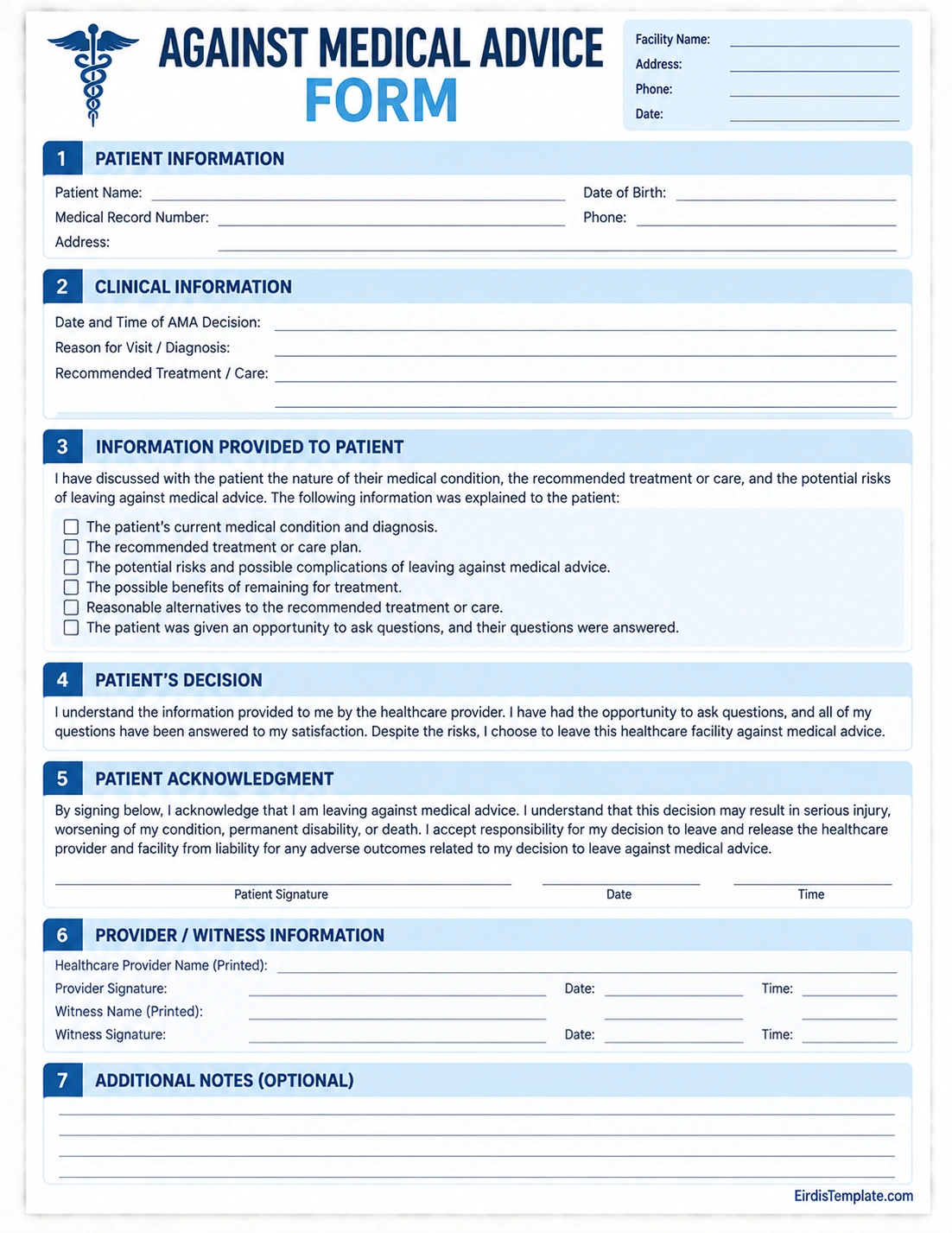
An against medical advice form template can provide a structured starting point for documenting a patient’s informed refusal or decision to leave. A practical template should be clear, easy to complete, and organized around the information that needs to be documented.
For example, an AMA form may include patient information, clinical information, details about the recommended treatment, risks and benefits discussed, the patient’s decision, acknowledgment, provider information, witness information, and additional notes.
What Should an Against Medical Advice Form Include?
The exact contents of an AMA form may vary by healthcare organization and applicable requirements. However, several sections are commonly useful for documenting the patient’s decision and the information discussed.
1. Patient Information
The form should provide space for basic identifying and encounter information. This may include the patient’s name, date of birth, medical record number, address, telephone number, and the date of the AMA decision.
Healthcare organizations should use the patient-identification fields and procedures required by their own policies.
2. Clinical Information
A section for clinical information can identify the reason for the patient’s visit, relevant diagnosis or clinical concern, and recommended treatment or care.
The documentation should be specific enough to accurately reflect the patient’s situation without relying on vague statements such as simply stating that the patient “refused treatment.”
3. Information Provided to the Patient
This is one of the most important parts of an against medical advice form. Documentation should reflect the information communicated to the patient.
Depending on the circumstances, this may include:
- The patient’s condition or diagnosis.
- The recommended treatment or continued care.
- Potential risks of refusing treatment or leaving.
- Potential benefits of continuing treatment.
- Reasonable alternatives that were discussed.
- Potential consequences of delaying or refusing care.
- Instructions for obtaining additional medical assistance.
The actual clinical discussion should be documented accurately rather than relying solely on a checkbox or signature.
4. Patient Decision and Acknowledgment
The form should clearly document the patient’s decision. It may include an acknowledgment stating that the patient received information about the recommended care and potential consequences of refusing or leaving.
The wording should be appropriate for the organization’s policies and reviewed by qualified professionals. A signature by itself should not be treated as proof that every aspect of informed decision-making occurred.
5. Provider and Witness Information
Depending on facility policy, the form may include the healthcare provider’s name and signature as well as witness information. Dates and times can also help establish when the discussion and decision occurred.
6. Additional Notes
A notes section gives healthcare professionals space to record relevant circumstances that may not fit into the standard fields. This can be useful when documenting questions asked by the patient, additional instructions provided, attempts to encourage continued care, or other significant details.
How Does the AMA Process Work?
The process surrounding an AMA decision should focus on communication, patient understanding, safety, and accurate documentation rather than simply obtaining a signed document.
Step 1: Assess the Patient
The healthcare team should assess the patient’s clinical situation and determine what care is recommended. The appropriate assessment and documentation procedures depend on the circumstances and applicable policies.
Step 2: Explain the Recommended Care
The healthcare provider should explain the recommended treatment, continued observation, admission, procedure, or other appropriate care in terms the patient can understand.
Step 3: Discuss Risks, Benefits, and Alternatives
The provider should explain relevant risks of refusing or leaving, as well as the potential benefits of following the recommended plan. Reasonable alternatives should be discussed when appropriate.
Step 4: Allow Questions
Patients should have an opportunity to ask questions and seek clarification. Documentation should accurately reflect significant questions, concerns, and explanations when relevant.
Step 5: Document the Decision
If the patient chooses to leave or refuse recommended care, the healthcare team should document the decision and the relevant discussion in accordance with facility policy and applicable requirements.
Step 6: Provide Appropriate Instructions
When appropriate, the patient should receive information about follow-up care, warning signs, medications, referrals, or instructions for seeking additional medical attention. The specific instructions should be based on the patient’s clinical circumstances.
What Is Informed Refusal?
Informed refusal describes a situation in which a patient declines recommended medical care after receiving relevant information about the proposed care and its potential consequences.
An against medical advice decision can involve informed refusal, but the documentation should reflect the actual circumstances rather than assuming that every patient who leaves has completed the same process.
Healthcare professionals should follow applicable standards for assessing decision-making capacity and documenting informed refusal. A patient’s signature on an AMA form does not automatically establish capacity or eliminate the need for appropriate clinical documentation.
AMA Form vs. Regular Discharge
A standard discharge and leaving against medical advice are not necessarily the same situation.
In a routine discharge, the healthcare team determines that the patient can leave under the applicable discharge plan. When a patient leaves despite a recommendation to continue treatment or remain under medical care, the situation may be documented as an AMA departure according to the facility’s procedures.
The distinction matters because the documentation should accurately describe what occurred. Healthcare providers should avoid using an AMA form as a substitute for a proper discharge process when the patient is being appropriately discharged.
Tips for Creating an Effective AMA Form
If a healthcare organization is developing an against medical advice form template, the document should be practical and easy to understand.
- Use clear language: Avoid unnecessary medical or legal jargon when communicating with patients.
- Keep the layout organized: Separate patient information, clinical information, risks, decisions, and signatures into clearly labeled sections.
- Provide adequate writing space: Include enough room for notes and explanations.
- Include dates and times: These fields can help establish when important events occurred.
- Document communication: Record important information discussed rather than relying only on checkboxes.
- Include signature fields: Provide appropriate spaces for the patient, provider, and witness when required by policy.
- Review the wording: Have qualified clinical, legal, and compliance professionals review the form before implementation.
- Follow facility policy: The template should support, not replace, the organization’s established procedures.
Common Mistakes When Using an AMA Form
An AMA form can be useful, but poor documentation can reduce its value. Common problems include treating the form as a simple liability waiver, failing to document the discussion, or using generic language that does not reflect the patient’s actual circumstances.
Other mistakes may include:
- Failing to document the recommended treatment.
- Not recording significant risks that were discussed.
- Failing to document the patient’s questions or concerns when relevant.
- Assuming a signature alone proves informed refusal.
- Using a form without considering the patient’s decision-making capacity.
- Failing to provide appropriate follow-up or safety information.
- Using outdated language or a form that does not match current organizational policy.
Healthcare providers should document the clinical encounter according to professional standards and applicable requirements, even when a patient refuses to sign an AMA form.
Does Signing an AMA Form Waive Liability?
Signing an against medical advice form does not automatically guarantee that a healthcare provider or facility will be protected from every future claim or legal issue.
The legal effect of an AMA form depends on the facts of the situation, applicable law, the quality of the communication and documentation, and other circumstances. A form should therefore be viewed primarily as part of the overall documentation process rather than as a guaranteed liability waiver.
Healthcare organizations should obtain appropriate legal and compliance advice when developing or revising an AMA form.
Frequently Asked Questions About Against Medical Advice Forms
What is an against medical advice form used for?
An against medical advice form is used to document a patient’s decision to leave a healthcare facility or refuse recommended care after the relevant information has been discussed. It can document the recommended treatment, risks, benefits, alternatives, patient questions, decision, and signatures.
Is an AMA form the same as a medical release form?
No. An AMA form specifically addresses a patient’s decision to leave or refuse recommended medical care against the advice of the healthcare provider. A medical release form can refer to different types of authorization or disclosure documents, depending on its purpose.
Does a patient have to sign an AMA form?
Requirements vary according to the situation, facility policy, and applicable law. A patient’s refusal to sign does not necessarily mean that the healthcare provider cannot document the patient’s decision and the circumstances surrounding it.
Can a patient leave the hospital against medical advice?
A patient may choose to leave in many circumstances, but the specific rights, procedures, and limitations can depend on the patient’s condition, decision-making capacity, applicable law, and the circumstances of care. Healthcare providers should follow appropriate clinical and organizational procedures.
What should be documented when a patient leaves AMA?
Documentation may include the patient’s condition, recommended treatment, risks and benefits discussed, alternatives when applicable, questions and answers, assessment of relevant decision-making capacity, the patient’s decision, instructions provided, and the date and time of the event. The exact requirements depend on applicable standards and facility policy.
Can an AMA form protect a hospital from liability?
An AMA form can be an important part of the medical record, but it is not necessarily a complete protection from liability. Its value depends on the circumstances and the quality of the overall clinical assessment, communication, informed refusal process, and documentation.
Can an AMA form be used for every patient who refuses treatment?
Not necessarily. The appropriate documentation depends on the clinical situation and the type of refusal. Healthcare professionals should follow their organization’s policies and applicable professional and legal requirements rather than automatically using the same form for every refusal of care.
Conclusion
An against medical advice form provides a structured way to document a patient’s decision to leave a healthcare facility or refuse recommended medical care. A useful form can record patient information, the clinical situation, recommended treatment, risks and benefits discussed, alternatives, patient questions, the patient’s decision, and relevant signatures.
However, an AMA form should be more than a signature page. Effective documentation should reflect the actual conversation and decision-making process and should be completed alongside appropriate clinical assessment and follow-up procedures.
For healthcare organizations, an against medical advice form template can serve as a practical starting point, but the final form should be reviewed and customized to meet applicable clinical, legal, regulatory, and organizational requirements.
Download: Against Medical Advice Form

- Free Printable Attendance Sheet Template - October 5, 2026
- Asset Purchase Agreement Template (Word) - October 5, 2026
- Free Annual Budget Template (Excel) - October 5, 2026
