An authenticity certificate is a document used to confirm that an item is genuine and to provide important information about its identity, origin, ownership, or history. It can be particularly useful for artwork, collectibles, antiques, jewelry, limited-edition products, and other valuable or distinctive possessions.
A well-prepared certificate of authenticity can provide useful supporting documentation when an item is insured, transferred to a new owner, exhibited, or offered for resale. Depending on the type of item and who issues the certificate, it may also document details such as the item’s creator, production date, edition number, provenance, previous owner, or identifying characteristics.
This guide explains what an authenticity certificate is, what information it should contain, how to create one, and how a certificate of authenticity can support ownership records and the documentation of an item’s history.
What Is an Authenticity Certificate?
An authenticity certificate, often called a certificate of authenticity (COA), is a document that states that a particular item is genuine according to the information and verification available from the issuer.
The certificate typically identifies the item and provides details that can help distinguish it from similar items. Depending on the circumstances, it may also identify the creator, manufacturer, artist, seller, issuing organization, or previous owner.
A COA can be especially valuable when an item may change hands over time. Keeping the certificate with the item creates a useful documentation trail that can help future owners understand the item’s identity and history.
Why Is a Certificate of Authenticity Important?
An authenticity certificate can provide several practical benefits for owners, buyers, sellers, collectors, and organizations. Its usefulness depends on the quality of the information provided and the credibility of the person or organization issuing it.
Provides Supporting Proof of Authenticity
A COA can document that an issuer considers an item genuine. For collectors and buyers, this provides an additional record that can be reviewed alongside the item itself and other supporting documentation.
However, a certificate should not automatically be treated as conclusive proof. Its reliability depends on who issued it, how the item was examined, and whether the issuer has appropriate expertise or authority.
Documents Ownership and Item History
An authenticity certificate can include ownership or provenance information when that information is known and appropriate to document. A record of previous owners may help establish the item’s history and provide context about how it came to its current owner.
Supports Insurance Documentation
When an item is valuable, documentation can be useful when discussing insurance coverage or maintaining personal records. A certificate may help identify the item and preserve information about its characteristics, origin, or estimated significance.
Insurance companies may require additional documentation, appraisals, photographs, receipts, or professional valuations, so a COA should not be assumed to establish an insurance value by itself.
May Support Resale
Buyers may feel more comfortable purchasing an item when its history and authenticity are supported by credible documentation. Keeping an original certificate can therefore be useful when an item is later sold, transferred, or consigned.
What Information Should an Authenticity Certificate Include?
The information included in a certificate of authenticity should be specific enough to identify the item without creating unnecessary complexity. The appropriate fields depend on the type of possession and the reason for issuing the certificate.
Common information includes:
- Item name: The title or identifying name of the item.
- Description: A detailed description of the item’s appearance, characteristics, or distinguishing features.
- Creator or maker: The artist, designer, manufacturer, or other responsible creator when applicable.
- Creation or production date: The known date or approximate period associated with the item.
- Material: The materials used to create the item.
- Dimensions: Size, weight, or other relevant measurements.
- Serial or identification number: A unique identifier when one exists.
- Edition information: Edition number or production quantity for limited-edition items.
- Origin: Known location or source associated with the item’s creation or acquisition.
- Provenance: Available information about the item’s ownership history.
- Current owner: The person or organization currently documented as the owner, where appropriate.
- Issuer information: Name and contact information of the person or organization issuing the certificate.
- Verification statement: A clear statement explaining what the certificate confirms.
- Signature and date: Identification of the person authorizing the certificate.
Authenticity Certificate Template
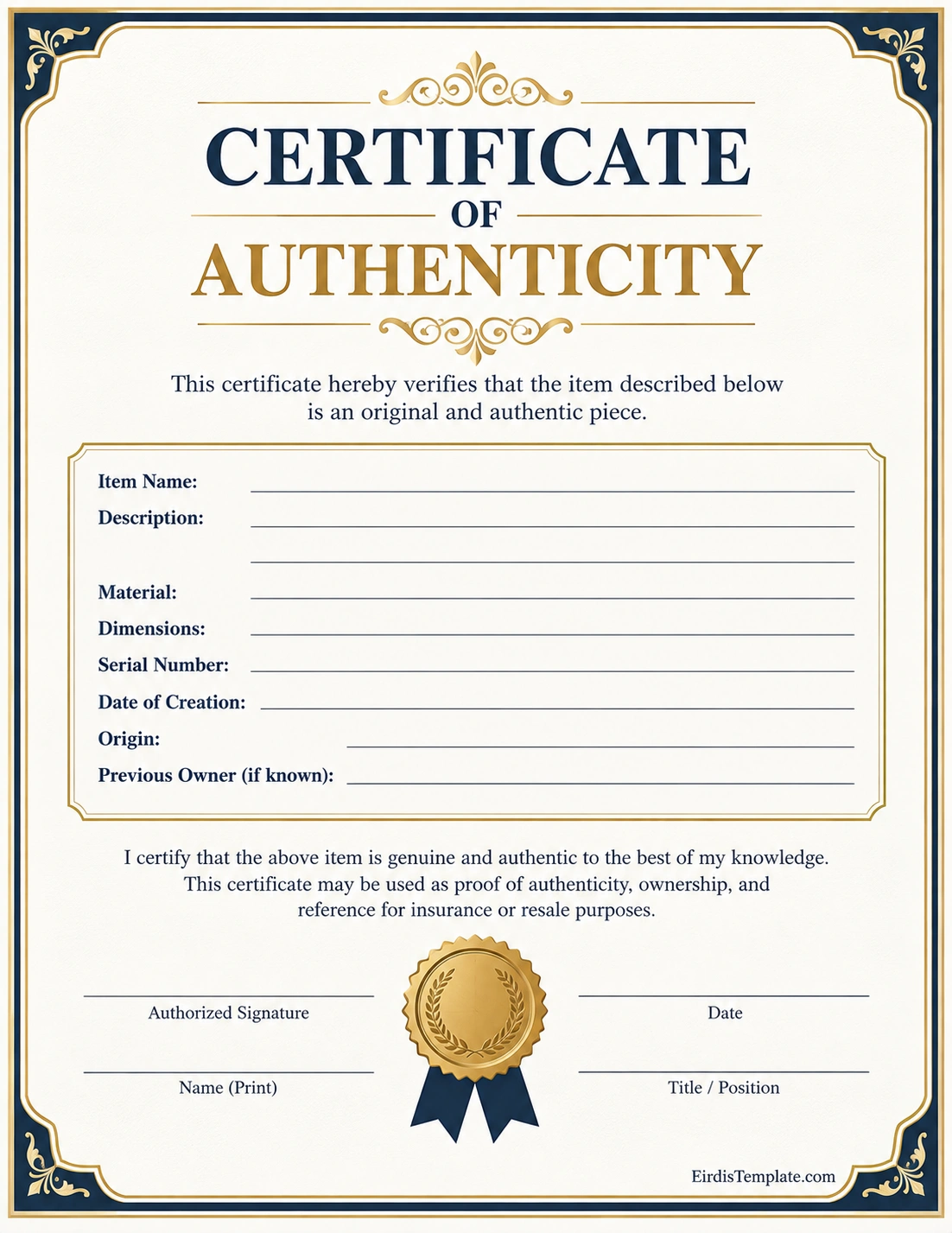
An authenticity certificate template provides a structured starting point for documenting an item’s identity and authenticity. A well-designed template can include dedicated fields for the item description, creator, materials, dimensions, serial number, origin, previous ownership, verification statement, and authorized signature.
A printable certificate of authenticity can be completed by hand, while a digital version can be completed electronically and saved with the item’s supporting records.
How to Create an Authenticity Certificate
Creating an authenticity certificate starts with identifying the item and documenting information that can be verified. The certificate should be clear, specific, and consistent with any supporting records.
1. Identify the Item
Begin with the item’s exact name or title. If the item has a model number, serial number, edition number, catalog number, or other unique identifier, include it whenever appropriate.
2. Describe the Item Clearly
Write a concise but useful description. Include characteristics that help distinguish the item from similar objects, such as materials, dimensions, colors, markings, edition information, or unique features.
3. Document the Creator or Maker
Identify the artist, designer, manufacturer, or creator when the information is known. For artwork, this may include the artist’s name and the title of the work. For collectibles or manufactured items, it may include the brand, model, or production information.
4. Add Provenance Information
If reliable ownership history is available, document previous owners, acquisition dates, galleries, dealers, exhibitions, or other relevant provenance details. Do not include information that cannot reasonably be supported.
5. Add the Verification Statement
The verification statement should clearly explain what the issuer is certifying. Avoid vague language that could create confusion about the scope of the certification.
6. Identify the Issuer
Include the name, title, organization, or other identifying information of the person responsible for issuing the certificate. Contact information can also be useful for future verification.
7. Sign and Date the Certificate
A signature and date help establish when the certificate was issued and identify the person responsible for the certification. A unique certificate number can also be added when certificates are issued as part of a formal recordkeeping system.
What Types of Items Can Use an Authenticity Certificate?
Certificates of authenticity can be used for many types of possessions where authenticity, origin, ownership, or provenance is important.
Artwork
Artists, galleries, studios, and other authorized parties may provide certificates for paintings, sculptures, prints, photographs, and other original works. Details may include the artist, title, medium, dimensions, creation date, edition, and provenance.
Collectibles
Collectible items such as memorabilia, rare objects, limited editions, and specialty collections may benefit from documentation identifying the item and its origin.
Antiques
For antiques, documentation may include the item’s approximate age, origin, materials, maker, known history, and previous ownership. Additional professional appraisal or provenance research may be appropriate for high-value items.
Jewelry and Luxury Items
Jewelry and other valuable possessions may require detailed identification, including materials, dimensions, markings, serial numbers, maker information, and other distinguishing characteristics.
Limited-Edition Products
Limited-edition items can use certificates to document edition numbers, production quantities, release information, and identifying characteristics.
Authenticity Certificate vs. Appraisal
An authenticity certificate and an appraisal serve different purposes. An authenticity certificate generally focuses on whether an item is genuine and may document identifying or provenance information. An appraisal focuses on determining or estimating an item’s value for a specific purpose.
For example, an artwork may have a certificate confirming its authenticity while a qualified appraiser separately provides an opinion of its market value.
These documents can complement each other, but one should not automatically be treated as a substitute for the other.
Authenticity Certificate vs. Proof of Ownership
An authenticity certificate may contain ownership information, but authenticity and ownership are not necessarily the same thing.
A COA can identify an item as genuine, while documents such as purchase receipts, invoices, bills of sale, transfer records, or other ownership documents may provide stronger evidence of a particular ownership transaction.
When documenting a valuable possession, it can be useful to maintain the authenticity certificate together with purchase records, appraisal documents, photographs, and relevant provenance records.
Tips for Creating a Reliable Certificate of Authenticity
A professional-looking certificate should also contain accurate and useful information. Consider these tips when preparing a COA:
- Use a unique certificate number when appropriate.
- Describe the item using specific identifying details.
- Record serial numbers and edition numbers accurately.
- Keep copies of supporting photographs and documentation.
- Identify the issuer clearly.
- Include the date of issuance.
- Use consistent terminology throughout the certificate.
- Avoid making claims that cannot be verified.
- Keep provenance information supported by available records.
- Store the certificate securely with other ownership documents.
How to Protect an Authenticity Certificate
The certificate itself can become an important part of an item’s documentation. Protect the original from damage, loss, or unauthorized alteration.
Consider keeping a high-quality digital copy in secure storage. For valuable items, maintain photographs of both the item and its identifying characteristics so the documentation can be compared with the possession if necessary.
If a certificate contains sensitive personal information, avoid sharing unnecessary details publicly. Store digital copies using appropriate security measures and limit access when necessary.
Common Mistakes to Avoid
Using Vague Descriptions
A certificate that simply states an item is “authentic” without identifying the item clearly may have limited practical value. Include enough information to connect the certificate to the specific possession.
Leaving Out Identifying Numbers
Serial numbers, edition numbers, model numbers, and other identifiers can be important for distinguishing one item from another. Include them when available and relevant.
Making Unsupported Claims
Do not state that an item has a particular history, origin, or ownership record unless the information can reasonably be supported. Accurate documentation is more useful than an impressive but unverifiable claim.
Confusing Authenticity With Value
A certificate confirming authenticity does not necessarily establish market value. Valuation may require a separate professional appraisal based on the item’s condition, market, rarity, demand, and intended valuation purpose.
Failing to Identify the Issuer
A certificate should make it clear who issued it and, when appropriate, how that person or organization can be contacted for verification.
Frequently Asked Questions About Authenticity Certificates
What is an authenticity certificate?
An authenticity certificate is a document that identifies an item and states that the issuer considers it genuine based on the available information and verification. It may also document the item’s origin, characteristics, provenance, or ownership history.
What is a certificate of authenticity used for?
A certificate of authenticity can be used to document the identity and authenticity of an item and preserve supporting information about its origin or history. It may also be useful when maintaining insurance records, transferring ownership, or preparing an item for resale.
Does an authenticity certificate prove ownership?
Not necessarily. A certificate may contain ownership information, but proof of ownership can depend on purchase receipts, bills of sale, transfer documents, provenance records, and other evidence. The certificate should not automatically be treated as conclusive proof of legal ownership.
Does a certificate of authenticity prove an item’s value?
No. Authenticity and value are different concepts. A COA can document authenticity, while a professional appraisal may be used to estimate or determine value for a particular purpose.
Who can issue a certificate of authenticity?
The appropriate issuer depends on the type of item. It may be the creator, artist, manufacturer, gallery, dealer, recognized expert, organization, or another party with appropriate knowledge or authority. The credibility of the issuer can affect how useful the certificate is.
What should be included on a certificate of authenticity?
A certificate may include the item name, description, creator or maker, materials, dimensions, serial or edition number, creation date, origin, provenance, ownership information, issuer details, verification statement, signature, date, and certificate number.
Can I create my own authenticity certificate?
You can create a document to record authenticity information, but its credibility depends on the circumstances and who is making the certification. For valuable or specialized items, documentation from a qualified or recognized source may carry greater weight.
Should an authenticity certificate have a certificate number?
A unique certificate number is not always required, but it can be useful for organized recordkeeping. Numbering certificates can make it easier for an issuer or organization to track certificates and verify records later.
Conclusion
An authenticity certificate is a useful documentation tool for recording an item’s identity, authenticity, origin, and available ownership history. It can provide supporting information for collectors, owners, buyers, sellers, galleries, and other parties who need a reliable record connected to a specific possession.
A strong certificate should identify the item clearly, include relevant distinguishing details, identify the issuer, document available provenance, and provide a clear verification statement. For valuable possessions, it can also be helpful to keep the certificate together with receipts, appraisals, photographs, and other ownership records.
Whether you are documenting artwork, collectibles, antiques, jewelry, memorabilia, or limited-edition products, an organized certificate of authenticity template can make the documentation process easier while creating a professional record for future reference.
Download: Authenticity Certificate Template

- Bank Letter For Direct Deposit Template - October 6, 2026
- Background Check Authorization Form Template - October 6, 2026
- Free Autobiography Template (Word) - October 6, 2026
