An attendance sheet is a simple but effective way to record who is present, absent, late, or otherwise unavailable during a specific period. Schools, businesses, training programs, organizations, and events can use an attendance sheet to keep accurate records and make attendance information easier to review.
A well-organized attendance sheet helps managers, teachers, supervisors, and administrators monitor attendance without relying on memory or scattered notes. It can also support payroll processing, performance monitoring, administrative reporting, compliance documentation, and day-to-day decision-making.
Whether you need a monthly employee attendance sheet, student attendance sheet, meeting attendance record, or training attendance form, a structured template can make the process faster and more consistent.
What Is an Attendance Sheet?
An attendance sheet is a document used to record the attendance status of individuals over a defined period. Depending on the setting, it may track employees, students, volunteers, trainees, participants, or members.
A basic attendance sheet typically includes names, dates, attendance codes, and a summary of attendance. More detailed versions may include arrival times, departure times, reasons for absence, supervisor notes, or signature fields.
Attendance records can be maintained on paper, as a printable form, or digitally in a spreadsheet or attendance management system. The best format depends on the size of the group, the frequency of attendance tracking, and the organization’s recordkeeping needs.
Why Is an Attendance Sheet Important?
Consistent attendance tracking provides a reliable record that can be reviewed when questions arise. Instead of estimating attendance or searching through separate documents, an organization can refer to one organized record.
1. Creates an Accurate Attendance Record
An attendance sheet provides a chronological record of who attended and who was absent. This makes it easier to verify attendance for a particular day, week, or month.
2. Supports Accountability
Regular attendance records help individuals and supervisors understand attendance patterns. In a workplace, the information may help managers identify recurring lateness or absences. In a classroom, it can help teachers monitor participation and follow up when students miss sessions.
3. Helps With Payroll and Administration
Employee attendance information can be useful when reviewing working days, scheduled hours, lateness, or approved absences. Depending on the organization’s payroll system and applicable rules, attendance records may provide supporting information for payroll processing.
4. Provides Documentation
Organized attendance records can serve as supporting documentation for internal reviews, audits, training records, or administrative inquiries. The exact legal or compliance value of an attendance record depends on the situation and applicable requirements.
5. Makes Patterns Easier to Identify
A monthly or yearly attendance record can reveal patterns that may not be obvious from individual days. For example, management may notice frequent absences, repeated late arrivals, or attendance changes during particular periods.
What Should an Attendance Sheet Include?
The information included in an attendance sheet should match the purpose of the record. A simple form may only need names and daily attendance, while an employee attendance tracker may require additional details.
Common fields include:
- Organization, company, or school name
- Department, class, or group
- Month and year
- Employee, student, or participant name
- Attendance dates
- Present status
- Absent status
- Late or tardy status
- Leave or approved absence
- Total attendance
- Arrival or departure time when needed
- Remarks or notes
- Supervisor, teacher, or administrator information
Not every attendance form needs all of these fields. Keeping the layout focused can make the sheet easier to complete and review.
Attendance Sheet Template
An attendance sheet template provides a ready-made structure for recording attendance without creating a new document from scratch. A printable template can be particularly useful when attendance needs to be recorded manually.
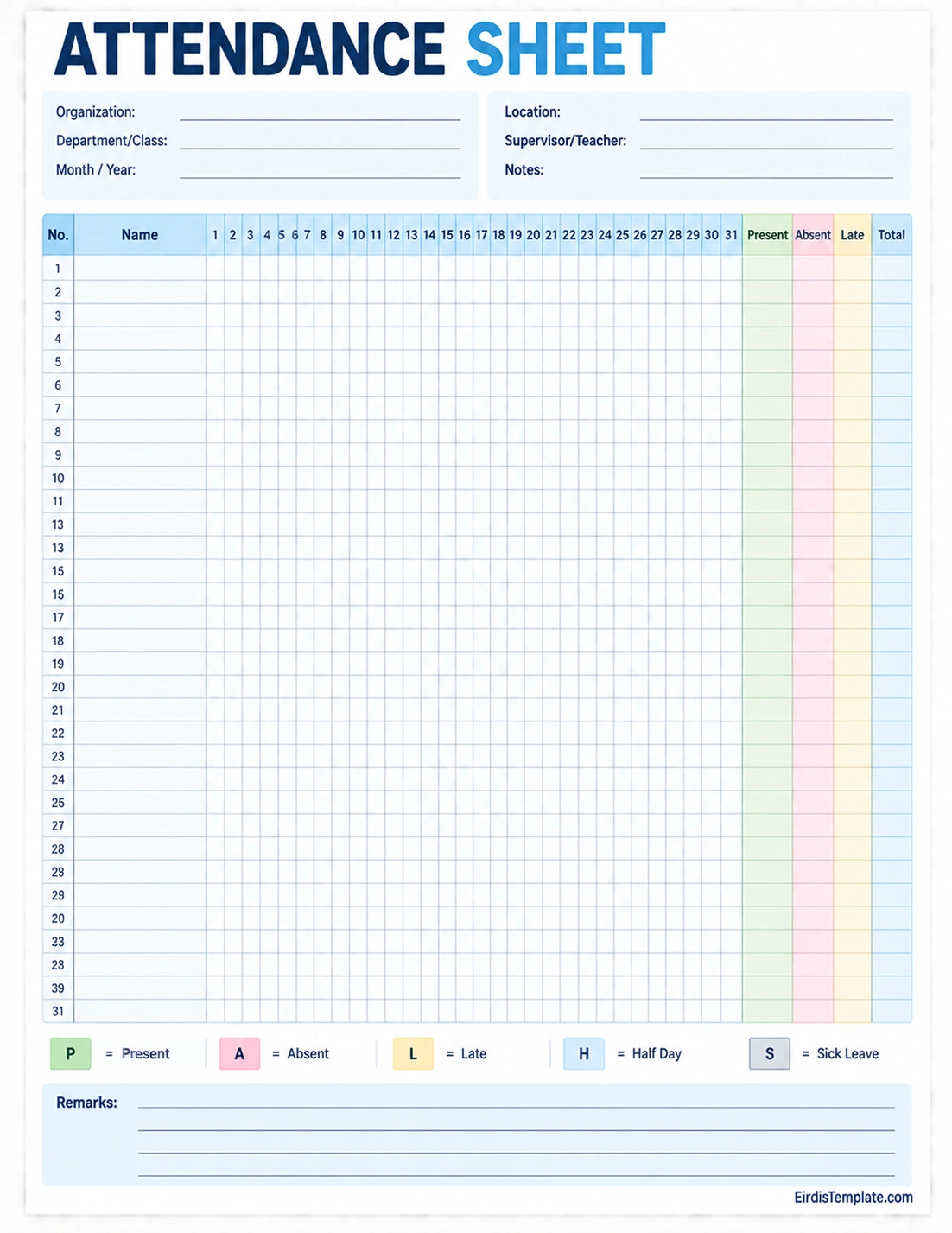
A practical monthly attendance template can include a row for each individual and columns for the days of the month. Attendance codes can then be used to record the status for each day.
For example, an organization might use:
- P = Present
- A = Absent
- L = Late
- H = Half Day
- S = Sick Leave
The exact codes should be explained clearly in a legend so that everyone using the attendance record understands them consistently.
Types of Attendance Sheets
Different situations require different approaches to attendance tracking. Choosing the right format can make the record more useful and easier to maintain.
Employee Attendance Sheet
An employee attendance sheet tracks the presence and absence of workers. It may include regular working days, late arrivals, approved leave, sick days, and other relevant attendance information.
For organizations that also need to track working hours, a separate timesheet may be more appropriate because an attendance sheet and a timesheet serve different purposes.
Student Attendance Sheet
A student attendance sheet is commonly used by teachers and schools to record daily classroom attendance. It may include student names, dates, attendance status, and notes for unusual circumstances.
Training Attendance Sheet
A training attendance sheet records participants who attend a workshop, seminar, orientation, or professional development session. It may include participant names, session dates, departments, and signatures.
Meeting Attendance Sheet
A meeting attendance sheet provides a record of who attended a meeting or organizational event. A signature field can be useful when participants need to confirm their presence.
Daily Attendance Sheet
A daily attendance sheet focuses on one specific day. This format works well when attendance is collected separately for each class, shift, meeting, event, or training session.
Monthly Attendance Sheet
A monthly attendance sheet provides a broader view of attendance. It typically lists individuals vertically and dates horizontally, making it possible to review attendance across an entire month.
How to Use an Attendance Sheet
Using an attendance sheet consistently is more important than simply having one. A simple process can help keep attendance records accurate.
Step 1: Add the Basic Information
Enter the organization or class name, department, month, year, supervisor, teacher, or other relevant information before recording attendance.
Step 2: List Everyone Being Tracked
Add the names of employees, students, trainees, or participants. Keep the spelling consistent with your official records to make later comparisons easier.
Step 3: Record Attendance Daily
Mark the appropriate attendance status as soon as possible. Recording attendance consistently reduces the chance of forgetting or incorrectly reconstructing attendance later.
Step 4: Record Exceptions Clearly
If someone is late, absent, on approved leave, or has another attendance status, use the appropriate code or note. Avoid creating informal abbreviations that other people may not understand.
Step 5: Review the Record
At the end of the week or month, review the attendance sheet for missing entries, unclear marks, duplicate names, or other errors. Correct mistakes according to your organization’s recordkeeping procedures.
Tips for Maintaining Accurate Attendance Records
A good attendance tracker should be easy to understand and consistently maintained. The following practices can improve accuracy.
- Use consistent attendance codes: Define the meaning of each abbreviation before using it.
- Record attendance promptly: Complete the sheet during or immediately after the relevant session or work period.
- Keep names consistent: Use the same spelling and order throughout your records.
- Avoid unclear marks: Make handwritten entries legible if the form is printed.
- Review entries regularly: Check the record for missing or inconsistent information.
- Keep supporting documentation: When appropriate, retain approved leave requests or other records according to organizational procedures.
- Protect personal information: Store attendance records securely and limit access to people who need the information.
- Use one standard format: A consistent attendance form makes records easier to compare over time.
Attendance Sheet vs. Timesheet
An attendance sheet and a timesheet are related but are not always interchangeable.
An attendance sheet generally answers the question, “Was this person present?” It may track present, absent, late, or leave status.
A timesheet typically focuses on “How much time did this person work?” It may record start time, end time, breaks, total hours, project codes, or specific tasks.
If an organization only needs to know whether someone attended, an attendance sheet may be sufficient. If it needs detailed working-hour information, a timesheet or time-tracking system may be more appropriate.
Digital vs. Printable Attendance Sheets
Both digital and printable attendance records can be useful. The right choice depends on the environment and workflow.
Printable Attendance Sheets
A printable attendance sheet is useful when attendance is recorded manually in classrooms, workshops, meetings, small offices, or events. It is simple to distribute and does not require a computer or specialized software during the attendance process.
Digital Attendance Sheets
A digital attendance tracker can make calculations, sorting, filtering, reporting, and long-term storage easier. Spreadsheet-based systems can also automatically calculate attendance totals when properly configured.
For larger organizations, dedicated attendance management software may provide additional features such as automated reports, permissions, notifications, and integrations.
Common Attendance Tracking Mistakes
Even a well-designed attendance form can produce unreliable records if it is not used consistently. Some common mistakes include:
- Leaving attendance entries blank without an explanation
- Using different codes for the same attendance status
- Recording attendance several days later from memory
- Failing to distinguish approved leave from unexcused absence
- Not reviewing the completed sheet for errors
- Allowing unauthorized people to modify attendance records
- Using a form that does not match the organization’s actual attendance requirements
Creating a simple standard procedure for completing and reviewing the attendance sheet can prevent many of these problems.
Frequently Asked Questions About Attendance Sheets
What is the purpose of an attendance sheet?
The purpose of an attendance sheet is to systematically record attendance information. It helps track presence, absence, lateness, leave, and other relevant attendance statuses for a defined group and period.
What is usually included in an attendance sheet?
A typical attendance sheet includes the names of individuals, attendance dates, attendance codes or statuses, totals, and a section for notes or remarks. Additional fields can be added depending on the organization’s needs.
Can I use an attendance sheet for employees?
Yes. An employee attendance sheet can be used to record daily presence, absence, lateness, leave, and other attendance information. Organizations should ensure that their recordkeeping practices comply with applicable workplace policies and requirements.
Can an attendance sheet be used for students?
Yes. A student attendance sheet is commonly used to record classroom attendance by date. Teachers can use it to maintain an organized record and identify attendance patterns that may require follow-up.
What is the difference between attendance and a timesheet?
Attendance records generally indicate whether someone was present or absent, while a timesheet typically records the amount of time worked or spent on specific activities. Some organizations may use both documents.
How often should an attendance sheet be updated?
Attendance should generally be recorded as close as possible to the time the attendance event occurs. Daily recording is often the simplest approach, although the appropriate schedule depends on the organization and purpose of the record.
Can I print an attendance sheet?
Yes. A printable attendance sheet can be used for classrooms, offices, training sessions, meetings, events, and other situations where attendance is recorded manually. A monthly layout is especially useful for tracking attendance across multiple dates.
Conclusion
An attendance sheet is a practical tool for keeping attendance information organized, consistent, and easy to review. Whether it is used for employees, students, training participants, meetings, or events, a clear attendance record can improve accountability and simplify administrative work.
The most effective attendance sheet is one that matches the purpose of the record, uses clear attendance codes, is updated consistently, and is stored securely. A printable attendance sheet template can provide a convenient starting point for creating a reliable attendance tracking system without unnecessary complexity.
Download: Attendance Sheet Template

- Free Printable Attendance Sheet Template - October 5, 2026
- Asset Purchase Agreement Template (Word) - October 5, 2026
- Free Annual Budget Template (Excel) - October 5, 2026
