A bank statement is an official record of the activity in a bank account over a specific period. It typically lists deposits, withdrawals, transfers, payments, fees, balances, and other transactions. By reviewing a bank statement, account holders can understand how money moved through their account and confirm that the recorded transactions are accurate.
Bank statements are useful for everyday financial management as well as important financial tasks. People may review them to track spending, identify unauthorized transactions, reconcile an account, prepare tax records, or provide proof of financial activity when applying for certain financial services.
Understanding how to read a bank statement can make personal and business financial management much easier. The following guide explains what a bank statement contains, how to read one, why it is important, and how to use it effectively.
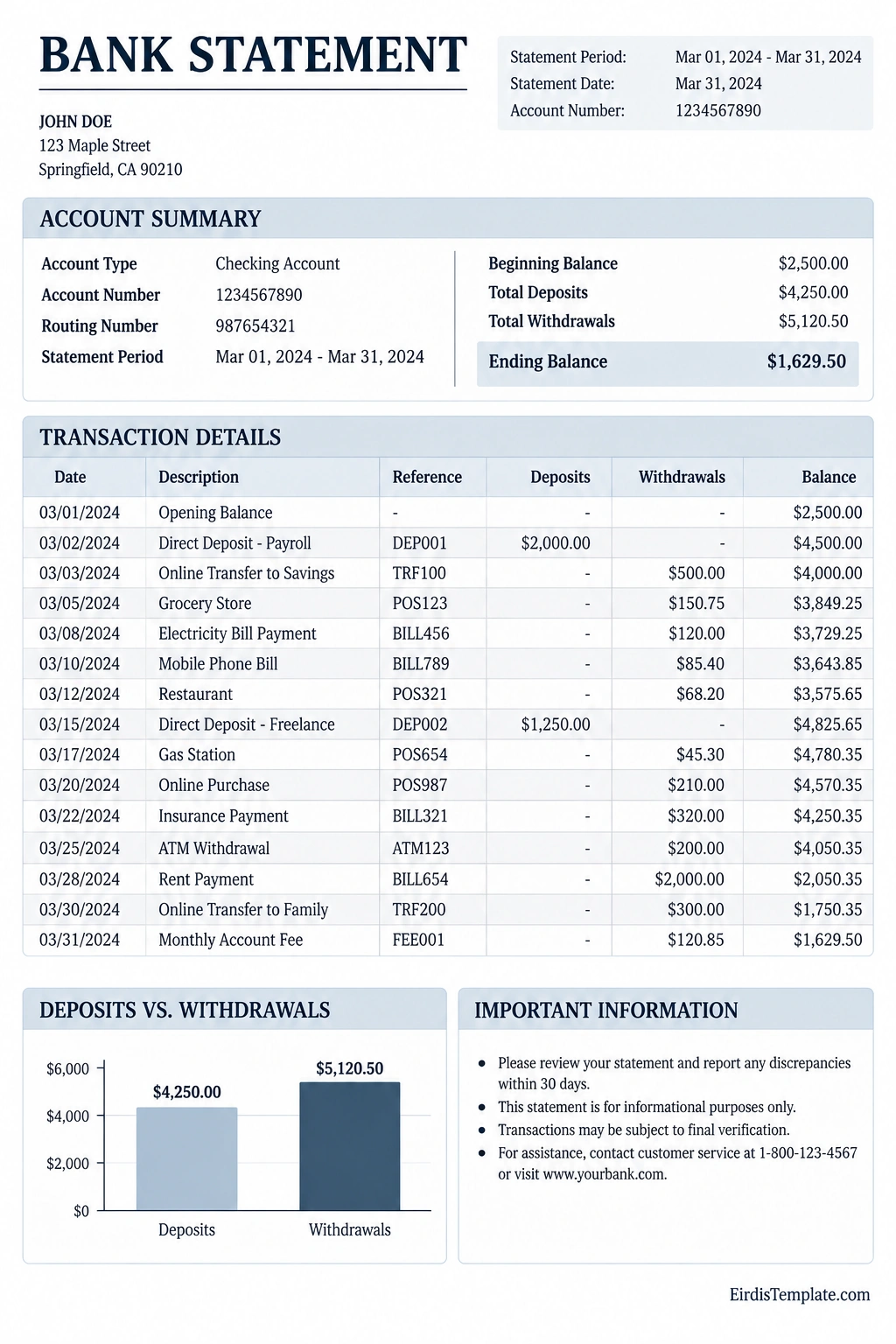
What Is a Bank Statement?
A bank statement is a document issued by a bank or financial institution that summarizes the activity of a specific account during a defined statement period. It provides a chronological record of transactions and usually includes important account information such as the account holder, account type, statement dates, and account balance.
Depending on the bank and account type, a statement may be delivered as a printed document, downloadable PDF, electronic document, or online account record.
A typical statement may show:
- Beginning balance: The amount in the account at the start of the statement period.
- Deposits: Money added to the account.
- Withdrawals: Money removed from the account.
- Transfers: Money moved between accounts.
- Payments: Transactions used to pay bills, purchases, or other expenses.
- Fees: Charges applied by the financial institution.
- Ending balance: The account balance at the end of the statement period.
What Does a Bank Statement Show?
The exact layout varies between financial institutions, but most bank statements contain similar categories of information. Learning what each section means makes it easier to review the document and identify unusual activity.
Account Information
The first section usually identifies the account and the statement period. It may include the account holder’s name, mailing address, account type, partial account number, and the dates covered by the statement.
Some statements also display a statement date, customer service information, routing information, or other account identifiers.
Account Summary
An account summary provides a quick overview of the financial activity during the statement period. It may show the beginning balance, total deposits, total withdrawals, and ending balance.
This section is particularly useful when you want to understand the overall movement of money without reviewing every individual transaction.
Transaction History
The transaction section provides a detailed list of account activity. Each transaction may include a date, description, reference number, amount, and resulting balance.
Depending on the account, transactions may include direct deposits, ATM withdrawals, debit card purchases, electronic transfers, bill payments, checks, interest payments, and account fees.
How to Read a Bank Statement
Reading a bank statement becomes easier when you review it in a consistent order. Instead of looking at individual transactions randomly, start with the account information and then work through the summary and transaction details.
1. Check the Statement Period
First, confirm the beginning and ending dates of the statement. The statement period tells you which transactions should appear in the document.
For example, a monthly bank statement may cover transactions from the first day through the last day of a particular month.
2. Review the Beginning Balance
The beginning balance shows how much money was in the account at the start of the statement period. Compare it with the ending balance from the previous statement when possible.
If the amounts do not appear to match, review previous transactions or contact the financial institution for clarification.
3. Review Deposits and Credits
Next, review money added to the account. Deposits may come from an employer, customer payments, transfers from another account, refunds, interest, or other sources.
Make sure expected deposits appear correctly and investigate any unfamiliar credit.
4. Review Withdrawals and Debits
Examine money that left the account. Look for purchases, ATM withdrawals, bill payments, transfers, checks, and recurring charges.
Pay particular attention to transactions that you do not recognize. An unfamiliar transaction does not automatically mean fraud, because it could be a merchant using a different business name or a recurring service you forgot about. However, it should be investigated.
5. Confirm the Ending Balance
The ending balance represents the account balance at the end of the statement period according to the bank’s records. Confirm that it makes sense based on the deposits, withdrawals, and other transactions shown on the statement.
Why Is a Bank Statement Important?
A bank statement provides more than a list of transactions. It can serve as an important financial record that helps individuals and businesses maintain accurate financial information.
Track Spending
Reviewing transaction history can reveal where money is being spent. Grouping expenses into categories such as housing, food, transportation, subscriptions, and entertainment can help identify spending patterns.
Detect Errors and Unauthorized Transactions
Regularly reviewing a bank statement can help you spot transactions that appear incorrect or unfamiliar. Early detection gives you an opportunity to contact the bank and investigate the issue.
Reconcile Your Account
Account reconciliation involves comparing your personal or business records with the transactions recorded by the bank. This can help identify missing transactions, recording mistakes, duplicate entries, or unexpected fees.
Document Financial Activity
A bank statement can provide documentation of financial activity when appropriate. Depending on the situation and the institution requesting the information, statements may be used to support applications or demonstrate account activity.
When Might You Need a Bank Statement?
There are many situations in which a person or organization may request a bank statement. The exact requirements depend on the purpose and the organization involved.
- Loan applications: Financial institutions may request statements as part of an application.
- Mortgage applications: Applicants may need financial documentation during the lending process.
- Rental applications: A landlord or property manager may request proof of financial resources.
- Tax preparation: Statements can help organize and verify financial transactions.
- Business accounting: Businesses can use statements to reconcile bank activity with accounting records.
- Financial planning: Transaction history can help identify spending patterns and recurring expenses.
- Proof of funds: Certain applications may require documentation showing available financial resources.
- Record keeping: Statements provide a historical record of account activity.
Bank Statement vs. Transaction History
A bank statement and an online transaction history may contain similar information, but they are not always the same document.
A transaction history is often a live or continuously updated list of recent account activity available through online banking. A bank statement, on the other hand, generally represents an official statement period and is issued by the financial institution.
When an organization specifically asks for a bank statement, it is important to check whether it requires an official statement rather than a screenshot or manually created transaction list.
Paper Bank Statements vs. Electronic Statements
Many banks offer customers a choice between paper statements and electronic statements. Electronic statements are commonly available through online banking and may be downloaded as PDF files.
Paper Statements
Paper statements are physical documents mailed or provided to the account holder. They can be useful for people who prefer physical records, but they require storage space and can be more difficult to organize over many years.
Electronic Statements
Electronic statements are generally easier to store, search, and retrieve. A customer can often download a statement and keep it in a secure digital folder for future reference.
Regardless of the format, financial documents should be stored securely because they may contain sensitive personal and account information.
How to Check a Bank Statement for Errors
Reviewing a bank statement regularly can help you catch discrepancies before they become difficult to resolve. A simple review process can make this task more manageable.
- Confirm the statement period.
- Compare the beginning balance with your previous records.
- Check expected deposits and incoming transfers.
- Review withdrawals, purchases, and outgoing transfers.
- Look for duplicate transactions.
- Check account fees and other charges.
- Investigate unfamiliar transactions.
- Compare the ending balance with your own records.
- Contact the financial institution when something appears incorrect.
How to Organize Bank Statements
Organizing bank statements can make financial management much easier, especially when you need to find an older record.
Use Consistent File Names
For digital statements, use a consistent naming system such as the financial institution name, account type, and statement month. This makes files easier to locate later.
Create Monthly Folders
Organize statements chronologically using folders by year and month. This approach works well for both personal and business records.
Protect Sensitive Information
Bank statements may contain account numbers, addresses, transaction information, and other sensitive details. Store physical documents securely and use appropriate security measures for digital files.
What Is a Bank Statement Template?
A bank statement template is a document layout designed to demonstrate or organize the typical information found on a bank statement. A sample may include sections for account details, statement dates, balances, transaction descriptions, deposits, withdrawals, and other information.
Templates can be useful for educational purposes, document design demonstrations, accounting exercises, or explaining the structure of a financial statement.
However, a template or sample document should not be presented as an authentic statement issued by a real financial institution. Official financial records should always come directly from the appropriate bank or financial institution.
Tips for Reviewing Your Bank Statement
A few simple habits can make statement reviews faster and more effective.
- Review statements regularly: Do not wait until you need a financial document to examine your account activity.
- Know your recurring payments: Keep track of subscriptions, utilities, insurance, and other automatic charges.
- Investigate unfamiliar transactions: Check the transaction description and contact the bank when necessary.
- Compare statements with your budget: Use actual transaction data to improve your spending plan.
- Keep important records: Store statements according to your personal or business record-keeping needs.
- Protect your information: Avoid sharing complete bank statements publicly or with unverified individuals.
Frequently Asked Questions About Bank Statements
What is a bank statement?
A bank statement is a record of transactions and account activity for a specific period. It typically includes deposits, withdrawals, transfers, fees, beginning balances, and ending balances.
How often do banks provide statements?
Many banks provide statements monthly, although the exact frequency depends on the financial institution, account type, and customer’s preferences. Electronic statements may be available through online banking.
What information is included on a bank statement?
A bank statement commonly includes the account holder’s information, statement period, account type, transaction dates, descriptions, deposits, withdrawals, fees, and account balances.
Can a bank statement be used as proof of income?
A bank statement can show deposits and financial activity, but it is not necessarily the same as formal proof of income. Whether it is accepted depends on the organization and the specific requirements of the application.
Can a bank statement be used as proof of address?
In some situations, a bank statement may be accepted as proof of address if it displays the account holder’s name and address. Requirements vary by organization, so it is important to confirm which documents are accepted.
How can I get a bank statement?
You can generally obtain a bank statement through online banking, a mobile banking application, a bank branch, or by requesting one from the financial institution. Availability and delivery options vary by bank.
How long should I keep bank statements?
The appropriate retention period depends on the purpose of the records, applicable laws, tax requirements, and personal or business circumstances. Keep important financial documents securely and follow the applicable record-keeping guidance for your situation.
What should I do if I see an unfamiliar transaction?
Review the transaction description first to determine whether it may be a merchant name, subscription, transfer, or other transaction you recognize. If it still appears unfamiliar, contact your bank or financial institution promptly and follow its procedures for reporting potentially unauthorized activity.
Conclusion
A bank statement is an important financial record that provides a clear view of account activity over a specific period. By showing deposits, withdrawals, transfers, fees, and balances, it helps account holders monitor spending, reconcile records, identify potential errors, and maintain organized financial documentation.
Learning how to read and organize a bank statement can make personal and business financial management easier. Whether you are reviewing everyday spending, preparing financial records, or responding to a legitimate documentation request, understanding the information on your statement allows you to use this important financial record more effectively.
Download: Bank Statement Template

- Printable Bill of Lading Form Template - October 8, 2026
- Free Behavior Contract Template (Word) - October 8, 2026
- Free Printable Baseball Schedule Template - October 8, 2026
