A Teacher Letter of Recommendation is a formal document in which a teacher provides a personal and academic assessment of a student. It can help colleges, universities, scholarship committees, employers, and other organizations understand an applicant beyond grades, test scores, and other standard application information.
Because teachers observe students in an academic environment, they can provide valuable insight into learning habits, classroom participation, character, responsibility, communication skills, and potential. A thoughtful recommendation letter combines these observations with specific examples to create a credible and meaningful picture of the student.
What Is a Teacher Letter of Recommendation?
A Teacher Letter of Recommendation is a written statement from a teacher who knows a student through classroom instruction, academic projects, extracurricular activities, or another educational setting. The letter explains the student’s strengths, achievements, personal qualities, and potential for success in a new academic or professional environment.
Unlike a transcript, which primarily records academic results, a recommendation letter provides context. A teacher can explain how a student approaches challenging assignments, contributes to discussions, works with classmates, responds to feedback, or demonstrates persistence when facing difficulties.
The strongest letters are usually specific and personal. Rather than simply describing a student as “hardworking” or “intelligent,” the writer can provide a brief example that demonstrates those qualities.
Why Is a Teacher Recommendation Letter Important?
A recommendation letter can add a personal perspective to an application. Academic records show measurable accomplishments, while a teacher’s recommendation can describe behaviors and qualities that may not appear elsewhere in the application.
- Provides personal context: The teacher can explain how the student performs and behaves in an academic setting.
- Highlights academic strengths: The letter can discuss subjects, skills, projects, or learning habits in which the student excels.
- Demonstrates character: Specific observations can illustrate responsibility, integrity, perseverance, collaboration, or leadership.
- Supports application goals: The recommendation can connect relevant student qualities to the opportunity being pursued.
- Adds credibility: A detailed assessment from a teacher can provide an independent perspective on the applicant.
Who Can Write a Teacher Letter of Recommendation?
The most appropriate writer is generally a teacher who knows the student well enough to provide meaningful and specific observations. The best choice depends on the requirements of the application and the relationship between the student and teacher.
A subject teacher may be particularly useful when the student is applying to a program related to that subject. For example, a mathematics teacher may be able to provide relevant observations for a student applying to an engineering or mathematics program.
Other educators may also be appropriate depending on the application requirements. Before requesting a letter, students should check whether the school, college, scholarship, employer, or organization specifies who may provide a recommendation.
What Should a Teacher Letter of Recommendation Include?
A professional recommendation letter should have a clear structure. The writer should provide enough information to establish their relationship with the student and then explain why the student is a strong candidate.
Teacher and School Information
The letter can begin with the teacher’s name, professional title, school name, contact information, and date. Official school letterhead may be appropriate when required or permitted.
Recipient Information
When the recipient is known, address the letter to the appropriate person or committee. If no individual recipient is provided, a professional general greeting can be used.
Relationship With the Student
Explain how the teacher knows the student. Mention the subject or course taught, the approximate period of instruction, and any other relevant context that establishes the basis for the recommendation.
Academic Strengths
Discuss meaningful academic qualities that the teacher has personally observed. These may include analytical thinking, research ability, creativity, writing skills, problem-solving, curiosity, or consistent engagement with coursework.
Personal Qualities
A recommendation can also describe characteristics that contribute to the student’s success. Depending on the student, these might include reliability, initiative, empathy, teamwork, leadership, resilience, or willingness to learn.
Specific Examples
Examples are often more persuasive than general statements. Describe a project, classroom situation, academic achievement, leadership experience, or challenge that demonstrates the student’s qualities.
Closing Recommendation
End with a clear statement of support. The teacher can summarize the student’s relevant strengths and explain why those qualities make the student suitable for the opportunity, based on the writer’s direct knowledge.
Teacher Letter of Recommendation Template
A Teacher Letter of Recommendation Template provides a structured starting point for writing a professional recommendation. It can help the teacher organize the student’s academic strengths, personal qualities, specific examples, and closing recommendation without overlooking important details.
A useful template should remain flexible rather than forcing every student into the same wording. The strongest recommendation letters should be personalized to reflect the teacher’s genuine observations and the student’s individual characteristics.
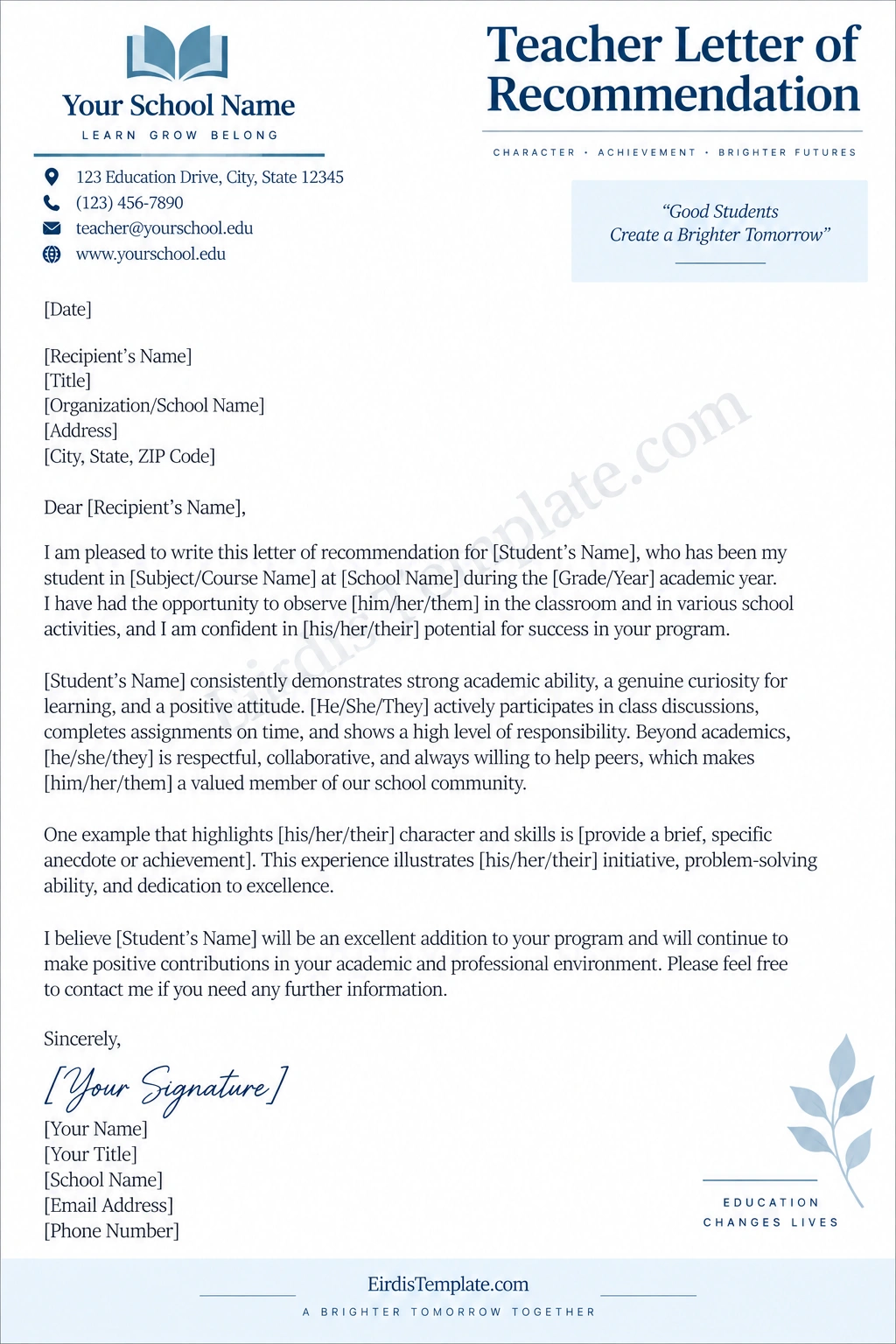
The template below includes space for school information, recipient details, the teacher’s relationship with the student, academic and personal observations, a specific example, the final recommendation, and the teacher’s signature and contact information.
How to Write a Teacher Letter of Recommendation
Writing an effective recommendation requires thoughtful preparation. The teacher should focus on information they can personally support rather than relying on vague or exaggerated descriptions.
1. Confirm the Purpose of the Letter
First, determine what the student is applying for. A college application, scholarship, internship, employment opportunity, or academic program may require different emphasis. Understanding the purpose helps the writer select the most relevant examples.
2. Review the Student’s Information
Ask the student for useful background information when appropriate. This may include the opportunity description, application requirements, résumé, academic interests, accomplishments, extracurricular activities, or a personal statement.
This information should supplement the teacher’s own observations rather than replace them. The letter should remain authentic to the writer’s experience with the student.
3. Identify Two or Three Strong Qualities
Rather than attempting to describe every positive characteristic, choose a few qualities that are particularly relevant. Strong qualities are easier to communicate when each one can be supported with a specific example.
4. Add Specific Evidence
Think of moments when the student demonstrated the qualities being discussed. A successful research project, difficult assignment, group activity, class presentation, or independent initiative can provide useful evidence.
5. Connect the Examples to Future Potential
Explain what the examples reveal about the student’s potential. For example, a student who independently solved a difficult problem may demonstrate initiative and persistence that could be valuable in future academic work.
6. End With a Professional Recommendation
Conclude by summarizing the student’s relevant strengths and expressing your professional assessment. Include contact information if the recipient may need additional information.
How Long Should a Teacher Recommendation Letter Be?
There is no universal length that applies to every recommendation letter. The application instructions should always take priority. If no specific requirement is provided, a concise letter that provides meaningful evidence is generally more useful than a long letter filled with repetition.
A well-developed recommendation can often communicate the student’s qualities effectively within a few paragraphs. Focus on relevant observations, concrete examples, and a clear connection between the student’s strengths and the opportunity.
What Makes a Teacher Recommendation Letter Effective?
An effective recommendation should sound authentic. Readers should be able to understand not only what the teacher thinks about the student but also why the teacher reached that conclusion.
- Personal: Include observations based on the teacher’s actual experience with the student.
- Specific: Support important claims with concrete examples.
- Relevant: Focus on qualities related to the opportunity.
- Balanced: Present a realistic and credible assessment rather than excessive praise.
- Professional: Use an appropriate tone and clear organization.
- Authentic: Write in the teacher’s own voice and avoid generic language.
- Concise: Remove repetition and keep the focus on meaningful information.
Common Mistakes to Avoid
A recommendation letter can lose its impact when it relies on generic statements or lacks evidence. Before submitting the letter, review it carefully for clarity, accuracy, and relevance.
- Using the same generic description for every student.
- Making broad claims without providing examples.
- Repeating information already obvious from the student’s transcript.
- Including irrelevant personal information.
- Using exaggerated language that does not sound credible.
- Failing to address the correct recipient or opportunity.
- Making spelling, grammar, or formatting errors.
- Missing the submission deadline or application instructions.
Tips for Students Requesting a Teacher Recommendation
Students can make the process easier by giving the teacher sufficient time and useful information. A thoughtful request allows the teacher to decide whether they know the student well enough to provide a meaningful recommendation.
- Ask early: Give the teacher reasonable time to write the letter.
- Explain the opportunity: Share what the recommendation is for and why it matters.
- Provide relevant information: Supply application instructions, deadlines, résumé details, or other helpful materials.
- Choose someone who knows you well: A teacher with meaningful firsthand experience can usually provide more specific observations.
- Respect the teacher’s decision: Give the teacher an opportunity to decline if they cannot provide a strong recommendation.
- Follow up professionally: Confirm submission requirements without creating unnecessary pressure.
- Say thank you: Acknowledge the teacher’s time and effort after the letter has been completed.
Teacher Recommendation Letter for College Applications
For college applications, a teacher recommendation can provide insight into the student’s academic engagement and classroom behavior. The letter may discuss intellectual curiosity, participation, academic growth, collaboration, persistence, or other characteristics relevant to the student’s educational goals.
The teacher should follow the specific requirements of the college or application platform. If the application asks for particular information, the recommendation should address those requirements while remaining truthful and based on direct observations.
Teacher Recommendation Letter for Scholarships
Scholarship applications may ask teachers to comment on academic achievement, leadership, service, character, potential, or other selection criteria. Before writing the letter, the teacher should review the scholarship requirements and identify examples that are genuinely relevant.
A specific story can help demonstrate a student’s qualities more effectively than a list of adjectives. For example, describing how a student took initiative during a project can provide evidence of leadership or responsibility when those qualities are relevant to the scholarship.
Teacher Recommendation Letter for Employment
A teacher may also be asked to recommend a student or recent graduate for employment. In this situation, the letter can focus on transferable skills such as communication, reliability, organization, teamwork, problem-solving, initiative, and the ability to learn new tasks.
The writer should avoid claiming professional experience they did not directly observe. Instead, connect classroom behaviors to relevant skills when there is a reasonable basis for doing so.
Teacher Letter of Recommendation Checklist
Use this checklist before completing a recommendation letter:
- Confirm the purpose of the recommendation.
- Check the recipient and submission requirements.
- Include the teacher’s professional information.
- Explain the relationship with the student.
- Identify relevant academic strengths.
- Describe meaningful personal qualities.
- Include specific examples or anecdotes.
- Connect the student’s qualities to future potential.
- Provide a clear closing recommendation.
- Check names, dates, spelling, and contact information.
- Follow formatting and submission instructions.
- Maintain appropriate confidentiality and professionalism.
Final Thoughts
A Teacher Letter of Recommendation gives colleges, scholarship committees, employers, and other organizations a valuable perspective that cannot always be captured by grades and test scores alone. A teacher can describe classroom performance, academic habits, personal qualities, and specific experiences that help demonstrate the student’s potential.
The most effective recommendation letters are specific, relevant, professional, and authentic. A Teacher Letter of Recommendation Template can make the writing process easier by providing a clear structure, but the content should always be customized to reflect the individual student and the teacher’s firsthand experience.
By focusing on meaningful qualities, supporting those qualities with concrete examples, and following the requirements of the intended recipient, a teacher can create a recommendation that provides useful context and a credible assessment of the student’s academic and personal potential.
Download: Teacher Letter of Recommendation Template

- Teacher Letter of Recommendation Template - September 17, 2026
- Free Printable Treatment Plan Template - September 17, 2026
- Free Printable Service Invoice Template - September 17, 2026
