Buying a house together is an exciting milestone, but unmarried couples should plan for more than the purchase itself. A cohabitation agreement for buying a house helps two people establish clear expectations about property ownership, financial contributions, household expenses, and what happens if they stop living together.
Whether you are an unmarried couple, close friends, or family members purchasing a home together, a written property agreement can help protect everyone’s financial interests. It can also reduce misunderstandings by documenting who contributes what and how important decisions will be made.
Before signing a mortgage or transferring money toward a down payment, it is worth discussing the details of your shared investment. This guide explains what a cohabitation agreement should include, why it matters, and how to prepare one before buying a home.
What Is a Cohabitation Agreement for Buying a House?
A cohabitation agreement is a written contract between two people who live together or plan to share a home without being legally married. When used for a property purchase, it outlines each person’s ownership interest, financial responsibilities, and rights concerning the house.
The agreement can address both everyday arrangements and major financial decisions. For example, it may explain how partners will divide mortgage payments, pay for repairs, manage renovations, and distribute the proceeds if the property is sold.
Unlike a verbal understanding, a written agreement provides a record of what both parties have accepted. However, its legal requirements and enforceability depend on the applicable state law and the circumstances of the agreement.
Why Do Unmarried Couples Need a House Purchase Agreement?
Unmarried homeowners may not receive the same property protections that apply to married couples during divorce. Without a clear agreement, disagreements about ownership and financial contributions can become complicated if one person moves out or the relationship ends.
A cohabitation agreement can help address several important concerns.
- Ownership clarity: It identifies each person’s ownership percentage and financial interest in the property.
- Financial protection: It documents down payments, mortgage contributions, closing costs, and other expenses.
- Shared responsibilities: It explains who pays property taxes, insurance, utilities, and maintenance costs.
- Dispute prevention: It establishes a process for handling disagreements about the home.
- Separation planning: It provides options for selling the property or allowing one person to buy out the other’s share.
Planning these arrangements before purchasing a home can help both parties understand their responsibilities from the beginning.
What Should a Cohabitation Agreement Include?
A well-prepared cohabitation agreement should reflect the actual financial arrangement between the people buying the property. Although every situation is different, several essential sections deserve attention.
1. Names and Personal Information
Start by identifying both parties using their full legal names and current addresses. The agreement should also include the date it becomes effective.
If other people will have an ownership interest in the property, they should be properly identified and included in the relevant legal documents.
2. Property Description and Purchase Details
Clearly identify the house being purchased. Include its complete street address and any available legal property description.
Other useful details include:
- Expected or final purchase price.
- Estimated closing date.
- Type of property, such as a house, condominium, or townhouse.
- Mortgage lender and loan details, when available.
- Names of the individuals listed on the property deed.
Accurate property information helps prevent confusion about which asset the agreement covers.
3. Ownership Percentages
One of the most important provisions is the ownership arrangement. Decide whether both parties will own equal shares or whether their percentages will reflect different financial contributions.
For example, one person might own 60% of the property while the other owns 40%. Alternatively, both may agree to equal 50/50 ownership even if their initial contributions are different.
The agreement should clearly state the intended ownership percentages. It should also match the deed and any applicable declaration of trust or other property documents.
4. Down Payment and Closing Costs
Document how much each person contributes toward the initial purchase. The down payment and closing costs can represent a substantial investment, so both parties should agree on how these payments affect their financial interests.
For example, if Partner A contributes $30,000 and Partner B contributes $20,000, the agreement should explain whether these amounts create different ownership shares, are treated as loans, or are simply agreed contributions toward a jointly owned home.
Keep payment records, bank statements, receipts, and closing documents to support the agreed arrangement.
5. Mortgage Payments and Monthly Expenses
Explain how ongoing housing expenses will be divided. Some homeowners prefer an equal arrangement, while others divide costs according to income or ownership percentages.
Consider including the following expenses:
- Monthly mortgage principal and interest.
- Property taxes.
- Homeowners insurance.
- Utilities and internet services.
- Routine maintenance and repairs.
- Homeowners association fees, if applicable.
Also explain what happens if one person cannot make an agreed payment. The agreement should distinguish between missed contributions, loans between the parties, and changes to ownership interests.
6. Repairs, Renovations, and Improvements
Home improvements can increase a property’s value, but they can also create disagreements when one person pays more than the other.
Decide how major renovations and unexpected repairs will be approved and funded. You may also specify whether a large financial contribution toward an improvement will be reimbursed or credited when calculating each person’s share of the property.
For significant projects, keep written estimates, invoices, receipts, and proof of payment.
7. Property Management and Important Decisions
Explain how both parties will manage the property. Routine decisions may be handled individually, but major financial decisions should generally require an agreed approval process.
Consider establishing rules for:
- Major renovations and remodeling.
- Refinancing or obtaining additional financing.
- Renting the property to another person.
- Selling or transferring an ownership interest.
- Hiring contractors for significant work.
Clear decision-making rules can prevent one person from making important property decisions without consulting the other owner.
What Happens If the Relationship Ends?
A separation plan is one of the most valuable parts of a cohabitation agreement. Even when both people expect to live together for many years, it is sensible to discuss what happens if their circumstances change.
There are several possible arrangements.
Option 1: One Person Buys Out the Other
One party may choose to remain in the house and purchase the other person’s ownership interest. The agreement should explain how the property’s fair market value will be determined, how outstanding mortgage debt will be considered, and when the buyout must be completed.
It should also address whether the remaining owner must refinance the mortgage to release the departing person from loan obligations. A private agreement alone does not remove anyone from a mortgage contract.
Option 2: Sell the Property and Divide the Proceeds
Another option is to sell the house and distribute the remaining proceeds according to the agreed ownership arrangement.
The agreement should explain how selling costs, mortgage balances, unpaid expenses, and any agreed reimbursements will be handled before the remaining proceeds are distributed.
Option 3: Temporary Shared Ownership
In some situations, the parties may agree to maintain joint ownership for a limited period after separating. For example, they might wait until the property can be sold under more favorable circumstances.
If this option is selected, establish who will occupy the home, who will pay the mortgage, and how maintenance expenses will be handled during the transition.
Important Legal Considerations Before Signing
A cohabitation agreement can provide valuable protection, but it should not be treated as a substitute for every legal document involved in purchasing a house.
Understand the Difference Between a Deed and a Mortgage
The property deed identifies the legal owners, while the mortgage agreement establishes the borrowers’ obligations to the lender. These documents serve different purposes.
For example, a person might have an ownership interest in a property without being personally responsible for the mortgage, depending on the transaction and applicable rules. Similarly, signing a mortgage does not automatically establish the ownership percentage that the parties intend.
Make sure the deed, mortgage arrangements, and cohabitation agreement are consistent with the intended purchase structure.
Choose the Appropriate Ownership Structure
In the United States, unmarried co-owners commonly consider two ownership arrangements:
- Joint tenancy with right of survivorship: Depending on state law and the deed, the surviving joint owner may automatically receive the deceased owner’s interest.
- Tenancy in common: Each owner holds a separate ownership interest. The interest may pass through a will or applicable inheritance laws rather than automatically transferring to the other owner.
The appropriate choice depends on the parties’ intentions, estate planning goals, and state law. Ask a real estate attorney to explain the consequences before selecting an arrangement.
Get Independent Legal Advice
Both parties should have an opportunity to obtain independent legal advice before signing. An attorney can review the agreement, explain state-specific requirements, and identify provisions that may need additional documentation.
Depending on the jurisdiction, formalities such as written terms, signatures, notarization, witnesses, or other requirements may apply. Do not assume that simply signing a generic template guarantees enforceability.
How to Prepare a Cohabitation Agreement Before Buying a House
Preparing an agreement does not have to be complicated. Following a practical process can help both parties discuss important details before committing to a major purchase.
- Step 1: Discuss your financial expectations, including down payments, mortgage contributions, and ownership percentages.
- Step 2: Gather property details, purchase estimates, and relevant financial records.
- Step 3: Decide how ongoing expenses, repairs, and major decisions will be managed.
- Step 4: Agree on what happens if one person wants to leave, sell, or buy out the other person’s share.
- Step 5: Put the agreed terms into a written cohabitation agreement.
- Step 6: Ask qualified attorneys to review the arrangement and ensure the property documents are consistent.
- Step 7: Sign and retain the final documents according to applicable legal requirements.
It is best to complete this process before closing on the property or making substantial financial contributions.
Use a Cohabitation Agreement Template to Organize Your Terms
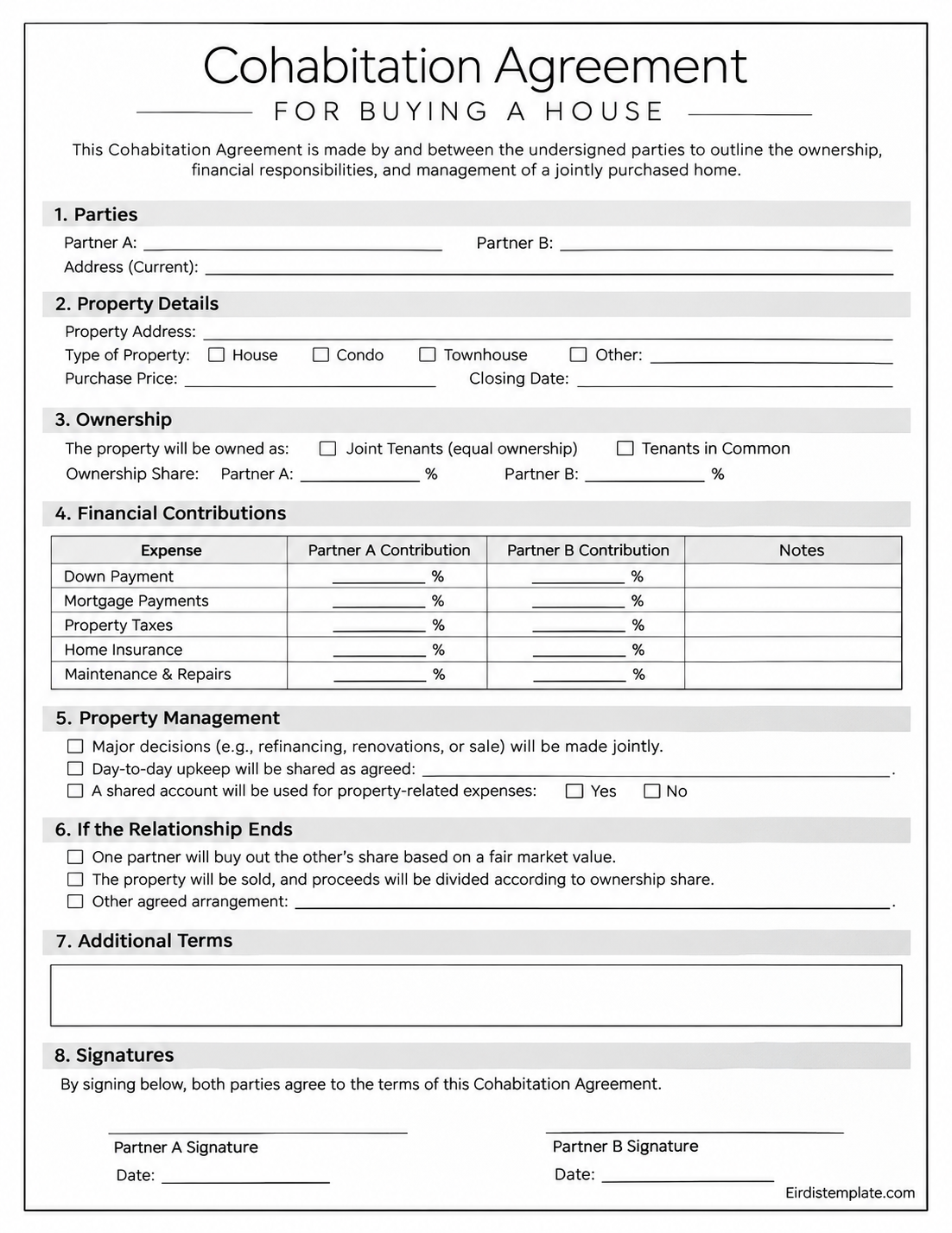
A printable cohabitation agreement template can make it easier to organize the information needed for a shared home purchase. It provides a starting point for documenting personal details, property information, ownership percentages, financial contributions, and separation arrangements.
Use the template below as a planning worksheet to discuss your expectations with the other buyer. Fill in the relevant information, review each section carefully, and identify any terms that require professional legal advice.
Remember that a general printable template is an organizational tool, not a substitute for a state-specific legal contract prepared or reviewed by an attorney.
Frequently Asked Questions
Is a cohabitation agreement legally binding?
A cohabitation agreement can be legally binding when it meets the applicable contract requirements. Its enforceability depends on state law, the wording of the agreement, and factors such as voluntary consent and proper execution. Having an attorney review the document can help reduce legal risks.
Can unmarried couples buy a house together?
Yes. Unmarried couples can generally purchase and jointly own a house in the United States. They should decide how the property will be titled, who will be responsible for the mortgage, and how ownership interests and expenses will be divided.
Should both partners be listed on the property deed?
If both people intend to be legal owners, their ownership interests should be properly reflected in the deed. However, the best arrangement depends on the purchase structure and applicable law. Consult a real estate attorney before finalizing the title.
What happens if one partner pays more toward the house?
The parties can agree to recognize unequal contributions through different ownership percentages, reimbursement provisions, or documented loans. The agreement should explain exactly how those payments affect each person’s financial interest rather than leaving the arrangement open to interpretation.
Does a cohabitation agreement protect someone who is not on the deed?
A written agreement may establish contractual rights between the parties, but it does not automatically make someone a legal owner of the property. The effect of the agreement depends on local law and its specific terms. Anyone contributing substantial money without being listed on the deed should obtain independent legal advice before proceeding.
Can friends or family members use a cohabitation agreement to buy a house?
Yes. Although the term is commonly associated with unmarried romantic partners, friends and family members can also use a written co-ownership or property agreement to document their shared purchase. The document should reflect their actual relationship and ownership arrangement.
What happens to a jointly owned house if one owner dies?
The outcome depends on the ownership structure, the deed, estate planning documents, and state inheritance laws. With a valid joint tenancy that includes survivorship rights, the surviving owner may receive the deceased person’s interest automatically. Under tenancy in common, the deceased owner’s share generally passes through their estate or applicable inheritance laws.
Can a cohabitation agreement be changed after buying a house?
Yes. Both parties may agree to update their arrangement when financial contributions, ownership interests, or personal circumstances change. Any amendment should follow the agreement’s modification provisions and applicable legal requirements. Changes affecting legal property ownership may also require separate deed documentation.
Conclusion
Buying a house together is a significant financial commitment, especially for people who are not legally married. A cohabitation agreement for buying a house helps establish clear expectations about ownership, mortgage payments, property expenses, and future decisions.
By documenting these arrangements before purchasing a home, both parties can better understand their financial responsibilities and reduce the risk of disagreements later. Take time to discuss every important detail, keep accurate financial records, and seek independent legal advice before signing.
A carefully prepared agreement is more than a planning document. It is an important step toward making shared homeownership clearer, more organized, and financially responsible.
Download: Cohabitation Agreement for Buying a House
