A cohabitation agreement is a written legal document that helps unmarried couples establish clear financial and property arrangements while living together. It explains how partners intend to manage shared expenses, own assets, handle debts, and address financial responsibilities if their relationship ends.
Living together can involve many financial decisions, especially when two people share a home, purchase property, open joint accounts, or contribute to household expenses. Without a clear agreement, misunderstandings may arise about who owns certain assets or who is responsible for outstanding debts.
A written agreement can help prevent these problems by documenting each partner’s expectations and responsibilities. Whether you are moving in together, purchasing a home, or already sharing household expenses, a cohabitation agreement can provide a useful foundation for financial planning.
In this guide, you will learn what a cohabitation agreement is, why unmarried couples may need one, what information to include, and how to create an agreement that reflects both partners’ intentions. You will also find a printable template to help organize the important details.
What Is a Cohabitation Agreement?
A cohabitation agreement is a written agreement between two people who live together in a committed relationship without being legally married. It establishes how they intend to manage their financial and property arrangements during the relationship and, where legally permitted, if they separate.
The document can address several important matters, including:
- Ownership of individually and jointly acquired property.
- Responsibility for household expenses and bills.
- Ownership of savings, investments, and other assets.
- Responsibility for individual and shared debts.
- Contributions toward mortgage or rent payments.
- Arrangements for dividing jointly owned property after separation.
- Other financial responsibilities agreed upon by both partners.
Some agreements also discuss children, financial support, and parenting intentions. However, provisions concerning child custody, visitation, and child support are generally subject to applicable family law and the child’s best interests. Partners cannot necessarily make those decisions legally binding through a private agreement.
The main purpose is to create clarity before disagreements occur. By discussing important financial matters in advance, couples can reduce uncertainty and establish expectations that both partners understand.
Free Printable Cohabitation Agreement Template
A printable cohabitation agreement template provides a structured starting point for couples who want to document their living arrangements and financial responsibilities. It organizes important sections into a clear format that both partners can review and complete.
The template includes spaces for partner information, household expenses, property ownership, debts, separation arrangements, additional terms, and signatures.
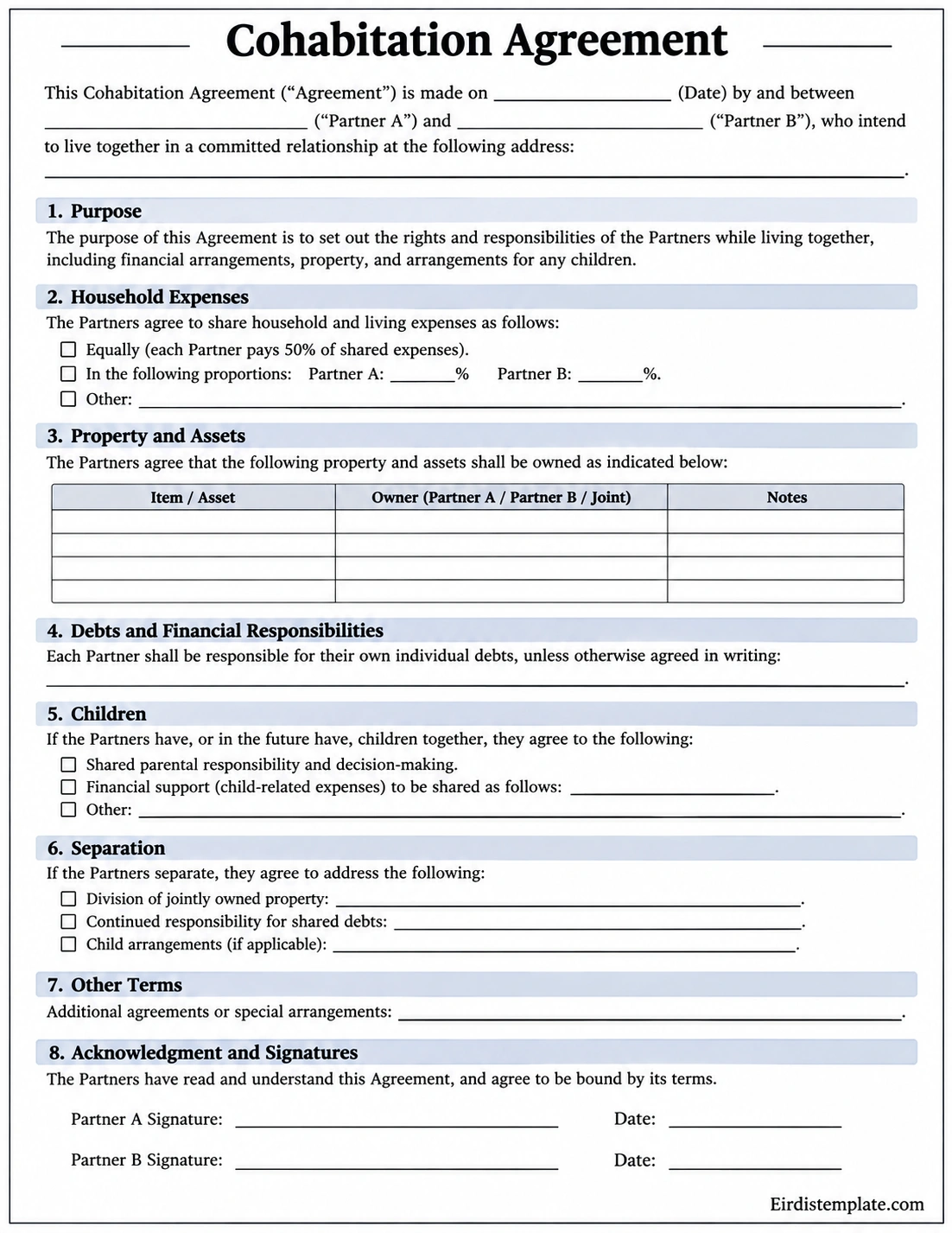
This template is intended as a general educational reference. Before signing or relying on it, both partners should review the terms and consider obtaining independent legal advice. Laws governing unmarried couples differ between jurisdictions.
Why Do Unmarried Couples Need a Cohabitation Agreement?
Many couples assume that living together for several years automatically provides the same legal protections as marriage. However, this is not necessarily true.
Legal rights for unmarried couples vary significantly depending on the country, state, or jurisdiction. Some places recognize certain rights for qualifying domestic partnerships or common-law marriages, while others provide limited protections simply because two people live together.
A written agreement can help couples address financial matters that might otherwise become sources of conflict.
1. Protects Individual Property
Partners may enter a relationship with different financial circumstances. One person may own a house, vehicle, investment account, or other valuable property before moving in together.
A cohabitation agreement can document which assets belong individually to each partner and which items are jointly owned. This can help reduce disagreements about property ownership if the relationship ends.
2. Clarifies Shared Financial Responsibilities
Living together often involves shared expenses such as rent, utilities, groceries, insurance, and household maintenance.
The agreement can explain how these expenses will be divided. Partners may choose an equal arrangement or divide costs according to their respective incomes.
3. Helps Address Debt Responsibilities
Debt can become complicated when couples share financial commitments. For example, partners may jointly finance a vehicle, sign a rental agreement, or take out a loan for household improvements.
A written agreement can clarify their intended responsibilities for individual and shared debts. However, it does not automatically change obligations owed to outside creditors or lenders.
4. Reduces the Risk of Disputes
Financial disagreements can become more difficult when partners separate. Without documented arrangements, each person may have a different understanding of who contributed to certain purchases or payments.
Clearly written terms can provide useful evidence of the partners’ intentions and help reduce misunderstandings.
5. Supports Financial Planning
A cohabitation agreement encourages couples to discuss important financial decisions before problems arise. It provides an opportunity to establish shared goals, define responsibilities, and plan for future expenses.
What Should Be Included in a Cohabitation Agreement?
A well-organized agreement should address the financial and property matters most relevant to the couple. Although every relationship is different, several sections are commonly considered.
1. Partner Information
Begin with the full legal names of both partners, their current residential address, and the date the agreement is made.
The introductory section should clearly identify the people entering into the agreement and establish their intention to live together.
2. Household Expenses
Explain how the partners will share regular living costs. This may include:
- Rent or mortgage payments.
- Electricity, water, and internet bills.
- Groceries and household supplies.
- Home maintenance and repairs.
- Insurance and other recurring expenses.
- Other shared household costs.
Specify whether expenses will be divided equally, according to income, or through another mutually agreed arrangement.
3. Property and Asset Ownership
Property ownership is one of the most important sections of a cohabitation agreement. It should identify assets that belong to each partner individually and assets that are owned jointly.
Examples include:
- Residential property and real estate.
- Vehicles and other major purchases.
- Furniture and household equipment.
- Personal savings and investments.
- Business interests.
- Other valuable personal property.
Where appropriate, include purchase dates, ownership percentages, contribution records, and supporting documentation.
4. Debts and Financial Responsibilities
The agreement should explain how individual and shared debts will be handled. This may include personal loans, credit card balances, mortgages, and jointly financed purchases.
Partners should identify which debts existed before they began living together and which financial obligations they agreed to take on jointly.
Remember that a private agreement between partners does not necessarily release either person from an obligation to a lender or creditor.
5. Savings and Joint Accounts
If the couple maintains joint savings or bank accounts, the agreement can explain how contributions and withdrawals will be managed.
It may also identify what happens to the remaining balance if the relationship ends. Clear records of contributions can help support the partners’ understanding of ownership.
6. Children and Parenting Arrangements
Some couples have children together or may have children from previous relationships. They may wish to discuss financial responsibilities, childcare costs, and general parenting intentions.
However, legal provisions involving parental responsibility, custody, visitation, and child support are governed by applicable family law. A private cohabitation agreement cannot override a court’s authority or the child’s best interests.
7. Separation and Property Division
Although discussing separation may feel uncomfortable, it is an important part of financial planning. This section can explain how partners intend to handle jointly owned assets and shared financial commitments if they stop living together.
Possible arrangements include:
- Selling jointly owned property and dividing the proceeds according to agreed ownership shares.
- Allowing one partner to purchase the other’s interest in a shared property.
- Returning individually owned belongings to their respective owners.
- Dividing jointly held savings according to documented contributions or agreed percentages.
- Addressing outstanding shared expenses and debts.
Any proposed arrangement involving real estate, joint loans, or other regulated assets should be reviewed for compliance with applicable law.
8. Signatures and Agreement Date
The agreement should include signature spaces for both partners and the date of signing. Depending on local requirements, independent legal advice, witnesses, notarization, or other formalities may be important.
Both partners should receive a complete copy of the signed document and retain supporting financial records.
How to Create a Cohabitation Agreement
Creating an agreement requires open communication and careful consideration of each partner’s financial circumstances. Follow these steps to prepare a document that reflects your shared intentions.
Step 1: Discuss Financial Expectations
Start by discussing income, savings, property, debts, and regular expenses. Both partners should have an opportunity to explain their expectations and concerns.
Step 2: Identify Individual and Joint Assets
Prepare a list of significant assets owned individually and jointly. Include relevant purchase records, ownership documents, and information about financial contributions.
Step 3: Agree on Household Expenses
Decide how rent, utilities, groceries, and other shared expenses will be paid. Write down the agreed arrangement so that each partner understands their responsibilities.
Step 4: Discuss Debt and Financial Obligations
Identify existing debts and any obligations the partners intend to share. Make sure the agreement does not incorrectly suggest that a lender’s contractual rights have changed.
Step 5: Plan for Possible Separation
Discuss how jointly owned property, savings, and shared financial commitments should be addressed if the relationship ends.
Step 6: Review the Agreement with Independent Lawyers
Each partner should have an opportunity to obtain independent legal advice before signing. This is particularly important when the agreement involves real estate, substantial assets, business interests, or significant financial differences.
Step 7: Sign and Store the Document
After reviewing the final terms, both partners can sign the agreement in accordance with applicable legal requirements. Keep signed copies and relevant supporting records in a secure location.
Tips for Making a Cohabitation Agreement More Effective
A clear agreement is easier to understand and may be more useful if disagreements arise. Consider these practical recommendations when preparing your document.
- Be specific: Avoid vague statements about property ownership and financial responsibilities.
- Provide full financial disclosure: Both partners should understand the relevant assets, debts, and financial circumstances.
- Keep supporting records: Save receipts, account statements, ownership documents, and contribution records.
- Avoid pressure: Both partners should have enough time to review and consider the proposed terms freely.
- Use independent legal advice: Each person should understand their rights and the possible consequences of signing.
- Check local legal requirements: Enforceability depends on the applicable jurisdiction and circumstances.
- Review the agreement regularly: Update it when major financial or family circumstances change.
- Keep signed copies: Both partners should have access to the final document.
Cohabitation Agreement vs. Prenuptial Agreement
A cohabitation agreement and a prenuptial agreement are both used to establish financial arrangements between partners. However, they are designed for different circumstances.
A cohabitation agreement generally applies to unmarried partners who live together. It can address property ownership, household expenses, debts, and financial arrangements during the relationship or following separation.
A prenuptial agreement is made in anticipation of marriage. It typically addresses how property, assets, and certain financial responsibilities will be handled during marriage and in the event of divorce or death, subject to applicable law.
The main difference is the relationship status and legal context in which each agreement operates.
Frequently Asked Questions About Cohabitation Agreements
Is a cohabitation agreement legally binding?
A cohabitation agreement may be legally binding if it satisfies the applicable legal requirements. Factors can include proper execution, full financial disclosure, voluntary consent, clarity of terms, and whether the agreement complies with local law. Requirements differ between jurisdictions.
Can unmarried couples make a cohabitation agreement?
Yes. Unmarried couples who live together can generally document their financial arrangements through a written agreement. The specific rights and enforceability of its terms depend on the laws where they live.
Does a cohabitation agreement protect property?
It can help document the partners’ intentions regarding individual and jointly owned property. It may clarify ownership shares, financial contributions, and proposed arrangements if the relationship ends. However, property rights and enforceability depend on applicable law and relevant ownership documents.
Can a cohabitation agreement cover debts?
Yes. Partners can document how they intend to manage individual and shared debts. However, an agreement between partners does not automatically change the rights of outside creditors or remove a person’s existing contractual liability.
Can a cohabitation agreement include child custody arrangements?
Partners can document their parenting intentions and discuss proposed arrangements for their children. However, custody, visitation, parental responsibility, and child support are subject to applicable family law. Courts generally prioritize the child’s best interests, and private agreements cannot override those legal requirements.
When should an unmarried couple sign a cohabitation agreement?
Ideally, partners should discuss and prepare an agreement before moving in together or making significant joint financial commitments. It can also be prepared later if their financial circumstances or living arrangements change.
Does a cohabitation agreement need to be notarized?
Notarization requirements vary by jurisdiction and document type. In some places, notarization may help establish the authenticity of signatures, but it does not automatically make every provision legally enforceable. Obtain local legal advice about the required formalities.
Can a cohabitation agreement be changed?
Yes. Partners may update their agreement when their circumstances change, such as purchasing a home, having children, or taking on significant financial obligations. Any amendment should be documented properly and follow applicable legal requirements.
What happens if an unmarried couple separates without an agreement?
Without a written agreement, property ownership and financial responsibilities may need to be determined using applicable property, contract, family, and other relevant laws. Disagreements may become more difficult and expensive to resolve, particularly when ownership or financial contributions are disputed.
Can I write my own cohabitation agreement?
You can prepare an initial draft using a general template. However, because the document may affect significant financial and property rights, both partners should obtain independent legal advice before signing.
Conclusion
A cohabitation agreement is a useful planning document for unmarried couples who want to establish clear expectations about property, household expenses, debts, and financial responsibilities. It encourages honest discussions and helps partners understand how their shared financial arrangements should work.
Using a printable cohabitation agreement template can make the preparation process more organized. It provides a starting point for identifying important topics and documenting the terms both partners wish to discuss.
However, a template should not replace professional legal advice. Laws affecting unmarried couples differ between jurisdictions, and some matters, particularly those involving children and third-party creditors, cannot necessarily be determined by a private agreement.
Take time to discuss your arrangements, review the applicable legal requirements, and obtain independent advice before signing. A carefully prepared agreement can provide greater clarity and help both partners approach their shared future with confidence.
Download: Cohabitation Agreement Template
