Living together as an unmarried couple is an important step in a relationship. Whether you are moving in together for the first time or have already shared a home for several years, discussing finances, property, and household responsibilities can help prevent misunderstandings. A cohabitation agreement for unmarried couples provides a practical way to put these arrangements in writing.
A cohabitation agreement is a written contract that explains how two unmarried partners will manage their shared life. It can cover household expenses, individual and jointly owned property, financial obligations, and what should happen if the relationship ends or one partner dies.
Although discussing these subjects may feel uncomfortable, having clear expectations can protect both partners and provide greater financial clarity. In this guide, you will learn what a cohabitation agreement includes, why it matters, and how to prepare one. You will also find a sample document preview to help you understand its typical structure.
What Is a Cohabitation Agreement for Unmarried Couples?
A cohabitation agreement is a written legal contract between two people who live together or intend to live together without being legally married. It establishes their agreed rights, responsibilities, and financial arrangements during their relationship.
Unlike informal conversations, a written agreement provides a record of what both partners have agreed to. Depending on the applicable law and how the document is prepared, it may also be legally enforceable.
Common subjects covered in a cohabitation contract include:
- Household expenses: How rent, utilities, groceries, and other shared costs will be paid.
- Property ownership: Which assets belong to each partner and how jointly acquired property is owned.
- Individual debts: How existing and future financial obligations will be handled.
- Household responsibilities: How everyday duties and maintenance will be divided.
- Separation arrangements: How shared assets, debts, and living arrangements will be handled if the relationship ends.
- Death and estate planning: How the agreement relates to inheritance, beneficiary designations, and other estate planning documents.
The purpose is to create a mutual understanding before disagreements arise. Both partners should have an opportunity to review and negotiate the terms.
Why Do Unmarried Couples Need a Cohabitation Agreement?
Many couples assume that living together automatically provides the same financial and property protections as marriage. However, legal rights for unmarried partners vary considerably depending on the country, state, or jurisdiction.
A cohabitation agreement can help address this uncertainty by documenting the partners’ intentions and financial arrangements.
1. Protect Individual Property
Partners may enter a relationship with different financial circumstances. One person might own a house, vehicle, savings, or other valuable assets before moving in together.
A written agreement can identify separately owned property and explain how it will be treated during cohabitation. This can reduce confusion about ownership if the relationship ends.
2. Establish Clear Financial Responsibilities
Sharing a home often means sharing expenses. Without an agreed arrangement, disagreements may arise over rent, mortgage payments, utilities, groceries, and household purchases.
A cohabitation agreement can specify whether expenses will be divided equally, proportionally according to income, or through another arrangement agreed upon by both partners.
3. Reduce Disagreements During Separation
Ending a relationship can be emotionally and financially challenging. Decisions about furniture, jointly purchased property, shared accounts, and outstanding debts can make the situation more complicated.
Establishing separation procedures in advance gives both partners a clearer starting point if they decide to live separately.
4. Provide Greater Financial Transparency
Preparing an agreement encourages both partners to discuss income, debts, property ownership, and financial expectations. These conversations can build trust and help prevent assumptions about money.
What Should a Cohabitation Agreement Include?
A comprehensive cohabitation agreement should reflect the couple’s actual circumstances. While every relationship is different, several important sections are commonly included.
1. Names and Personal Information
Start with the full legal names and current addresses of both partners. The document should also identify the date the agreement is made and the address of the shared residence, if applicable.
2. Living Arrangements
Explain where the partners intend to live and how the residence will be managed. If one partner owns the home, clarify whether the other partner is contributing toward household expenses, mortgage costs, or improvements.
3. Shared Expenses and Financial Contributions
Describe how regular household expenses will be divided. Include specific arrangements for:
- Rent or mortgage payments.
- Electricity, water, gas, and internet bills.
- Groceries and household supplies.
- Home maintenance and repairs.
- Insurance and other shared expenses.
For example, the partners may agree to contribute 50% each or divide expenses according to their respective incomes. The agreement should explain the chosen method clearly.
4. Separate and Joint Property
Property ownership is one of the most important parts of an unmarried couples agreement. Identify assets each person owns individually and explain how property purchased together will be owned.
Consider including:
- Real estate and vehicles.
- Furniture and household equipment.
- Personal savings and investments.
- Valuable personal belongings.
- Property purchased jointly during the relationship.
For major purchases, keep receipts, ownership records, and written evidence of each person’s financial contribution.
5. Individual and Shared Debts
Explain how existing debts and future financial obligations will be handled. Each partner should understand which debts are individual and which obligations they have jointly accepted.
Also clarify how shared loans, credit obligations, or other jointly incurred liabilities will be addressed. A private agreement between partners does not automatically change the rights of banks, lenders, or other creditors.
6. Household Responsibilities
Although financial matters receive considerable attention, everyday responsibilities can also create disagreements. The agreement may outline how cleaning, cooking, maintenance, and other household tasks will be shared.
7. Separation and Property Division
Include a practical procedure for ending the shared living arrangement. This section may address notice periods, moving arrangements, shared furniture, jointly owned assets, and outstanding household expenses.
If the partners jointly own a property, they may also establish a process for obtaining a valuation, arranging a buyout, or selling the property, subject to applicable law and any lender requirements.
8. Death and Estate Planning
A cohabitation agreement can document the partners’ intentions concerning certain financial arrangements if one partner dies. However, it should not be treated as a substitute for a will, trust, or other estate planning document.
Partners should separately review beneficiary designations, property title arrangements, life insurance, and applicable inheritance laws. The agreement’s effect on inheritance rights depends on the relevant jurisdiction.
9. Signatures and Legal Formalities
Both partners should sign and date the final agreement. Depending on local requirements, witnesses, notarization, independent legal advice, or other formalities may be necessary.
Each partner should receive a complete signed copy and keep it with their important personal documents.
Sample Cohabitation Agreement for Unmarried Couples
Below is an example of how a cohabitation agreement may be organized. It illustrates the types of provisions couples can discuss when preparing their own document.
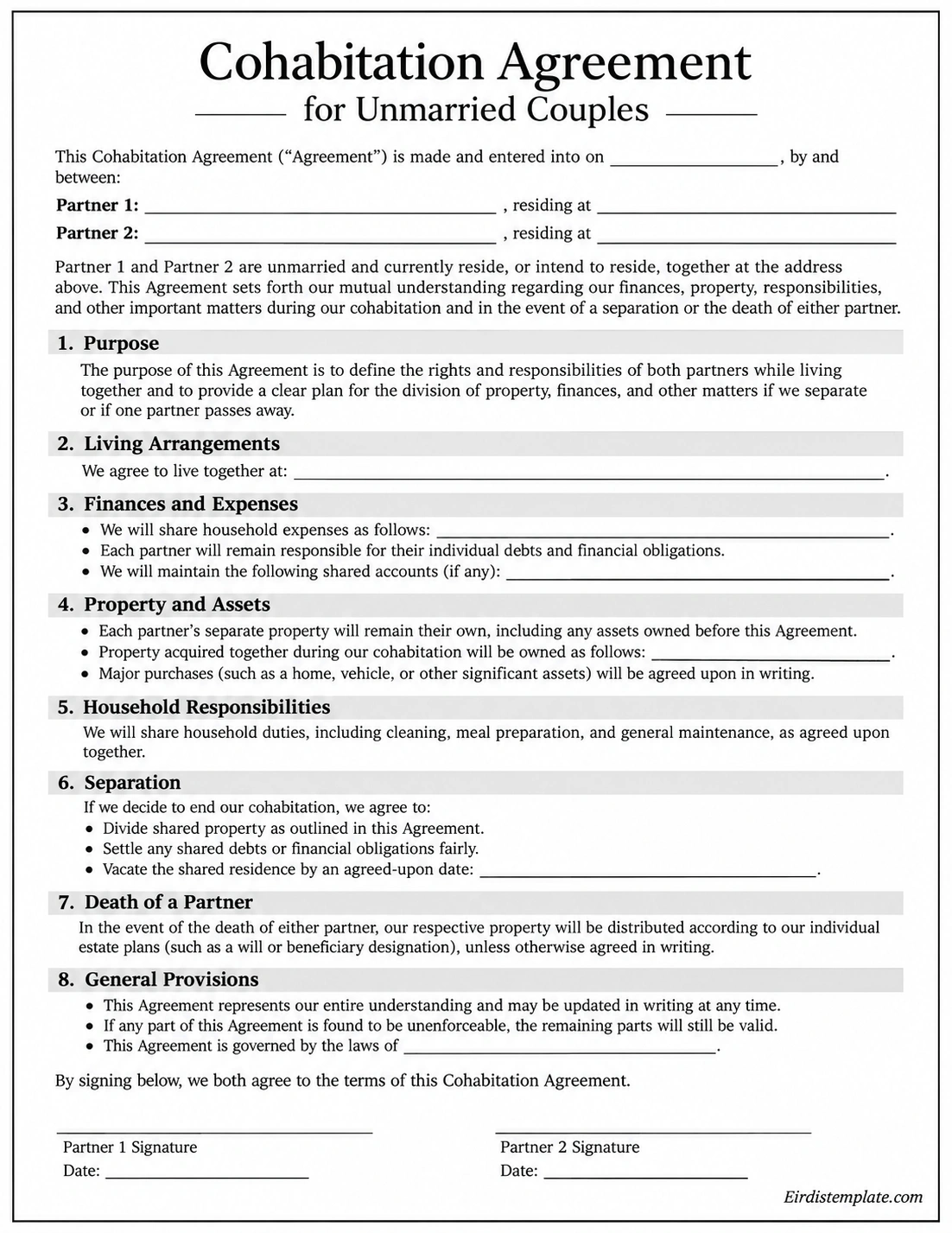
A typical agreement may contain the following introductory wording and sections:
COHABITATION AGREEMENT
This Agreement is made on [Date] between [Partner 1 Full Name] and [Partner 2 Full Name], who are unmarried partners living together or intending to establish a shared residence.
1. Purpose of Agreement
The purpose of this Agreement is to document the partners’ mutual understanding concerning property, finances, household expenses, and responsibilities during their cohabitation.
2. Financial Arrangements
The partners agree to contribute toward shared household expenses according to the following arrangement: [Describe the agreed contribution method].
3. Property Ownership
Each partner retains ownership of their separately owned property. Property acquired jointly will be owned according to the following terms: [Describe ownership shares and contributions].
4. Separation Arrangements
If the partners end their cohabitation, they agree to address jointly owned property, shared financial obligations, and the shared residence according to the following procedure: [Describe the agreed arrangements].
5. General Provisions
Any amendments to this Agreement should be made in writing and signed by both partners. The governing law and any required legal formalities should be specified in accordance with applicable local law.
Partner 1 Signature: ____________________
Partner 2 Signature: ____________________
Date: ____________________
This example is for educational purposes only. It is not a complete legal contract or a substitute for jurisdiction-specific legal advice. Additional clauses and formalities may be required depending on the partners’ circumstances.
How to Create a Cohabitation Agreement
Creating an agreement does not have to be complicated. A structured approach can help both partners identify their priorities and prepare a document that reflects their intentions.
Step 1: Discuss Financial Circumstances
Start by discussing income, savings, existing debts, property ownership, and regular expenses. Both partners should provide accurate financial information so the agreement is based on a clear understanding.
Step 2: Identify Individual and Shared Assets
Make a list of property each partner owns separately and assets they plan to acquire together. Keep supporting documents such as purchase receipts, property records, and account statements.
Step 3: Agree on Household Contributions
Decide how rent, utilities, groceries, repairs, and other shared expenses will be divided. Choose an arrangement that both partners consider reasonable and document it clearly.
Step 4: Discuss What Happens If You Separate
Although this conversation may be difficult, it is important to agree on how jointly owned property, shared debts, and living arrangements will be handled if the relationship ends.
Step 5: Prepare and Review the Document
Organize the agreed terms into clear sections. Avoid vague statements and make sure each provision explains the partners’ intentions. Both partners should have enough time to review the complete document.
Step 6: Obtain Independent Legal Advice
Consult qualified legal professionals in the relevant jurisdiction before signing. Independent advice can help each partner understand their rights and identify terms that may be unenforceable or require additional documentation.
Step 7: Sign and Store the Agreement
Complete all required signatures and formalities. Give each partner a copy and store the signed document securely. Review the agreement whenever there are significant changes in finances, property ownership, or living arrangements.
Important Legal Considerations for Unmarried Couples
The legal effect of a cohabitation agreement depends on where the partners live. Some jurisdictions recognize certain agreements between unmarried partners, while others impose specific requirements or limitations.
Before signing, consider the following points:
- Voluntary agreement: Both partners should enter the agreement freely and without pressure.
- Financial disclosure: Relevant assets, debts, and financial obligations should be disclosed honestly.
- Independent advice: Each partner should have the opportunity to obtain separate legal advice.
- Clear language: Terms should be specific, understandable, and consistent.
- Local legal requirements: Check whether witnessing, notarization, registration, or other formalities are necessary.
- Estate planning: Prepare appropriate wills and beneficiary documents separately where necessary.
Some matters, including child support, parenting responsibilities, statutory rights, and third-party creditor obligations, may not be controlled by a private cohabitation agreement. Legal review is particularly important when children, real estate, substantial assets, or significant debts are involved.
When Should You Update a Cohabitation Agreement?
A cohabitation agreement should reflect the partners’ current circumstances rather than remain unchanged indefinitely. Review it whenever an important life or financial event occurs.
Common reasons to update the document include:
- Buying or selling a home together.
- One partner receiving a significant inheritance.
- Starting a business or acquiring valuable assets.
- Having or adopting children.
- Experiencing a major change in income or employment.
- Taking on substantial shared debt.
- Changing the ownership of jointly acquired property.
Any amendment should be properly documented and completed according to the applicable legal requirements.
Frequently Asked Questions About Cohabitation Agreements
1. Is a cohabitation agreement legally binding?
A cohabitation agreement may be legally binding if it meets the applicable legal requirements. Enforceability can depend on factors such as voluntary consent, financial disclosure, clarity of terms, legal formalities, and local law. Having a lawyer review the agreement is advisable.
2. Do unmarried couples need a cohabitation agreement?
Unmarried couples are not universally required to have a cohabitation agreement. However, it can be useful for documenting financial contributions, property ownership, shared expenses, and arrangements in the event of separation.
3. What is the difference between a cohabitation agreement and a prenuptial agreement?
A cohabitation agreement is generally designed for unmarried partners who live together or plan to do so. A prenuptial agreement is typically made by people who intend to marry and establishes certain financial arrangements in anticipation of marriage. Their legal treatment and requirements may differ.
4. Can a cohabitation agreement protect property owned before the relationship?
A cohabitation agreement can document each partner’s intention to retain separately owned property. However, the actual protection and enforceability of those provisions depend on local property laws, the circumstances of ownership, and the agreement’s wording.
5. Can unmarried couples divide household expenses equally?
Yes. Partners can agree to divide shared expenses equally or use another contribution arrangement, such as dividing expenses according to income. The chosen method should be clearly documented in the agreement.
6. Does a cohabitation agreement cover inheritance after a partner dies?
A cohabitation agreement may address certain intentions concerning property and financial arrangements after death. However, inheritance rights are governed by applicable estate and succession laws. Partners should prepare separate wills and review beneficiary designations where appropriate.
7. Can a cohabitation agreement be changed after signing?
Yes, partners may be able to amend their agreement by mutual consent. Any changes should be recorded in writing, signed by both partners, and completed according to the applicable legal requirements.
8. Should both partners have separate lawyers?
Obtaining independent legal advice is strongly recommended. Separate lawyers can help each partner understand the agreement’s consequences, identify potential problems, and make informed decisions before signing.
9. What happens if an unmarried couple separates without an agreement?
Without a written agreement, property ownership, shared debts, and financial disputes may need to be resolved under applicable local laws. The outcome can depend on ownership records, financial contributions, other evidence, and the jurisdiction’s legal rules.
Final Thoughts
A cohabitation agreement for unmarried couples is a practical way to establish clear expectations about finances, property ownership, household responsibilities, and separation arrangements. It encourages open communication and gives both partners an opportunity to understand their respective obligations before problems arise.
Whether you are moving into your first shared home or have been living together for years, documenting your financial arrangements can provide greater clarity and help reduce potential disputes.
Use the sample cohabitation agreement preview in this guide as a starting point for understanding the document’s structure. Customize the provisions to reflect your circumstances and consult qualified legal professionals to ensure the final agreement complies with the laws that apply to you.
Taking the time to prepare a clear and carefully reviewed agreement can help both partners move forward with greater confidence and a better understanding of their shared responsibilities.
Download: Cohabitation Agreement for Unmarried Couples
