An account statement is a summarized record of financial transactions between two parties over a specific period. It can show invoices, charges, payments, credits, adjustments, and the remaining balance so both the sender and recipient can understand the current status of an account.
Businesses commonly use account statements to communicate transaction history, confirm payments, identify outstanding balances, and maintain organized financial records. For customers and clients, an account statement provides a convenient summary of what has been billed, what has been paid, and what may still be due.
A clear account statement can improve financial communication and make it easier to identify discrepancies before they become larger problems. This guide explains what an account statement is, what it should include, how to create one, and how to use an account statement template effectively.
What Is an Account Statement?
An account statement is a document that summarizes the financial activity associated with an account during a defined period. It typically lists transactions chronologically and shows how each transaction affects the account balance.
For a business customer, an account statement might include invoices for products or services, payments received, credits, adjustments, and the outstanding amount. The document may also include payment terms and a due date.
Unlike a single invoice, which generally requests payment for a particular transaction, an account statement provides a broader view of multiple transactions within the selected statement period.
Why Is an Account Statement Important?
An account statement helps both parties maintain a shared understanding of account activity. It can be particularly useful when a customer has multiple invoices or payments over time.
- Summarizes transactions: Multiple financial activities can be presented in one document.
- Shows outstanding balances: Customers can quickly see what remains unpaid.
- Confirms payments: Payments already received can be included in the transaction history.
- Improves communication: Both parties have a common reference for discussing account activity.
- Supports recordkeeping: Statements can be retained as part of organized business records.
- Helps identify discrepancies: Missing payments, duplicate entries, or unexpected charges can be easier to spot.
- Encourages timely payment: A clearly presented outstanding balance and due date can remind customers about amounts that require attention.
What Information Should an Account Statement Include?
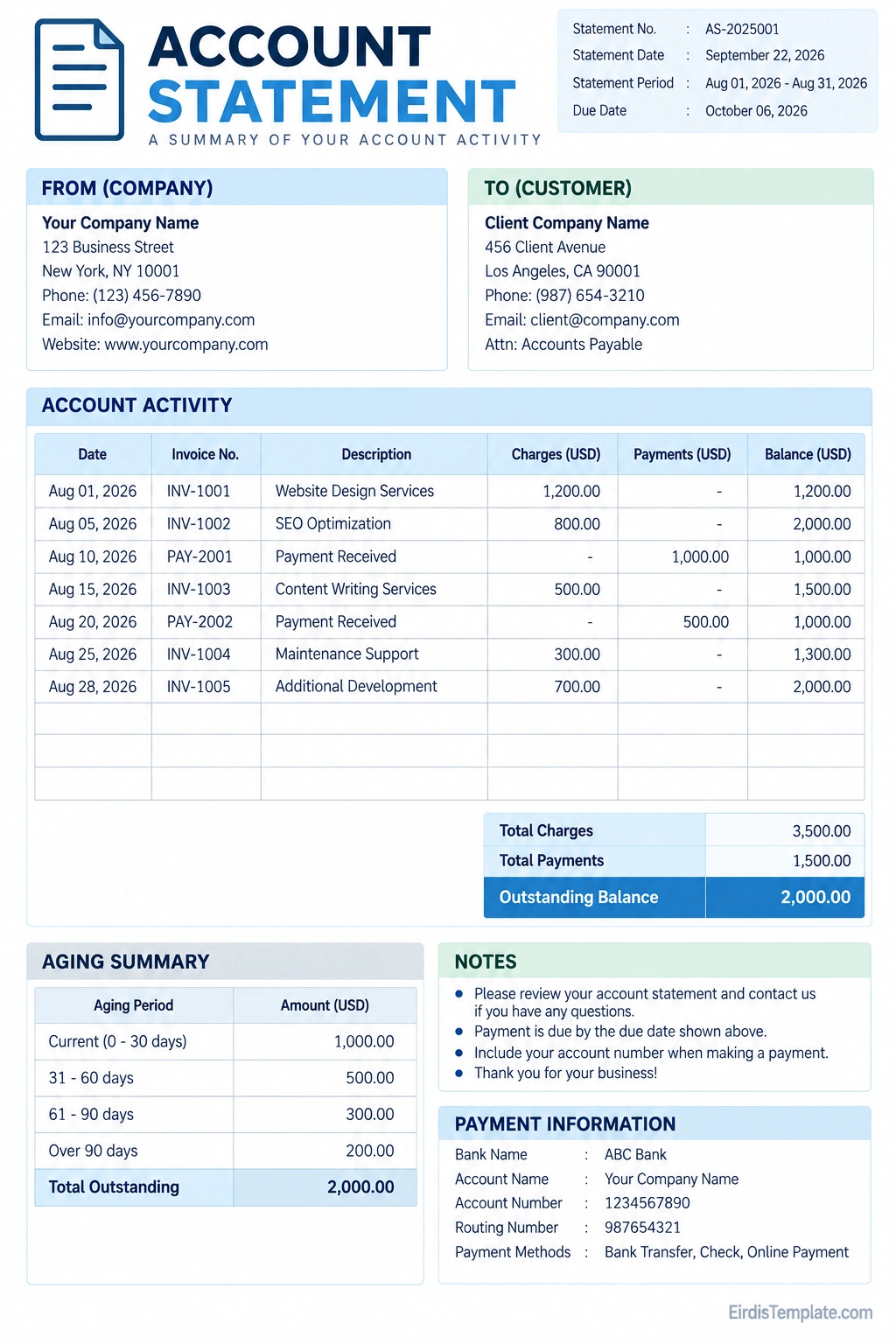
The exact format of an account statement depends on the business and the type of account. However, a professional statement usually contains several key sections.
Statement Information
The top section can identify the statement and define the period it covers.
- Statement number
- Statement date
- Statement period
- Due date, when applicable
- Account number or customer reference
Company Information
The sender’s information helps the recipient identify who issued the statement. This may include the business name, address, phone number, email address, and website.
Customer Information
The statement should clearly identify the customer or account holder. Depending on the business, this can include the customer name, company name, billing address, contact information, and accounts payable contact.
Account Activity
The transaction section is usually the central part of an account statement. Each transaction can include the date, invoice or reference number, description, charges, payments, credits, and resulting balance.
Outstanding Balance
The statement should clearly show the amount that remains outstanding at the end of the statement period. If payment is required, the due date and applicable payment instructions should also be easy to find.
Payment Information
When appropriate, businesses can include payment instructions such as accepted payment methods or information about where customers can submit payments. Sensitive payment details should be handled according to appropriate security practices.
Account Statement vs. Invoice
An account statement and an invoice are related but serve different purposes.
An invoice generally requests payment for a specific product, service, or transaction. It usually contains details about what was provided, the amount due, payment terms, and the payment deadline.
An account statement provides a broader summary of account activity. It can include several invoices, payments, credits, and adjustments over a defined period.
For example, a business may issue three invoices to a customer during a month. Instead of reviewing each invoice separately, the customer can use the monthly account statement to see the combined transaction history and current balance.
Account Statement vs. Receipt
A receipt generally confirms that a payment or purchase has been received or completed. An account statement provides a broader record of account activity and can include both charges and payments.
A receipt may therefore document one payment, while an account statement can summarize many transactions over a selected period.
How to Create an Account Statement
1. Choose the Statement Period
Determine the period covered by the statement. Common periods include weekly, monthly, quarterly, or another interval that fits the business relationship.
2. Gather Account Records
Collect the invoices, payments, credits, adjustments, and other relevant transactions associated with the account during the selected period.
3. Verify the Transactions
Check transaction dates, reference numbers, descriptions, amounts, and payment records before preparing the statement. Accuracy is important because customers may use the statement to reconcile their own records.
4. Calculate the Account Balance
Use the verified transaction information to determine the balance shown on the statement. Make sure charges, payments, credits, and adjustments are reflected consistently.
5. Add Customer and Company Details
Clearly identify both parties. Include the contact information needed for questions or payment-related communication.
6. Present the Statement Clearly
Use a table or structured layout for transactions. Make totals and the outstanding balance visually easy to identify without overcrowding the page.
7. Review Before Sending
Perform a final review for incorrect amounts, duplicate transactions, missing payments, incorrect dates, and outdated customer information.
How to Read an Account Statement
Customers can use an account statement to reconcile their own records with the information provided by the business.
Start by checking the statement period and account information. Then review each transaction and compare the listed invoices and payments with internal records.
Pay particular attention to:
- Invoices that have not yet been paid
- Payments that have already been submitted
- Credits or adjustments
- Incorrect or unfamiliar transactions
- The final outstanding balance
- The payment due date
If a transaction appears incorrect, contact the business using the appropriate contact information and provide the relevant invoice or payment reference.
Account Statement for Small Businesses
Small businesses can use account statements to keep customer billing information organized, particularly when customers receive multiple invoices over time.
A consistent statement process can help a business present account information professionally and reduce confusion around outstanding balances.
Businesses can create statements using accounting software, spreadsheets, invoicing systems, or a printable account statement template. The best option depends on transaction volume, accounting processes, and recordkeeping requirements.
How Often Should an Account Statement Be Sent?
The appropriate frequency depends on the type of business and customer relationship. Some businesses issue statements monthly, while others send them when there is an outstanding balance or when a customer requests an account summary.
A regular schedule can make reconciliation easier, but businesses should choose a process that fits their billing cycle and customer needs.
Tips for Creating a Professional Account Statement
- Keep the layout organized: Use clear headings and transaction columns.
- Show the statement period: Make it clear which transactions are included.
- Use consistent terminology: Use the same labels for charges, payments, credits, and balances.
- Highlight the current balance: Make the outstanding amount easy to locate.
- Check calculations: Verify totals against the underlying accounting records.
- Include useful contact information: Give customers a clear way to ask questions about their account.
- Protect sensitive information: Only include information necessary for the statement’s purpose.
- Keep copies: Maintain statements according to the business’s recordkeeping practices and applicable requirements.
Common Account Statement Mistakes to Avoid
Small errors can undermine confidence in an account statement. Before sending a statement, check for common problems such as:
- Incorrect customer information
- Missing invoice entries
- Payments that were not recorded
- Duplicate transactions
- Incorrect transaction dates
- Incorrect running balances
- Unclear payment terms
- An outstanding balance that does not match the transaction history
- Confusing or overcrowded formatting
A simple review process can help catch these issues before the statement reaches the customer.
Using an Account Statement Template
An account statement template provides a structured starting point for creating professional statements. Instead of designing a document from scratch, businesses can use predefined sections for company information, customer details, account activity, totals, balances, notes, and payment information.
A printable account statement template can be useful for small businesses, service providers, contractors, wholesalers, consultants, and other organizations that need to summarize customer transactions.
Before using a template, customize the fields to match your business process. Remove sections you do not need and add information that customers require for reconciliation or payment.
Frequently Asked Questions About Account Statements
What is an account statement?
An account statement is a summary of transactions between two parties over a specific period. It can show charges, invoices, payments, credits, adjustments, and the remaining account balance.
What is the purpose of an account statement?
The purpose of an account statement is to provide a clear summary of account activity so both parties can review transactions, reconcile records, identify outstanding balances, and address discrepancies.
Is an account statement the same as an invoice?
No. An invoice generally requests payment for a specific transaction, while an account statement summarizes multiple transactions and payments associated with an account over a defined period.
What is included in an account statement?
An account statement commonly includes the statement number, statement period, company information, customer information, transaction history, charges, payments, credits, outstanding balance, and payment information when applicable.
How often should an account statement be issued?
An account statement may be issued monthly, quarterly, or according to the business’s billing process. Some businesses also issue statements when an account has an outstanding balance or when a customer requests one.
Can a small business use an account statement template?
Yes. An account statement template can help a small business organize customer transactions and create consistent statements. The template should be customized to reflect the business’s actual billing and recordkeeping process.
What should I do if an account statement contains an error?
Compare the statement with the relevant invoices, payment confirmations, and account records. If an error remains, contact the business or accounting department and provide the transaction details needed to investigate the discrepancy.
Conclusion
An account statement provides a clear summary of financial activity between a business and its customer or another party. By bringing invoices, charges, payments, credits, and outstanding balances together in one document, it makes account reconciliation and financial communication easier.
A well-organized account statement should be accurate, easy to read, and specific to the statement period. Whether created with accounting software or an account statement template, a consistent process can help businesses maintain better records, communicate balances clearly, and give customers a reliable summary of their account activity.
Download: Account Statement Template

- Printable Acknowledgement Receipt Template - October 1, 2026
- Free Acknowledgement Letter Template (Word) - October 1, 2026
- Free Printable Accounting Ledger Template - October 1, 2026
