A seller financing agreement provides an alternative way to structure a purchase when a buyer and seller agree that the seller will provide financing instead of relying entirely on a traditional lender. In this arrangement, the seller effectively becomes the lender, while the buyer makes payments according to agreed terms.
Seller financing can be used in certain real estate transactions and, depending on the transaction structure, may also be used when purchasing a business or other assets. Instead of receiving the entire purchase price at closing, the seller receives a down payment and accepts a promise from the buyer to pay the remaining balance over time, usually with interest.
For buyers, seller financing may provide an alternative when conventional financing is unavailable or when the parties want more flexibility in structuring the transaction. For sellers, it can potentially expand the pool of prospective buyers while creating a stream of payments. However, the arrangement also creates legal, financial, and collection considerations for both parties.
What Is a Seller Financing Agreement?
A seller financing agreement is a written contract that establishes the terms under which a seller provides financing to a buyer for a purchase. The agreement identifies the parties, describes the property or asset being sold, states the purchase price and financing amount, and explains how the buyer will repay the seller.
In a typical transaction, the buyer makes an initial down payment and finances the remaining balance through the seller. The buyer then makes scheduled payments over an agreed period. Depending on the transaction, additional documents such as a promissory note and a mortgage, deed of trust, or other security instrument may also be used.
The agreement should clearly document the financial arrangement rather than relying on verbal promises. A detailed written record can help both parties understand their respective responsibilities and reduce uncertainty about payment terms, default procedures, and other important conditions.
How Seller Financing Works
The basic process begins when the buyer and seller agree on the purchase price and determine that seller financing will be part of the transaction. They then negotiate the financing terms and document those terms in appropriate agreements.
1. Agree on the Purchase Price
The parties first establish the total purchase price for the property or business. They should also determine the amount of the buyer’s down payment and the amount that will be financed by the seller.
2. Establish the Financing Terms
The parties determine important financial terms such as the financed principal, interest rate, payment frequency, repayment period, maturity date, and any applicable late-payment provisions.
3. Document the Transaction
The seller financing arrangement should be documented in writing. Depending on the transaction, this may involve a purchase agreement, seller financing agreement, promissory note, and security instrument.
4. Complete the Closing
The purchase and financing documents are executed and the transaction is completed according to the agreed closing process. For real estate, title, recording, and other closing requirements may apply depending on the jurisdiction and transaction structure.
5. Buyer Makes Scheduled Payments
After closing, the buyer makes payments according to the agreed repayment schedule. The seller receives the principal and interest specified by the financing arrangement until the obligation is paid, refinanced, or otherwise terminated according to the agreement.
Key Elements of a Seller Financing Agreement
A well-organized seller financing agreement should clearly identify the major terms of the transaction. The exact documents and provisions required can vary depending on the asset, transaction structure, and applicable law.
Seller and Buyer Information
Identify the legal names and contact information of the seller and buyer. If a party is a company, trust, estate, or other legal entity, the agreement should use the appropriate legal name and identify the authorized representative when necessary.
Property or Asset Description
Describe what is being purchased. For real estate, this may include the property address and a legal description. For a business transaction, the agreement may need to identify the business, assets, or interests being transferred.
Purchase Price and Down Payment
State the total purchase price and the amount the buyer will pay at closing. The agreement should clearly identify the remaining balance that will be financed by the seller.
Interest Rate and Payment Schedule
Specify the interest rate, payment frequency, payment amount or calculation method, and repayment term. The agreement should make it clear when payments begin and when the outstanding balance becomes due.
Maturity Date
A maturity date establishes when the financing obligation is scheduled to be fully paid or when any remaining balance becomes due under the agreement. Some arrangements may include a balloon payment, while others may be structured to fully amortize over the agreed term.
Collateral and Security
The parties should clearly identify what secures the seller’s financing, if applicable. In a real estate transaction, this may involve a mortgage or deed of trust depending on the jurisdiction. Other transactions may use a different type of security agreement.
Default and Remedies
The agreement should explain what constitutes a default and what happens if the buyer fails to meet the contractual obligations. Possible provisions may address late payments, notice of default, opportunities to cure, acceleration, enforcement of security interests, and other remedies permitted by applicable law.
Benefits of Seller Financing
Seller financing can offer potential benefits to both parties when the arrangement is properly structured.
Potential Benefits for Buyers
- Provides an alternative to traditional financing.
- May offer greater flexibility in negotiating certain transaction terms.
- Can potentially simplify financing discussions when both parties agree on the structure.
- May provide an opportunity to purchase when conventional financing is not available.
- Allows the parties to negotiate a repayment structure suited to the transaction, subject to applicable legal requirements.
Potential Benefits for Sellers
- May expand the number of potential buyers.
- Can create a stream of principal and interest payments.
- May allow the seller to negotiate financing terms as part of the overall transaction.
- Can potentially support a sale when a buyer cannot obtain conventional financing.
- May provide an opportunity to negotiate a higher overall price or interest income, depending on the transaction.
These potential benefits should be evaluated against the risks. Seller financing means the seller may remain exposed to the buyer’s ability to make payments, while the buyer takes on a contractual debt obligation.
Important Terms to Negotiate
Before signing a seller financing agreement, both parties should carefully discuss the terms that will determine how the transaction works over time.
- Purchase price: The total agreed value of the property or asset.
- Down payment: The amount paid by the buyer at closing.
- Financed amount: The portion of the purchase price financed by the seller.
- Interest rate: The rate applied to the outstanding principal.
- Payment frequency: Monthly, quarterly, or another agreed schedule.
- Loan term: The period over which payments are scheduled.
- Maturity date: The date the financing obligation is scheduled to mature.
- Late-payment terms: Contractual consequences for missed or late payments.
- Prepayment: Whether the buyer may pay the balance early and whether any conditions apply.
- Security: The collateral or security interest supporting the seller’s financing.
- Insurance and taxes: Responsibility for property-related expenses when applicable.
- Default provisions: The procedures and remedies that apply after a contractual default.
- Governing law: The jurisdiction whose law applies to the agreement, where legally appropriate.
Seller Financing for Real Estate
Seller financing is often discussed in connection with real estate because the property can potentially serve as collateral for the seller’s financing. The exact legal structure may involve a promissory note together with a mortgage or deed of trust, depending on the jurisdiction.
Real estate transactions also require careful attention to title, existing liens, recording requirements, insurance, taxes, and other property-related matters. A buyer and seller should determine whether an existing loan contains restrictions that could affect a proposed sale or financing arrangement.
Because real estate and secured lending rules can vary by jurisdiction, parties should have the transaction reviewed by qualified professionals familiar with the applicable law before signing.
Seller Financing for a Business Purchase
Seller financing can also be used in certain business sales. In this situation, the seller may agree to finance some portion of the purchase price rather than requiring the buyer to obtain all financing from a third-party lender.
The agreement may need to address which assets are being transferred, payment obligations, security interests, representations, warranties, restrictions on the buyer’s operation of the business, and what happens if the buyer defaults.
Business transactions can involve additional tax, corporate, employment, intellectual property, licensing, and regulatory considerations. A seller financing agreement should therefore be coordinated with the broader purchase agreement and other transaction documents.
Common Mistakes to Avoid
Seller financing can become complicated when important terms are left undefined. Both parties should review the agreement carefully before signing.
- Relying on verbal agreements: Important financing terms should be documented in writing.
- Leaving the interest rate unclear: State the applicable rate and how it applies to the outstanding balance.
- Failing to define payment dates: Specify when payments are due and how they should be made.
- Ignoring default provisions: Clearly describe what happens after a missed payment or other breach.
- Failing to document security: If the financing is secured, the appropriate security documents should be properly prepared and handled.
- Ignoring existing liens or obligations: Determine whether existing financing or other contractual restrictions could affect the transaction.
- Using a generic form without review: A template may provide structure but may not address the specific requirements of every transaction or jurisdiction.
- Overlooking tax considerations: Sellers and buyers should understand the potential tax consequences of installment payments and the underlying transaction.
Tips for Creating a Seller Financing Agreement
Start by identifying every financial and operational term that could cause disagreement later. The clearer the agreement is, the easier it can be for both parties to understand their obligations.
Use specific dates, amounts, definitions, payment procedures, and responsibilities instead of vague language. If a provision depends on another document, identify that document clearly.
Keep copies of the executed agreement and related transaction documents. For real estate transactions, confirm that required documents are properly executed, delivered, and recorded when applicable.
It is also important to distinguish between a seller financing agreement and other documents that may be part of the transaction. A purchase agreement establishes the sale, while a promissory note can evidence the buyer’s repayment obligation and a security instrument can establish collateral rights where applicable.
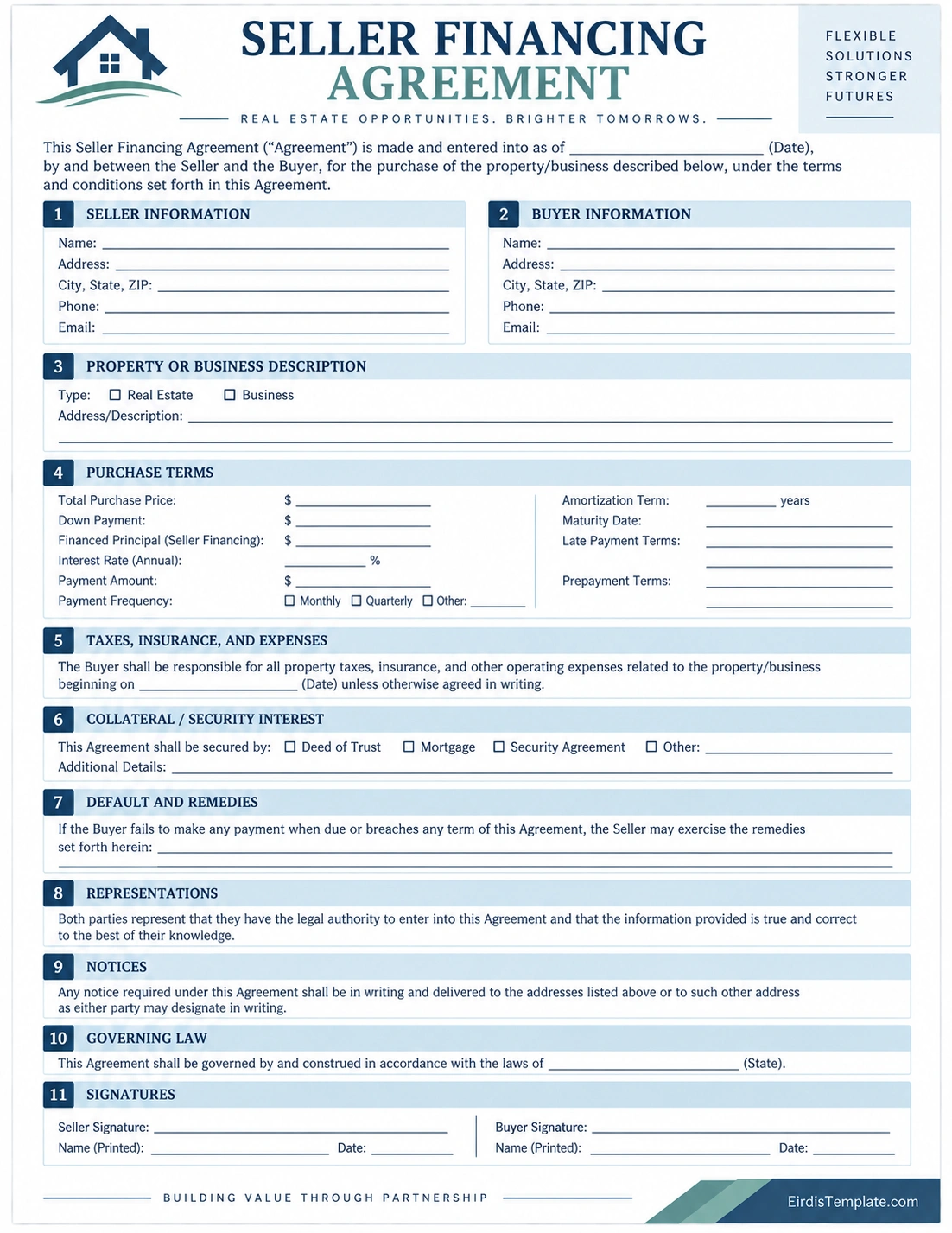
Seller Financing Agreement Template
A seller financing agreement template can provide a convenient starting point for organizing the major terms of a seller-financed transaction. A typical template may include sections for seller information, buyer information, property or business details, purchase terms, payment information, taxes and expenses, collateral, default, representations, notices, governing law, and signatures.
However, a template should not automatically be treated as a complete legal document for every situation. The appropriate language can depend on whether the transaction involves real estate, a business, personal property, or another asset, as well as the jurisdiction and the parties involved.
Before using a seller financing agreement for an actual transaction, review the document carefully and consider obtaining advice from a qualified attorney, real estate professional, tax professional, or other appropriate advisor.
Seller Financing Agreement Checklist
Use the following checklist when reviewing a proposed seller financing arrangement:
- Confirm the legal names of the seller and buyer.
- Describe the property, business, or asset being sold.
- State the total purchase price.
- Document the down payment.
- Calculate the seller-financed principal.
- Specify the interest rate.
- Define the payment amount and frequency.
- State the repayment term and maturity date.
- Address prepayment conditions.
- Identify collateral and related security documents.
- Define default and available remedies.
- Address taxes, insurance, maintenance, and other relevant expenses.
- Specify how notices will be delivered.
- Identify applicable governing law where appropriate.
- Provide signature blocks for all required parties.
- Have the completed documents reviewed when legal or financial complexity warrants professional advice.
Conclusion
A seller financing agreement provides a structured way for a seller to finance part or all of a buyer’s purchase obligation instead of relying exclusively on traditional financing. When carefully negotiated, the arrangement can create flexibility for buyers while potentially providing sellers with installment payments and an expanded pool of prospective buyers.
The most important part of the process is clearly documenting the transaction. Purchase price, down payment, interest rate, payment schedule, maturity date, security, default provisions, and other responsibilities should be addressed in appropriate written documents.
Because seller financing can involve real estate, lending, tax, contract, and other legal considerations, parties should not assume that a generic seller financing agreement will satisfy every transaction. Use a template as an organizational starting point, verify the requirements that apply to the specific transaction, and obtain professional advice when appropriate.
Download: Seller Financing Agreement Template

- Free Printable Weekly Lesson Planner Template - September 23, 2026
- Free Printable Wedding Day Timeline Template - September 23, 2026
- Free Printable Stakeholder Analysis Template - September 23, 2026
