A call sheet is an essential document in film and video production. It tells cast members, crew, and other production personnel where to report, when to arrive, and what to expect during a scheduled shooting day. By bringing important production details together in one place, a call sheet helps teams stay organized, coordinate activities, and reduce costly delays.
Whether you are filming a feature film, short movie, commercial, music video, documentary, or online video, a clear daily production schedule can make a significant difference. Cast members need to know their call times, crew members need location and department information, and production managers must communicate scene schedules and essential safety details.
A call sheet template provides a consistent format for sharing this information. It helps production teams prepare a reliable document for each filming day. This guide explains what a call sheet includes, how to create one, and how to use a printable call sheet template to keep a production running smoothly.
What Is a Call Sheet?
A call sheet is a daily production document that communicates the schedule and essential information for a specific day of filming. It is usually prepared by the production office, often with input from the assistant director and other department heads.
The document identifies the production, shooting date, locations, call times, planned scenes, cast requirements, and important contacts. Depending on the project, it may also include weather information, parking instructions, meal breaks, special equipment requirements, and emergency procedures.
A call sheet is not the same as a full production schedule. A production schedule organizes filming across multiple days, while a call sheet focuses on the details needed for one particular shooting day.
Because filming plans can change, the call sheet should be accurate and distributed to the relevant cast and crew before the scheduled workday. If important details change, the production team should communicate the revised information clearly.
Why Is a Call Sheet Important?
A well-prepared call sheet helps everyone understand the day’s plan before arriving on set. It reduces uncertainty and supports coordination between departments that depend on one another.
- Clarifies arrival times: Gives cast and crew clear instructions about when they need to report.
- Communicates locations: Provides addresses, parking instructions, and other location details.
- Organizes the shooting day: Lists planned scenes and estimated shooting times.
- Coordinates departments: Helps camera, sound, lighting, wardrobe, makeup, and other teams prepare for their work.
- Reduces avoidable delays: Makes important information available before filming begins.
- Improves communication: Identifies production contacts and department leads.
- Supports safety planning: Can provide emergency contacts, medical information, weather notices, and relevant site instructions.
A call sheet cannot prevent every production problem, but it gives the team a shared reference point. Accurate information and timely updates make it much more useful.
Printable Call Sheet Template
A printable call sheet template offers a structured layout for recording production details, shooting times, locations, scene information, and cast and crew requirements. It can be completed digitally and printed or adapted to a digital distribution format.
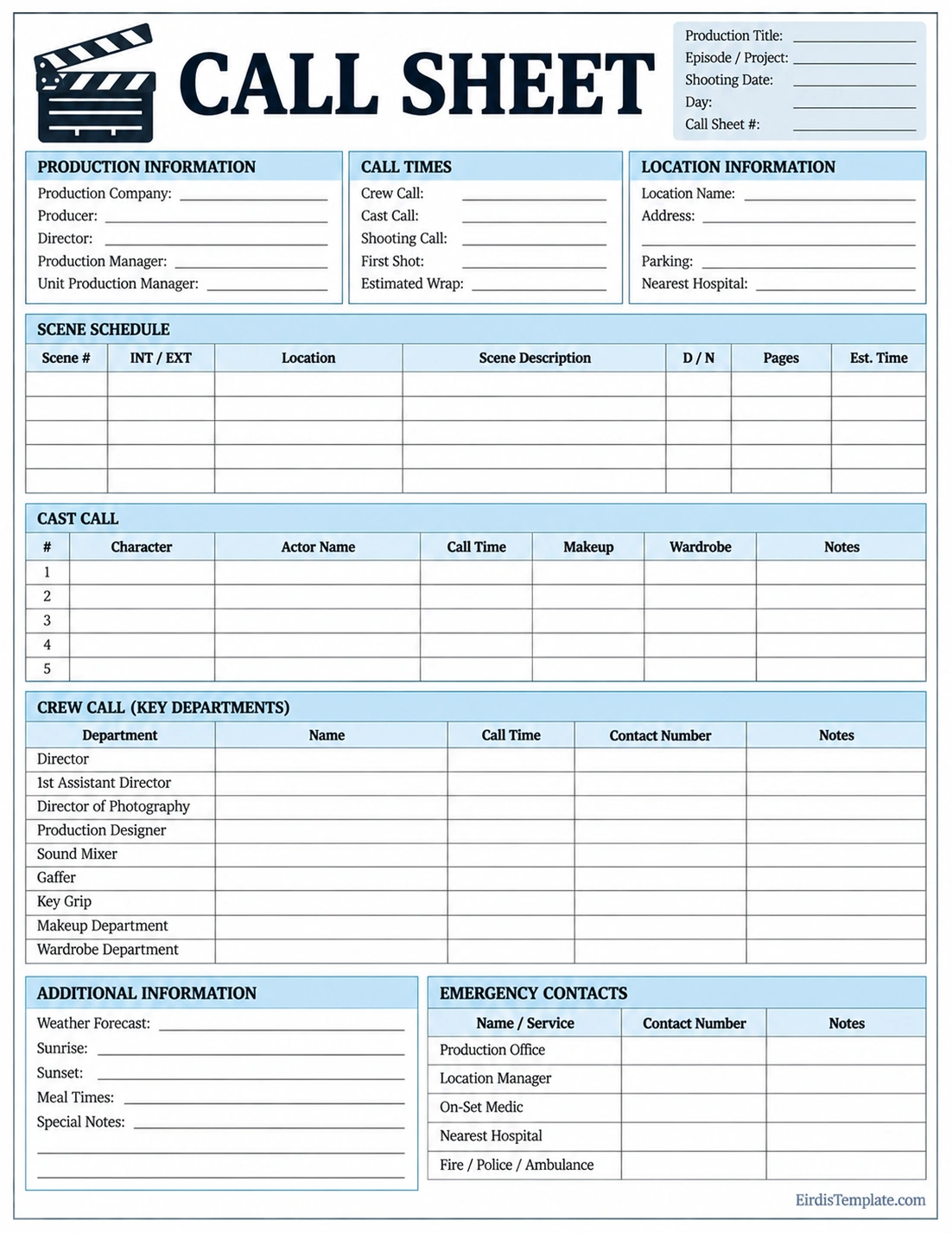
The template includes fields for the production title, shooting date, production personnel, crew and cast call times, location information, and estimated wrap time. A scene schedule table provides space for scene numbers, interior or exterior settings, descriptions, day or night details, page counts, and estimated duration.
Additional sections organize cast call times, key crew departments, weather information, meal times, special notes, and emergency contacts. You can customize these sections to suit the size and needs of your production.
Before distributing the completed call sheet, verify the shooting date, address, arrival times, scene assignments, and contact details. Remove unused fields where appropriate, and make sure the final document is easy to read on both paper and mobile devices.
What Information Should a Call Sheet Include?
The exact format varies by production, but most daily film call sheets contain several essential sections. Each section should provide practical information that helps people prepare for the shooting day.
Production Information
Start with the production title, project or episode name, shooting date, and day number. Include the production company and the names or contact details of key personnel when appropriate.
Clear identification helps cast and crew distinguish the current document from call sheets issued for previous shooting days.
General Call Times
A call time is the time a person or group is expected to report for work or a scheduled production activity. A call sheet may distinguish between crew call, cast call, department calls, and the planned first shot.
These times are not always identical. Actors may need time for makeup and wardrobe before their scenes, while crew members may arrive earlier to prepare equipment and the set.
Location and Parking Details
Provide the shooting location’s name and full address. Include parking instructions, access restrictions, entrance details, loading areas, and location-specific requirements when needed.
For remote locations or sites that are difficult to find, consider adding clear directions or a verified map link. Confirm that the location information is current before sending the call sheet.
Scene Schedule
The scene schedule lists the scenes planned for the day. Useful details may include the scene number, location, short description, interior or exterior designation, day or night setting, script page count, and estimated shooting time.
The schedule helps departments anticipate the work required for each scene. However, the order of scenes filmed may differ from the story’s chronological order because of location availability, actor schedules, lighting conditions, or production logistics.
Cast Call Information
List the actors required for the shooting day, along with their character names, individual call times, and relevant notes. Depending on the production, notes may cover makeup, wardrobe, rehearsal, or transportation requirements.
Share only the personal information necessary for production coordination. Sensitive details should be handled according to the production’s privacy and safety procedures.
Crew Departments and Contacts
Include contact details for relevant department heads and production personnel. Common departments include directing, cinematography, production design, sound, lighting, grip, makeup, and wardrobe.
Not every production needs a full department directory. A small video project may require only a few contacts, while a large film production may need a more detailed list.
Weather, Meals, and Special Notes
Outdoor productions may benefit from a weather forecast, sunrise and sunset times, and relevant environmental notices. The call sheet can also identify planned meal times, special equipment requirements, location restrictions, and other operational details.
Weather information should be checked against a reliable source for the correct location and date. If conditions may affect safety, the production team should communicate the appropriate precautions and contingency plans.
Emergency Information
Where appropriate, provide the location of the nearest suitable medical facility, on-set medical contact, and emergency contact procedures. Include any location-specific safety instructions that cast and crew need to know.
Emergency details must be accurate and easy to find. The production team should verify addresses, phone numbers, and access instructions rather than relying on outdated information.
How to Create a Call Sheet Step by Step
Preparing a call sheet requires coordination between the production schedule, cast availability, locations, and department requirements. Follow these steps to create a clear and practical daily production document.
- Step 1: Confirm the shooting day. Identify the project, date, production day, and scenes planned for filming.
- Step 2: Review the production schedule. Confirm the scene order, locations, cast requirements, and expected shooting duration.
- Step 3: Set call times. Coordinate crew, cast, and department arrival times with the assistant director or responsible production manager.
- Step 4: Verify locations. Confirm addresses, access instructions, parking, and any location restrictions.
- Step 5: Identify required cast and crew. List the people and departments needed for the day’s planned work.
- Step 6: Add logistical details. Include meal times, weather information, equipment notes, transportation details, and other relevant instructions.
- Step 7: Include safety information. Verify emergency contacts and communicate known hazards or required precautions.
- Step 8: Review the document. Check names, times, addresses, scene numbers, and contact details for errors or inconsistencies.
- Step 9: Distribute the call sheet. Send the approved version through the production’s established communication channel with enough time for recipients to prepare.
- Step 10: Communicate changes. If the plan changes, issue a clearly identified revision and notify the affected people directly.
Responsibility for preparing and approving a call sheet varies by production. Establish a clear review process so the final document reflects the latest approved schedule.
Tips for Creating an Effective Call Sheet
A call sheet should be comprehensive without becoming difficult to scan. These practical tips can improve accuracy and usability.
- Prioritize essential information: Put the shooting date, general call times, and location details where readers can find them quickly.
- Use consistent formatting: Apply the same time format, section headings, and scene notation throughout the document.
- Keep descriptions concise: Use short scene descriptions and direct instructions.
- Verify all contact details: Check phone numbers, names, addresses, and emergency information before distribution.
- Allow realistic preparation time: Coordinate call times with makeup, wardrobe, equipment setup, and location access.
- Make changes easy to identify: Include a revision date or version label when a call sheet is updated.
- Protect private information: Distribute the document only to the people who need it and avoid unnecessary sensitive details.
- Plan for contingencies: Consider weather changes, location issues, and other foreseeable disruptions.
- Use a readable layout: Ensure that tables, headings, and small-print instructions remain legible on mobile screens and printed pages.
Common Call Sheet Mistakes to Avoid
Small errors in a daily production schedule can cause missed calls, confusion, and delays. Check for these common problems before distributing the document.
- Incorrect call times: Confirm individual and general call times against the approved schedule.
- Incomplete location instructions: Provide enough information for people to find the correct entrance or meeting point.
- Outdated contact details: Verify key contacts and emergency information before each shooting day.
- Missing cast or crew members: Check that everyone required for the planned scenes is included.
- Unrealistic scene estimates: Coordinate the schedule with department heads and account for necessary preparation.
- Unclear revisions: Make sure recipients can identify the latest version of the call sheet.
- Overloading the document: Keep information relevant to the day’s production rather than adding unnecessary details.
- Ignoring safety communication: Include applicable site instructions and communicate urgent hazards directly.
Call Sheet vs. Production Schedule
A call sheet and a production schedule serve related but different purposes. A production schedule organizes the filming plan across multiple days, including which scenes will be filmed and when. A call sheet translates the plan for one specific shooting day into practical instructions for cast and crew.
For example, a production schedule may show that scenes at a particular location will be filmed on Thursday. The Thursday call sheet then provides the precise location, arrival times, required cast, planned scenes, parking information, and other daily details.
Both documents should remain consistent. When the production schedule changes, the team should review whether the current call sheet and related instructions also need updating.
Frequently Asked Questions About Call Sheets
What is the purpose of a call sheet?
A call sheet communicates the essential details for a day of filming, including arrival times, locations, scene assignments, cast and crew requirements, and relevant contacts. It helps coordinate departments and reduce avoidable delays.
Who prepares a call sheet?
The production office or assistant director’s team commonly prepares the call sheet, often with input from department heads and production management. The exact responsibilities depend on the size and structure of the production.
When should a call sheet be sent?
It should be distributed early enough for cast and crew to review their instructions and prepare for the next shooting day. Production teams often send it the previous day, but the timing depends on the project and its communication procedures.
What is the difference between a crew call and a cast call?
A crew call is the reporting time for crew members, while a cast call is the reporting time for actors. These times can differ because cast and crew have different preparation requirements and scheduled responsibilities.
Can I use a call sheet template for a small video production?
Yes. A call sheet template can be adapted for short films, commercials, music videos, interviews, and other video projects. Smaller productions may need fewer sections, but they should still communicate the schedule, location, required participants, and relevant safety information.
What happens if the call sheet changes?
The production team should distribute a clearly identified updated version and notify anyone affected by the changes. Important changes to call times, locations, or safety instructions should be communicated directly rather than relying only on a revised document.
Does a call sheet replace a production schedule?
No. A production schedule organizes the plan across multiple filming days, while a call sheet provides detailed instructions for one particular day. Both documents work together to keep the production organized.
Conclusion
A call sheet is a vital communication tool for film and video production. It brings daily call times, locations, scene information, cast and crew requirements, and important safety details into one accessible document.
Use a printable call sheet template to organize the information required for each filming day. Verify the details, distribute the approved document in time for everyone to prepare, and communicate revisions clearly. A well-maintained call sheet helps production teams coordinate their work, reduce confusion, and make better use of valuable shooting time.
Download: Call Sheet Template

- Free Printable Call Sheet Template - October 12, 2026
- Free Printable Business Hours Template - October 12, 2026
- Business Expense Template - October 12, 2026
