A building budget is an essential financial plan for managing the costs of a construction project. It helps property owners, contractors, and project managers estimate expenses, allocate resources, and track spending from the planning stage to completion. With a clear budget, you can make informed decisions, reduce financial surprises, and keep construction work within your available funds.
Building a house, renovating a property, or developing a commercial space involves many expenses. These may include design fees, permits, materials, labor, equipment, utilities, and finishing work. Without a structured plan, small cost increases can accumulate and put pressure on the entire project.
A building budget template provides a practical way to organize these costs in one place. By comparing estimated costs with actual spending, you can identify differences early and adjust your plans before they become major problems. This guide explains how to create a construction budget, which expenses to include, and how to use a printable building budget worksheet effectively.
What Is a Building Budget?
A building budget is a financial plan that estimates the total cost of a construction project. It lists expected expenses for each phase of the work and establishes a spending limit for the project as a whole.
A construction budget typically covers pre-construction activities, site preparation, structural work, building systems, interior finishes, exterior improvements, and contingency funds. Depending on the project, it may also include land acquisition, professional fees, insurance, financing costs, and taxes.
The budget serves as a reference for owners, architects, contractors, and other stakeholders. It helps everyone understand the expected financial commitment and provides a basis for monitoring spending throughout the project.
A building budget is different from a construction schedule. The budget focuses on money, while the schedule outlines when tasks should happen. However, the two should work together because delays can increase labor, equipment, storage, and other project costs.
Why Is a Construction Budget Important?
A detailed building budget makes it easier to control costs and manage resources. It also gives project stakeholders a clearer picture of the financial decisions required at each stage.
- Controls project costs: Establishes a spending plan and helps identify expenses that exceed estimates.
- Supports resource allocation: Helps plan the purchase of materials, labor, equipment, and subcontractor services.
- Improves decision-making: Allows owners to compare design choices and material options before committing to costs.
- Reduces financial surprises: Encourages early planning for price changes, delays, and unexpected site conditions.
- Improves communication: Gives owners, contractors, and project managers a shared financial reference.
- Tracks project performance: Makes it easier to compare estimated costs with actual spending.
- Protects project feasibility: Helps determine whether the proposed scope can be completed within the available funds.
A budget does not eliminate every construction risk. However, regular reviews can reveal problems early enough for the project team to consider practical solutions.
Printable Building Budget Template
A printable building budget template helps organize construction expenses into clear categories. It provides space to record estimated costs, actual costs, differences, and notes for each item.
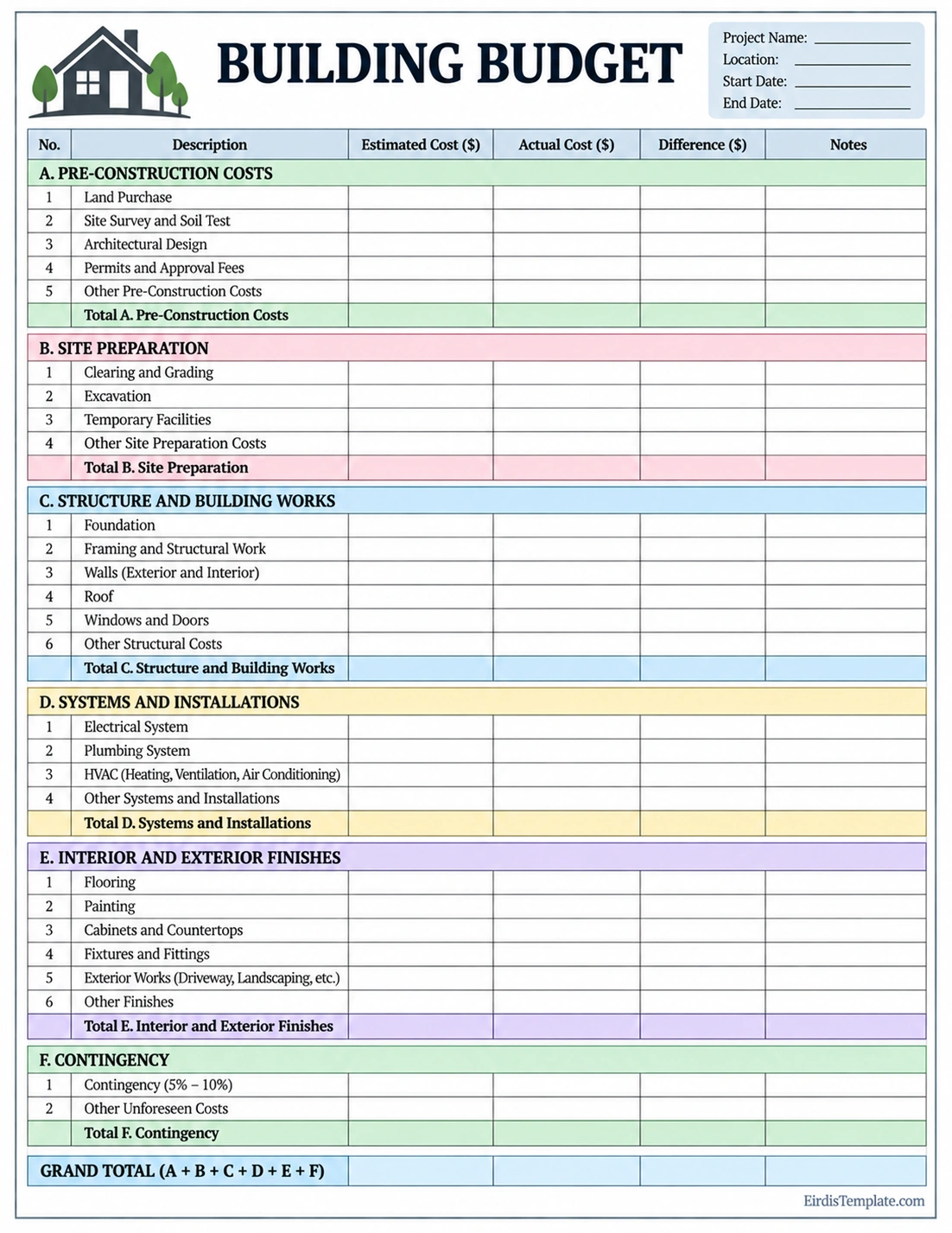
The worksheet includes sections for pre-construction costs, site preparation, structural work, systems and installations, interior and exterior finishes, and contingency expenses. It also provides project details, category subtotals, and a grand total section.
Enter the expected cost of each item before work begins. As the project progresses, record actual spending and note any difference between the estimate and the amount paid or committed. Use the notes column to explain price changes, approved variations, or other relevant details.
You can adapt the template to suit a new home, an extension, a renovation, or a small commercial building. Add or remove cost categories to match the scope of your project. For complex construction work, use the printable worksheet alongside a detailed spreadsheet or project cost management system.
What Should a Building Budget Include?
Every construction project is different, but a comprehensive budget should account for the major costs required to complete the planned work. Include direct construction expenses as well as relevant professional, administrative, and project-related costs.
Pre-Construction Costs
Pre-construction expenses occur before physical building work begins. They help establish the project’s feasibility, design, and legal readiness.
- Land purchase or site acquisition, if applicable
- Architectural and engineering design fees
- Site surveys and soil testing
- Planning applications, permits, and approval fees
- Consultant fees and other professional services
Confirm which approvals and professional services are necessary for your location. Requirements can vary according to the building type, size, intended use, and local regulations.
Site Preparation
Site preparation makes the land ready for construction. Costs depend on the existing conditions, access, drainage requirements, and amount of work needed.
- Clearing vegetation and debris
- Excavation and grading
- Soil improvement or stabilization
- Temporary site facilities and fencing
- Site access, drainage, and other preparation work
Unfamiliar ground conditions can create additional costs. Where appropriate, obtain professional site assessments before finalizing the construction estimate.
Structural and Building Work
Structural work forms the main physical structure of the building. Accurate estimates are important because these costs can represent a substantial portion of the total construction budget.
- Foundation and footing work
- Structural framing and load-bearing elements
- Exterior and interior walls
- Roofing and waterproofing
- Windows, exterior doors, and related installations
- Other structural materials and labor
Request detailed quotations that specify materials, quantities, labor, and the work included. This makes it easier to compare bids and identify items that may have been excluded.
Systems and Installations
Building systems make the property functional and comfortable. Depending on the project, the budget may include electrical wiring, plumbing, ventilation, heating, cooling, and related equipment.
Include installation labor, necessary materials, testing, and inspections where applicable. Coordinate these systems with the construction schedule to reduce rework and avoid unnecessary delays.
Interior and Exterior Finishes
Finishing costs can vary widely depending on the selected materials and quality level. Establish priorities before choosing products so that decorative upgrades do not consume funds needed for essential work.
- Flooring, wall finishes, and painting
- Cabinets, countertops, and built-in storage
- Doors, fixtures, and fittings
- Bathroom and kitchen finishes
- Driveways, landscaping, and exterior improvements
- Final cleaning and completion work
When comparing materials, consider durability, maintenance, availability, and installation costs rather than focusing only on the purchase price.
Labor, Equipment, and Other Costs
Depending on how the budget is structured, labor and equipment may be listed within each construction category or tracked separately. Include contractor charges, subcontractor fees, equipment rental, transportation, waste removal, and other costs required to complete the work.
Avoid counting the same expense in multiple categories. Consistent classification makes the total budget easier to understand and reduces the risk of double-counting.
Contingency Allowance
A contingency allowance is money reserved for unexpected or uncertain project costs. It may cover unforeseen site conditions, necessary design adjustments, material price changes, or other legitimate surprises.
The appropriate amount depends on the project’s complexity, design maturity, and risk level. Some preliminary budgets use a contingency of around 5% to 10%, but this is only a general starting point, not a universal rule. Projects with substantial uncertainty may require a different allowance based on professional advice.
How to Prepare a Building Budget Step by Step
Creating a reliable construction budget requires a clear scope, realistic estimates, and a consistent method for tracking costs. Follow these steps to develop a useful financial plan.
- Step 1: Define the project scope. Identify the building size, design, materials, quality level, and work included in the project.
- Step 2: Establish the available budget. Determine the amount of funding available and identify any financing limits or cash-flow constraints.
- Step 3: Obtain professional estimates. Request quotations from qualified contractors, suppliers, architects, engineers, or quantity surveyors as appropriate.
- Step 4: Break down the costs. Divide the project into categories and list major materials, labor, equipment, and professional fees.
- Step 5: Include indirect expenses. Consider permits, insurance, temporary facilities, transportation, waste removal, and other relevant project costs.
- Step 6: Set a contingency allowance. Assess the main project risks and reserve funds appropriate to the level of uncertainty.
- Step 7: Calculate the total estimated cost. Add the categories together and compare the result with the available budget.
- Step 8: Review and approve the budget. Resolve unclear quotations, exclusions, and assumptions before committing to major expenses.
- Step 9: Track actual costs. Record invoices, payments, purchase orders, and approved changes throughout construction.
- Step 10: Update the forecast. Recalculate the expected final cost whenever new information changes the financial outlook.
Before work begins, confirm whether the budget includes taxes, professional fees, utility connections, financing costs, and other items that may not appear in a contractor’s basic quotation.
Estimated Cost vs. Actual Cost
Comparing estimated costs with actual costs is one of the most useful parts of construction budget management. It shows whether spending is following the plan and helps the project team investigate differences.
Basic formula: Cost Difference = Actual Cost − Estimated Cost
If the estimated cost of a flooring installation is $4,000 and the actual cost is $4,500, the difference is $500 over budget. If the actual cost is $3,700, the difference is negative $300, meaning the work cost less than estimated.
For meaningful comparisons, use consistent definitions. Decide whether the actual cost column represents costs paid, costs incurred, or costs committed under contracts and purchase orders. These measures are related but not identical, so a project may track them separately.
Review significant differences as soon as they appear. Confirm whether the cause is a price increase, quantity change, design revision, delay, or estimation error. Then update the forecast and obtain approval for changes according to the project’s agreed procedures.
Tips for Staying Within Your Building Budget
Good budgeting depends on more than estimating the initial cost. Regular monitoring and clear communication help prevent small issues from becoming major financial problems.
- Finalize the scope early: Frequent design changes can increase material, labor, and scheduling costs.
- Compare detailed quotations: Check the scope, quality, exclusions, taxes, and delivery charges rather than comparing headline prices alone.
- Prioritize essential work: Protect structural quality, safety, and required systems before spending on optional upgrades.
- Track spending regularly: Update the budget weekly or at another interval appropriate to the project.
- Monitor material prices: Confirm supplier quotations, delivery dates, and price validity periods.
- Document variations: Record approved changes to materials, quantities, or scope along with their financial impact.
- Coordinate the schedule: Delays can lead to additional labor, equipment, storage, and temporary facility costs.
- Protect the contingency fund: Use reserved funds for justified project risks instead of treating them as extra money for optional upgrades.
- Communicate with stakeholders: Share budget updates and explain significant changes before they affect project decisions.
Common Building Budget Mistakes to Avoid
Construction budgets can become unreliable when estimates omit important costs or when spending is not tracked consistently. Avoid these common mistakes.
- Underestimating project scope: Incomplete plans can lead to missing materials, extra labor, and unexpected work.
- Ignoring indirect costs: Permits, insurance, delivery, waste removal, and professional services can add substantially to the total.
- Using outdated quotations: Material prices and contractor rates may change before purchases are made.
- Leaving out contingency: Without an appropriate reserve, unexpected costs may disrupt the project.
- Making unapproved changes: Additional work should be documented and assessed before it is authorized.
- Failing to update the forecast: An original estimate becomes less useful when actual costs and remaining commitments are not reflected.
- Choosing the lowest bid automatically: An unusually low quotation may exclude important work or rely on assumptions that are not realistic.
- Confusing budget and cash flow: A project may be within its total budget but still face payment problems if funds are not available when invoices fall due.
Frequently Asked Questions About Building Budgets
What is the purpose of a building budget?
A building budget estimates the cost of a construction project and provides a framework for managing spending. It helps allocate resources, compare actual costs with estimates, and identify financial risks before they affect the project significantly.
What should a building budget include?
It should include the relevant costs of design, permits, site preparation, materials, labor, equipment, structural work, building systems, finishes, and contingency. Depending on the project, it may also include land, insurance, taxes, utility connections, and professional fees.
How much contingency should a construction budget include?
The appropriate contingency depends on the project scope, design certainty, site conditions, and risks. A preliminary estimate may use 5% to 10% as a starting point, but a qualified construction professional can help determine a suitable allowance for the specific project.
How often should a building budget be updated?
Update the budget regularly throughout construction and whenever a significant cost, scope, or schedule change occurs. Weekly reviews may suit active projects, while smaller projects may use another consistent schedule.
What is the difference between a building budget and a construction estimate?
A construction estimate predicts the cost of specified work based on available plans, quantities, prices, and assumptions. A building budget is the broader financial plan used to allocate funds and control total project spending. The estimate helps establish the budget, while actual costs and approved changes help keep it current.
Can I use a building budget template for home renovation?
Yes. A building budget template can be adapted for home renovations, extensions, new construction, or commercial projects. Customize the categories to match the work and include the costs, contingency, and approvals relevant to your project.
What should I do if construction costs exceed the budget?
Identify the cause of the increase, review remaining work, and update the forecast. Consider value engineering, alternative materials, revised sequencing, or changes to optional features while maintaining required safety and quality standards. Discuss significant changes with the relevant stakeholders before approving them.
Conclusion
A building budget provides a financial roadmap for planning and controlling construction costs. By estimating expenses, allocating resources, tracking actual spending, and preparing for uncertainty, project owners and contractors can make better decisions throughout the building process.
Use a printable building budget template to organize cost categories, compare estimates with actual figures, and document important changes. Review the budget regularly, obtain detailed quotations, and maintain a suitable contingency allowance. With accurate records and consistent monitoring, you can improve cost control and make informed decisions from the initial planning stage to project completion.
Download: Building Budget Template

- Free Printable Call Sheet Template - October 12, 2026
- Free Printable Business Hours Template - October 12, 2026
- Business Expense Template - October 12, 2026
