A Staff Confidentiality Agreement is a written contract that establishes how employees must handle a company’s confidential and proprietary information. It helps define what information should remain private, how employees may use that information, and what responsibilities continue during and, where legally applicable, after employment.
Businesses routinely handle information that may provide commercial value, including customer lists, business plans, pricing information, product development details, internal processes, research, financial information, trade secrets, and intellectual property. Unauthorized disclosure or misuse of this information can create significant business and legal risks.
A clear confidentiality agreement gives employees specific expectations about protecting sensitive information. It also gives the company a written framework for addressing confidentiality obligations and potential breaches.
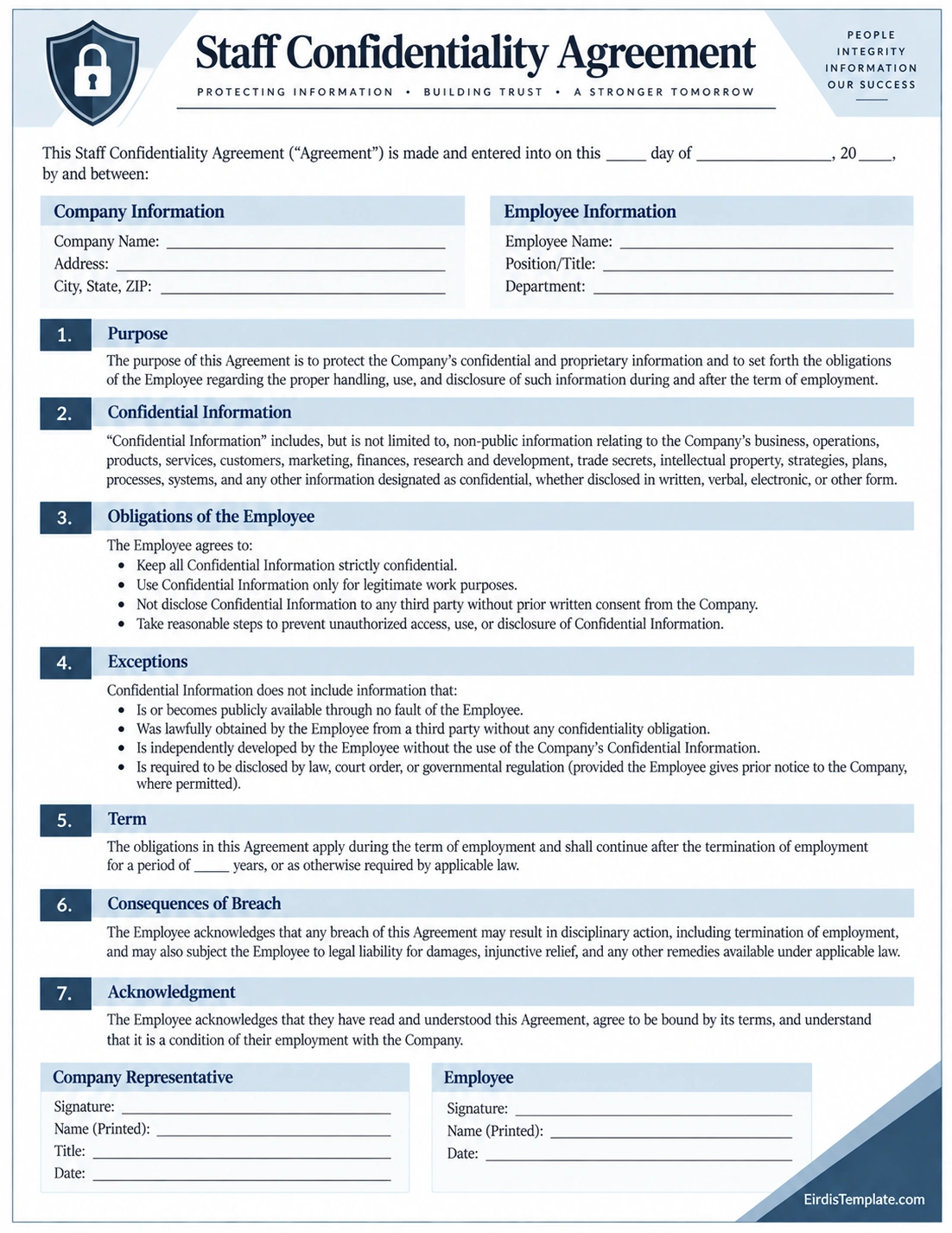
What Is a Staff Confidentiality Agreement?
A Staff Confidentiality Agreement is an agreement between an employer and an employee concerning the protection of confidential business information. It is sometimes referred to as an employee confidentiality agreement, employee non-disclosure agreement, or staff NDA, depending on its structure and purpose.
The agreement typically identifies categories of information that the company considers confidential and establishes rules governing the employee’s access, use, storage, and disclosure of that information.
The specific legal effect of a confidentiality agreement depends on its wording, applicable law, the employment relationship, and the type of information involved. A confidentiality agreement should therefore be drafted and used with the relevant legal requirements in mind.
Why Is a Staff Confidentiality Agreement Important?
Employees may have access to sensitive information simply because they need it to perform their jobs. A salesperson may work with customer data, a developer may access source code, and a manager may have access to financial reports or strategic plans.
A confidentiality agreement establishes clear expectations before confidential information is shared or accessed.
A Staff Confidentiality Agreement can help a company:
- Identify information that should be treated as confidential.
- Explain how employees may use sensitive information.
- Limit unauthorized disclosure or use.
- Protect commercially valuable information.
- Establish employee responsibilities for safeguarding company data.
- Clarify obligations relating to information after employment ends.
- Create a written record of the employee’s confidentiality commitments.
- Support the company’s broader information security and risk-management practices.
The agreement should work alongside appropriate technical, organizational, and legal safeguards rather than being treated as the only measure for protecting confidential information.
What Information Can Be Covered?
The definition of confidential information should be sufficiently clear to identify the types of information employees are expected to protect. Depending on the business, this may include information in written, electronic, verbal, visual, or other forms.
Trade Secrets
Trade secrets may include proprietary formulas, methods, processes, techniques, or other information that derives value from not being generally known and is subject to reasonable efforts to maintain its secrecy.
Businesses should not assume that every piece of internal information automatically qualifies as a trade secret. The applicable legal definition and requirements vary by jurisdiction.
Customer and Client Information
Customer lists, contact information, purchasing information, account details, preferences, and other business-related customer data may require protection. Some information may also be subject to privacy or data-protection requirements.
Business Plans and Strategies
Companies may want to protect information about future products, expansion plans, marketing strategies, pricing strategies, partnerships, acquisitions, and other non-public business plans.
Financial Information
Internal budgets, forecasts, financial reports, pricing structures, revenue information, cost data, and other non-public financial information may be included when appropriate.
Intellectual Property
Confidentiality provisions may cover information relating to inventions, designs, source code, technical documentation, research, product concepts, and other intellectual property-related materials.
What Should a Staff Confidentiality Agreement Include?
A well-structured employee confidentiality agreement should clearly explain the parties’ obligations without relying on unnecessarily broad or confusing language.
Company and Employee Information
Begin by identifying the employer and employee. Include the company name, employee name, job title, department, and other information needed to identify the parties accurately.
Purpose of the Agreement
The agreement should explain why confidentiality obligations exist. The purpose may be to protect company confidential information and establish rules for its appropriate use and disclosure.
Definition of Confidential Information
This section identifies the types of information covered by the agreement. The definition should be tailored to the company’s actual operations and the employee’s role.
Examples may include:
- Business strategies and plans.
- Customer and supplier information.
- Trade secrets.
- Product development information.
- Research and development materials.
- Internal processes and procedures.
- Marketing strategies.
- Non-public financial information.
- Technical documentation and source code.
- Proprietary intellectual property.
Employee Confidentiality Obligations
The agreement should explain what employees are expected to do with confidential information. Common obligations may include using confidential information only for legitimate work purposes, protecting it from unauthorized access, and not disclosing it to unauthorized individuals.
The employee may also be required to follow the company’s security policies and take reasonable precautions when storing, transmitting, or disposing of sensitive information.
Permitted Disclosures and Exceptions
A confidentiality agreement should address circumstances in which information is not considered confidential or may legally need to be disclosed.
Depending on the agreement and applicable law, exceptions may include information that is already publicly available through no breach of the agreement, information lawfully received from an independent source without a confidentiality obligation, independently developed information, or disclosures required by law or legal process.
Legal protections and exceptions can vary by jurisdiction, so this section should be reviewed carefully.
Duration of Confidentiality Obligations
The agreement should state when confidentiality obligations begin and, where appropriate, how long they continue. Some obligations may apply throughout employment, while certain obligations may continue after employment ends.
The appropriate duration can depend on the nature of the information and applicable law. Trade secret protection, for example, may be treated differently from ordinary confidential business information.
Employee Responsibilities for Confidential Information
A Staff Confidentiality Agreement should provide practical expectations rather than simply stating that information must remain secret.
Employee responsibilities may include:
- Accessing confidential information only when required for work.
- Using company information only for authorized purposes.
- Not sharing confidential information with unauthorized people.
- Following company information-security procedures.
- Protecting passwords, devices, documents, and other access credentials.
- Reporting suspected unauthorized access or disclosure.
- Returning or securely disposing of company information when required.
These obligations should be consistent with the company’s actual security policies and workplace practices.
Confidentiality After Employment Ends
Confidentiality responsibilities may continue after an employee leaves the company, depending on the agreement, the nature of the information, and applicable law.
A post-employment confidentiality provision may require a former employee to continue protecting qualifying confidential information and refrain from unauthorized disclosure or use.
When employment ends, the company may also require the employee to return company documents, devices, files, records, credentials, and other materials containing confidential information, subject to applicable requirements.
Confidentiality Agreement vs. Non-Disclosure Agreement
The terms confidentiality agreement and non-disclosure agreement (NDA) are often used interchangeably, but the exact scope of a document depends on its wording.
A staff confidentiality agreement generally focuses on an employee’s obligations to protect employer information. An NDA can be used in a wider range of relationships, including relationships between businesses, contractors, consultants, investors, or potential business partners.
The important consideration is not simply the document’s title but the actual provisions defining confidential information, permitted use, disclosure restrictions, exceptions, duration, and available remedies.
What Happens If Confidentiality Is Breached?
The agreement may explain the potential consequences of an unauthorized disclosure or misuse of confidential information. Depending on the circumstances and applicable law, consequences may include workplace disciplinary action, termination where permitted, or legal remedies.
The agreement should avoid suggesting that every breach automatically results in a particular legal outcome. The actual consequences can depend on the seriousness of the conduct, the contract, company policies, applicable law, and the facts of the situation.
Companies should also ensure that any contractual remedies are legally appropriate and enforceable in the relevant jurisdiction.
How to Create a Staff Confidentiality Agreement
Identify Sensitive Business Information
Start by identifying the categories of information employees may access and that the company legitimately needs to protect. Consider customer data, technical information, business strategies, financial information, intellectual property, and other non-public information.
Define Employee Responsibilities
Explain how employees are expected to use, protect, store, and disclose confidential information. Keep the obligations understandable and connected to actual workplace practices.
Include Appropriate Exceptions
Review whether the agreement needs exceptions for publicly available information, independently developed information, lawful third-party disclosures, legally required disclosures, or other circumstances recognized by applicable law.
Specify the Duration
State when the obligations begin and whether particular confidentiality obligations continue after employment ends. Different categories of information may require different treatment.
Review the Agreement Before Signing
Both the company and employee should understand the agreement before it is signed. Employers should also ensure that the document is consistent with employment policies, information-security procedures, and applicable laws.
Tips for Using a Staff Confidentiality Agreement Template
A Staff Confidentiality Agreement Template can provide a useful framework for organizing the main sections of an employee confidentiality document. A template may include company and employee details, the purpose of the agreement, confidential information, employee obligations, exceptions, duration, breach provisions, and signatures.
However, a template should be customized for the company’s actual circumstances. A technology company, healthcare organization, manufacturer, professional-services firm, and retail business may have very different categories of sensitive information.
Employers should avoid including information categories that are irrelevant or using unnecessarily broad language without considering applicable legal requirements. A qualified attorney can help review the agreement when the business needs legally significant confidentiality protections.
Common Mistakes to Avoid
- Using an overly vague definition: Employees should be able to understand what information is covered.
- Defining everything as confidential: The agreement should distinguish genuinely sensitive information from information that does not require protection.
- Ignoring exceptions: Appropriate exclusions and legally protected disclosures should be considered.
- Forgetting post-employment obligations: Address whether and how confidentiality duties continue after employment.
- Ignoring information-security practices: Contractual obligations should align with actual company policies.
- Using the same document for every situation: Different roles may involve different types of confidential information.
- Failing to update the agreement: Confidentiality practices may need revision as the company’s operations and technology change.
- Assuming a template guarantees legal protection: Enforceability depends on the agreement, circumstances, and applicable law.
Staff Confidentiality Agreement Checklist
Before finalizing an employee confidentiality agreement, review the following points:
- Company information is accurate.
- Employee information is complete.
- The purpose of the agreement is clearly stated.
- Confidential information is adequately defined.
- Employee obligations are understandable.
- Permitted uses of confidential information are addressed.
- Appropriate exceptions are included.
- Post-employment obligations are addressed where appropriate.
- Return or handling of company information is covered when necessary.
- Potential breach consequences are described appropriately.
- The agreement is consistent with company policies.
- The agreement has been reviewed for applicable legal requirements.
- Both parties have signed and dated the document.
Conclusion
A Staff Confidentiality Agreement helps establish clear expectations for protecting a company’s confidential and proprietary information. By defining sensitive information, employee responsibilities, permitted disclosures, exceptions, duration, and potential consequences of unauthorized use or disclosure, the agreement can become an important part of a company’s broader approach to information protection.
A Staff Confidentiality Agreement Template can simplify the process of organizing these provisions, but it should be customized to the company’s operations, the employee’s role, and applicable legal requirements.
Confidentiality agreements are only one part of protecting business information. Appropriate access controls, employee training, security policies, data-management procedures, and other safeguards can also play important roles in reducing unauthorized access or disclosure.
This article and template are provided for general informational purposes and are not legal advice. Because employment and confidentiality laws vary by jurisdiction and circumstances, businesses should consider obtaining advice from a qualified legal professional when preparing or implementing a legally binding agreement.
Download: Staff Confidentiality Agreement Template

- Printable Weekly Food Chart Template - September 18, 2026
- Free Printable Weekly Cleaning Chart Template - September 18, 2026
- Free Separation Agreement Template (Word) - September 18, 2026
