An annual budget is a financial plan that estimates your income and expenses for an entire year. It provides a clear framework for deciding how much money to allocate to housing, transportation, food, savings, debt repayment, business costs, and other financial priorities.
Creating an annual budget can make it easier to understand where money is expected to come from, where it will be spent, and whether current plans support long-term financial goals. Instead of making financial decisions month by month without a larger plan, an annual budget gives you a complete view of the year.
A well-organized budget can also help individuals, families, organizations, and small businesses prepare for seasonal expenses, monitor financial performance, manage unexpected costs, and make informed adjustments throughout the year.
What Is an Annual Budget?
An annual budget is a financial plan covering a 12-month period. It typically lists expected income, planned expenses, savings, debt payments, and other financial commitments for each month and for the year as a whole.
Unlike a simple monthly budget, an annual budget allows you to see how individual months fit into your overall financial plan. This can be especially useful when income or expenses change throughout the year.
For example, some expenses may occur only once or twice a year. Insurance premiums, property taxes, school expenses, annual subscriptions, holidays, maintenance, and business fees can be easier to manage when they are included in a yearly financial plan.
An annual budget does not need to predict every expense perfectly. Its purpose is to create a practical financial framework that can be reviewed and adjusted as circumstances change.
Why Is an Annual Budget Important?
A yearly budget provides a broader perspective than tracking individual transactions. It helps connect everyday spending with larger financial objectives.
Some of the main benefits include:
- Better financial planning: You can plan income and expenses before they occur.
- Improved spending control: Budget categories make it easier to identify unnecessary or excessive spending.
- Goal setting: You can allocate money toward savings, investments, debt repayment, or other priorities.
- Cash flow awareness: A yearly view can reveal months when expenses may be higher than income.
- Preparation for irregular expenses: Annual and seasonal costs can be planned in advance.
- Financial monitoring: Actual results can be compared with the original budget.
- Better decision-making: Financial choices can be evaluated against larger goals instead of short-term needs alone.
Annual Budget Template
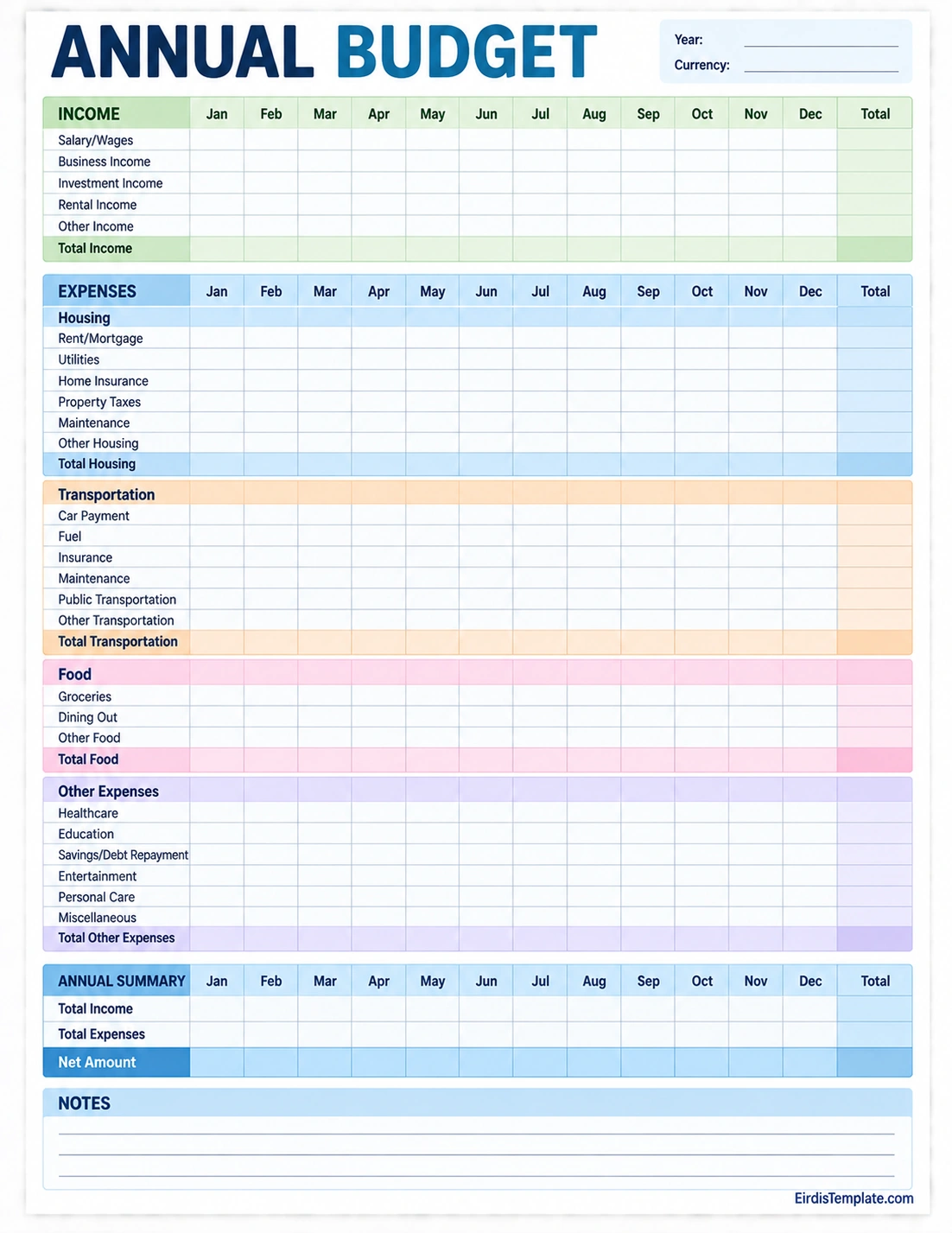
An annual budget template provides a structured way to organize projected income and expenses across all 12 months. A printable template can be particularly useful for people who prefer to write down financial information or review their budget away from a computer.
A practical yearly budget worksheet may include separate sections for income, housing, transportation, food, healthcare, education, savings, debt repayment, personal expenses, and miscellaneous costs. A summary section can then show total income, total expenses, and the remaining amount.
What Should an Annual Budget Include?
The categories in a yearly budget depend on your financial situation. However, a comprehensive budget usually includes several important areas.
Income
Start by estimating all regular and reasonably predictable sources of income. Depending on your situation, this may include salary, wages, freelance income, business income, rental income, investment income, or other recurring sources.
If income changes from month to month, use a realistic estimate rather than assuming that every month will produce the highest possible amount.
Housing Expenses
Housing is often one of the largest budget categories. Common expenses include rent or mortgage payments, utilities, home insurance, property taxes, maintenance, and other housing-related costs.
Transportation
Transportation costs can include car payments, fuel, insurance, maintenance, registration, parking, public transportation, and other travel-related expenses.
Including maintenance and other irregular vehicle expenses in the annual plan can help prevent unexpected costs from disrupting the monthly budget.
Food and Household Expenses
Food expenses may include groceries, dining out, takeout, and other household food costs. Creating separate categories can make it easier to identify spending patterns and adjust them when necessary.
Savings and Debt Repayment
An annual budget can include planned contributions to savings accounts, emergency funds, investments, and debt repayment. Treating these amounts as planned budget categories can help keep long-term financial priorities visible.
Other Expenses
Additional categories may include healthcare, education, insurance, subscriptions, entertainment, personal care, charitable contributions, gifts, travel, and miscellaneous expenses.
The goal is not to create an unnecessarily complicated spreadsheet. Use categories that reflect your actual financial life and make the budget easy to review.
How to Create an Annual Budget
Creating a yearly budget is easier when you build it step by step. Start with reliable information and then refine your estimates as you learn more about your actual spending.
1. Choose Your Budget Period
Decide which 12-month period you want to plan. Many people use January through December, but a different 12-month period may make more sense for a business, project, academic year, or personal financial cycle.
2. List Your Expected Income
Record your expected income for each month. If your income is stable, this may be straightforward. If it varies, use conservative estimates and update the budget when your actual income becomes known.
3. List Fixed Expenses
Identify expenses that generally remain consistent, such as rent, mortgage payments, subscriptions, insurance payments, or regular debt payments.
4. Estimate Variable Expenses
Next, estimate expenses that change from month to month. These can include groceries, fuel, utilities, entertainment, dining out, and household purchases.
5. Add Annual and Irregular Expenses
Review the year for expenses that do not occur every month. Include annual subscriptions, insurance payments, taxes, school costs, vehicle maintenance, holidays, travel, memberships, and other periodic expenses.
6. Set Financial Goals
Decide how much you want to allocate toward savings, investments, debt reduction, emergency reserves, or other financial objectives. Your goals should be realistic and consistent with your expected income.
7. Calculate the Annual Difference
Compare projected annual income with projected annual expenses. A simple calculation is:
Projected Annual Income – Projected Annual Expenses = Projected Annual Surplus or Shortfall
If the result is positive, you have a projected surplus that can potentially support savings, investments, debt repayment, or other goals. If the result is negative, review your expenses and assumptions to determine where adjustments may be needed.
How to Track an Annual Budget
Creating a budget is only the first step. Regular monitoring helps you determine whether actual financial activity is following the original plan.
At the end of each month, compare your actual results with your budgeted amounts. Look for significant differences rather than worrying about every small variation.
- Record actual income and expenses.
- Compare actual amounts with planned amounts.
- Identify categories with significant overspending.
- Review categories where spending was lower than expected.
- Update future months when circumstances change.
- Check progress toward annual savings and debt goals.
This process turns an annual budget into an active financial management tool rather than a document that is created once and forgotten.
Annual Budget vs. Monthly Budget
An annual budget and a monthly budget serve related but different purposes. A monthly budget focuses closely on short-term cash flow, while an annual budget provides a broader view of the entire financial year.
A monthly budget can answer questions such as, “How much can I spend this month?” An annual budget can help answer questions such as, “How much will I spend on this category this year?” or “Can I afford this annual expense while still reaching my financial goals?”
Using both approaches can provide a more complete picture. The annual plan establishes the larger framework, while monthly reviews help keep actual spending aligned with that plan.
How to Handle Unexpected Expenses
No budget can predict every financial event. Unexpected medical expenses, repairs, changes in income, emergencies, or other circumstances may require adjustments.
Instead of treating the original budget as unchangeable, use it as a planning framework. When something unexpected occurs, review the remaining months and determine which categories can be adjusted.
A budget can also include a reasonable miscellaneous or contingency category for expenses that are difficult to predict. The appropriate amount depends on your circumstances and financial priorities.
Tips for Making an Annual Budget Work
A useful budget should be realistic enough to follow and simple enough to maintain. Consider these practical tips:
- Use realistic estimates: Base projections on previous spending whenever reliable records are available.
- Separate needs and wants: This can make it easier to identify areas for adjustment.
- Plan for irregular expenses: Do not focus only on monthly bills.
- Review the budget regularly: A monthly review can help identify problems early.
- Keep financial goals visible: Include savings and debt goals in the main budget.
- Allow for changes: Income and expenses rarely remain exactly the same throughout an entire year.
- Avoid overly detailed categories: Too many categories can make a budget difficult to maintain.
- Use actual results to improve future budgets: Your previous year’s spending can provide useful information for the next plan.
Common Annual Budgeting Mistakes
Even a well-designed budget can become ineffective if the assumptions are unrealistic or the plan is not reviewed.
Common mistakes include:
- Underestimating irregular or seasonal expenses.
- Assuming income will always remain at its highest level.
- Forgetting annual subscriptions and recurring fees.
- Leaving savings and debt repayment out of the initial plan.
- Creating too many complicated categories.
- Failing to compare actual results with the budget.
- Refusing to adjust the budget when circumstances change.
- Setting financial goals that are unrealistic for the available income.
The best annual budget is not necessarily the most detailed one. It is the one that provides useful information and can realistically be maintained throughout the year.
Annual Budget for Families
Families can use an annual household budget to coordinate recurring bills, savings goals, education expenses, transportation costs, holidays, travel, and other major financial commitments.
A family budget can also make seasonal expenses easier to anticipate. For example, school-related costs or holiday spending may occur during specific months rather than evenly throughout the year.
Reviewing the budget together can help household members understand priorities and make financial decisions based on the same overall plan.
Annual Budget for Small Businesses
Small businesses can use an annual budget to estimate revenue, operating expenses, payroll, marketing costs, equipment purchases, taxes, debt payments, and other business expenses.
A business annual budget can also support planning for growth and help management compare expected financial performance with actual results throughout the year.
Businesses should distinguish between projected figures and actual financial results. An annual budget is a planning document and should not be treated as a substitute for appropriate accounting records or professional financial advice.
Frequently Asked Questions About Annual Budgets
What is an annual budget?
An annual budget is a financial plan covering a 12-month period. It estimates expected income and expenses and helps organize spending, savings, debt repayment, and other financial priorities.
What is the purpose of an annual budget?
The purpose of an annual budget is to provide a yearly financial framework for planning income, controlling expenses, managing resources, monitoring progress, and working toward financial goals.
What should an annual budget include?
An annual budget can include income, housing, transportation, food, healthcare, education, savings, debt payments, entertainment, personal expenses, business costs, and other relevant categories. It should also account for annual or irregular expenses.
How is an annual budget different from a monthly budget?
A monthly budget focuses on short-term income and expenses, while an annual budget provides a 12-month view. Using both can help you manage monthly cash flow while keeping long-term financial goals in sight.
How often should an annual budget be reviewed?
An annual budget should be reviewed regularly, often at least once a month. Regular reviews allow you to compare actual results with projections and adjust future months when income or expenses change.
Can an annual budget change during the year?
Yes. An annual budget is a planning tool, not a fixed prediction. Changes in income, expenses, goals, or unexpected events may require you to revise your projections and adjust spending plans.
What is an annual budget template?
An annual budget template is a pre-structured worksheet or spreadsheet used to organize income and expenses over a 12-month period. It can make yearly financial planning easier by providing predefined categories and monthly sections.
Is an annual budget useful for a small business?
Yes. A small business can use an annual budget to estimate revenue and expenses, plan operating costs, manage cash flow, allocate resources, and compare projected financial performance with actual results.
Conclusion
An annual budget provides a practical framework for managing finances over an entire year. By organizing projected income, fixed expenses, variable costs, savings, debt payments, and irregular expenses, you can gain a clearer understanding of your financial position and priorities.
The most effective budget is realistic, easy to understand, and reviewed regularly. Rather than treating the budget as a rigid document, use it as a flexible planning tool that can be updated when circumstances change.
Whether you are planning a household budget, personal finances, or a small business budget, an annual budget template can provide a simple structure for organizing monthly figures, tracking actual results, and working toward your financial goals throughout the year.
Download: Annual Budget Template

- Free Printable Attendance Sheet Template - October 5, 2026
- Asset Purchase Agreement Template (Word) - October 5, 2026
- Free Annual Budget Template (Excel) - October 5, 2026
