A student resume is a concise document that presents a student’s education, skills, achievements, activities, and relevant experiences. It is commonly used when applying for internships, part-time jobs, entry-level positions, scholarships, volunteer opportunities, or graduate school programs.
Unlike an experienced professional resume, a student resume does not need to depend on a long employment history. Students can highlight academic accomplishments, school projects, extracurricular activities, volunteer work, leadership experience, certifications, technical skills, and other achievements that demonstrate their abilities and potential.
The goal is to give the reader a clear understanding of who you are, what you can do, and how your background relates to the opportunity you are pursuing. A well-organized resume can help you present your strengths professionally even when you are still building your experience.
What Is a Student Resume?
A student resume is a resume specifically designed for students or recent graduates who may have limited professional experience. It focuses on qualifications that demonstrate potential rather than relying primarily on a long employment history.
Depending on the purpose, a student resume may be used for:
- Internship applications
- Part-time jobs
- Summer jobs
- Entry-level positions
- Scholarship applications
- Volunteer opportunities
- Student leadership positions
- Research opportunities
- Graduate school applications
- Academic programs
The content should be adjusted according to the opportunity. For example, a resume for a marketing internship may emphasize communication, social media, content creation, and relevant projects, while a resume for a research opportunity may emphasize academic projects, technical skills, coursework, and research experience.
Why Is a Student Resume Important?
A resume gives an employer, admissions team, scholarship committee, or organization a quick overview of your qualifications. It allows them to understand your background without having to review every detail of your academic or extracurricular history.
A strong student resume can help you:
- Present your qualifications in a professional format.
- Highlight relevant academic and extracurricular achievements.
- Showcase skills that are useful for the opportunity.
- Demonstrate initiative and responsibility.
- Connect your experience to the position or program.
- Make your application easier to review.
Because students often compete with applicants who have different levels of experience, organizing your strongest and most relevant qualifications clearly is especially important.
What Should a Student Resume Include?
The exact sections of a student resume can vary depending on the student’s background and the purpose of the application. However, several sections are commonly useful.
Contact Information
Begin with your basic contact information. Include your full name and appropriate contact details so the reader knows how to reach you.
Depending on the situation, this section may include:
- Full name
- Phone number
- Professional email address
- City and state
- LinkedIn profile
- Professional portfolio or personal website
Use an email address that looks professional and is easy to recognize.
Resume Summary or Objective
A short summary or objective can explain what you are seeking and what you can contribute. This section should be specific rather than using generic statements.
For example, a student applying for a graphic design internship could briefly mention their design education, relevant software skills, and interest in gaining professional experience.
Education
Education is often one of the most important sections of a student resume because students may have limited employment experience.
Include information such as:
- School or university name
- Degree or program
- Expected graduation date
- Relevant academic achievements
- Academic honors
- Relevant coursework when useful
If you have a strong academic record or relevant academic achievement, it can be highlighted when appropriate for the opportunity.
Skills
The skills section should contain abilities that are relevant to the position or program. Avoid creating an unnecessarily long list of unrelated skills.
Examples include:
- Microsoft Office or Google Workspace
- Graphic design software
- Programming languages
- Data analysis
- Research
- Written communication
- Public speaking
- Social media management
- Foreign languages
- Project organization
Experience
Student experience does not have to mean traditional full-time employment. Part-time jobs, internships, volunteer positions, campus jobs, freelance projects, and other relevant activities can demonstrate valuable skills.
When describing experience, focus on what you accomplished and the skills you developed rather than simply listing responsibilities.
How to Write a Student Resume With No Work Experience
One of the most common concerns students have is not having enough work experience. Fortunately, a resume can demonstrate useful qualifications without requiring a long employment history.
Instead of focusing on what you do not have, identify experiences that demonstrate transferable skills.
Use Academic Projects
School and university projects can demonstrate research, writing, teamwork, problem-solving, presentation, technical, or analytical skills.
For example, a student could describe a group project by explaining the objective, their role, the tools they used, and the result.
Include Extracurricular Activities
Clubs, organizations, sports teams, student government, and other activities can demonstrate teamwork, leadership, communication, organization, and commitment.
Highlight Volunteer Work
Volunteer experience can show responsibility and involvement outside the classroom. Describe the organization, your role, and the contribution you made.
Include Relevant Personal Projects
Personal projects can be particularly valuable for students pursuing technology, design, writing, marketing, photography, or other skill-based fields.
For example, a student interested in web development might include a website they designed and explain the technologies or tools used to create it.
Showcase Certifications
Relevant certifications and training can demonstrate that you have developed skills beyond your formal coursework.
How to Describe Student Experience
When writing resume bullet points, avoid simply stating what you were responsible for. Instead, explain the action you took and, when possible, the result.
Compare these two approaches:
- Basic: Helped with a school fundraising event.
- Stronger: Helped organize a school fundraising event by coordinating promotional materials, volunteer schedules, and event-day activities.
The second example gives the reader more information about the student’s responsibilities and transferable skills.
Important Skills to Highlight on a Student Resume
The skills you include should depend on the position or opportunity. It is generally more effective to select relevant skills than to list everything you have ever learned.
Communication Skills
Writing, public speaking, presentations, customer communication, and interpersonal communication can be valuable across many fields.
Teamwork
Group projects, sports, clubs, volunteer activities, and student organizations can provide evidence of your ability to work with others.
Leadership
Leadership experience may come from student organizations, academic projects, community activities, sports teams, or volunteer work.
Technical Skills
Technical abilities can be especially useful when applying for positions involving software, data, design, programming, engineering, or other specialized fields.
Problem-Solving
Academic projects, competitions, research assignments, and practical projects can demonstrate your ability to analyze problems and develop solutions.
How to Tailor a Student Resume
A generic resume may not communicate your most relevant qualifications effectively. Tailoring the document to each opportunity can make it easier for the reader to see the connection between your background and the position.
Start by reviewing the job description, internship requirements, scholarship criteria, or program information. Identify the qualifications and skills that appear most relevant.
Then adjust your resume by:
- Highlighting relevant skills.
- Prioritizing related experience.
- Including appropriate academic projects.
- Using terminology that accurately reflects the opportunity.
- Removing information that does not contribute to your application.
Tailoring does not mean adding skills you do not have. Every statement should accurately represent your background.
How Long Should a Student Resume Be?
For many students with limited experience, a one-page resume is often sufficient. The goal is not to fill a specific number of pages but to present the most relevant information clearly and efficiently.
If you have substantial academic projects, research experience, internships, leadership activities, or other relevant qualifications, additional content may be appropriate depending on the application requirements.
Focus on relevance rather than length. A concise resume containing strong, specific information is generally more useful than a longer document filled with unrelated details.
Student Resume Formatting Tips
Professional formatting makes a resume easier to read and helps the reader quickly locate important information.
- Use clear section headings.
- Choose a professional and readable font.
- Keep formatting consistent throughout the document.
- Use bullet points for experience and achievements.
- Maintain sufficient white space.
- Keep dates and locations consistently formatted.
- Use bold text selectively to emphasize important information.
- Proofread carefully before submitting.
- Save the final version in the requested file format.
A clean design is generally more useful than excessive graphics, decorative elements, or complicated layouts.
Common Student Resume Mistakes to Avoid
Students can improve their applications by avoiding several common resume problems.
Including Too Much Irrelevant Information
Not every activity or accomplishment needs to appear on every resume. Focus on information that supports your application.
Using Generic Statements
Statements such as “hard-working,” “motivated,” or “team player” can be difficult to evaluate without supporting evidence. Whenever possible, demonstrate these qualities through specific experiences.
Listing Duties Without Results
Explain what you actually did and, when possible, what changed because of your contribution.
Using an Unprofessional Email Address
A professional-looking email address creates a better first impression and makes your contact information easier to recognize.
Making the Resume Too Long
Adding unnecessary information can make the most important qualifications harder to find. Review every section and remove content that does not contribute to your application.
Failing to Proofread
Spelling, grammar, formatting, and inconsistent dates can distract from otherwise strong qualifications. Always review your resume carefully before submitting it.
Student Resume for Different Opportunities
A student resume can be adapted for different application goals.
Student Resume for an Internship
Focus on relevant coursework, projects, technical skills, extracurricular activities, and any previous work or volunteer experience related to the internship.
Student Resume for a Part-Time Job
Emphasize communication, reliability, teamwork, customer service, availability, and relevant previous experience.
Student Resume for a Scholarship
Academic achievements, leadership, community involvement, extracurricular activities, awards, and service experience may be particularly relevant.
Student Resume for Graduate School
Depending on the program, emphasize academic achievements, research experience, relevant projects, publications, presentations, certifications, and other qualifications that support your academic goals.
Using a Student Resume Template
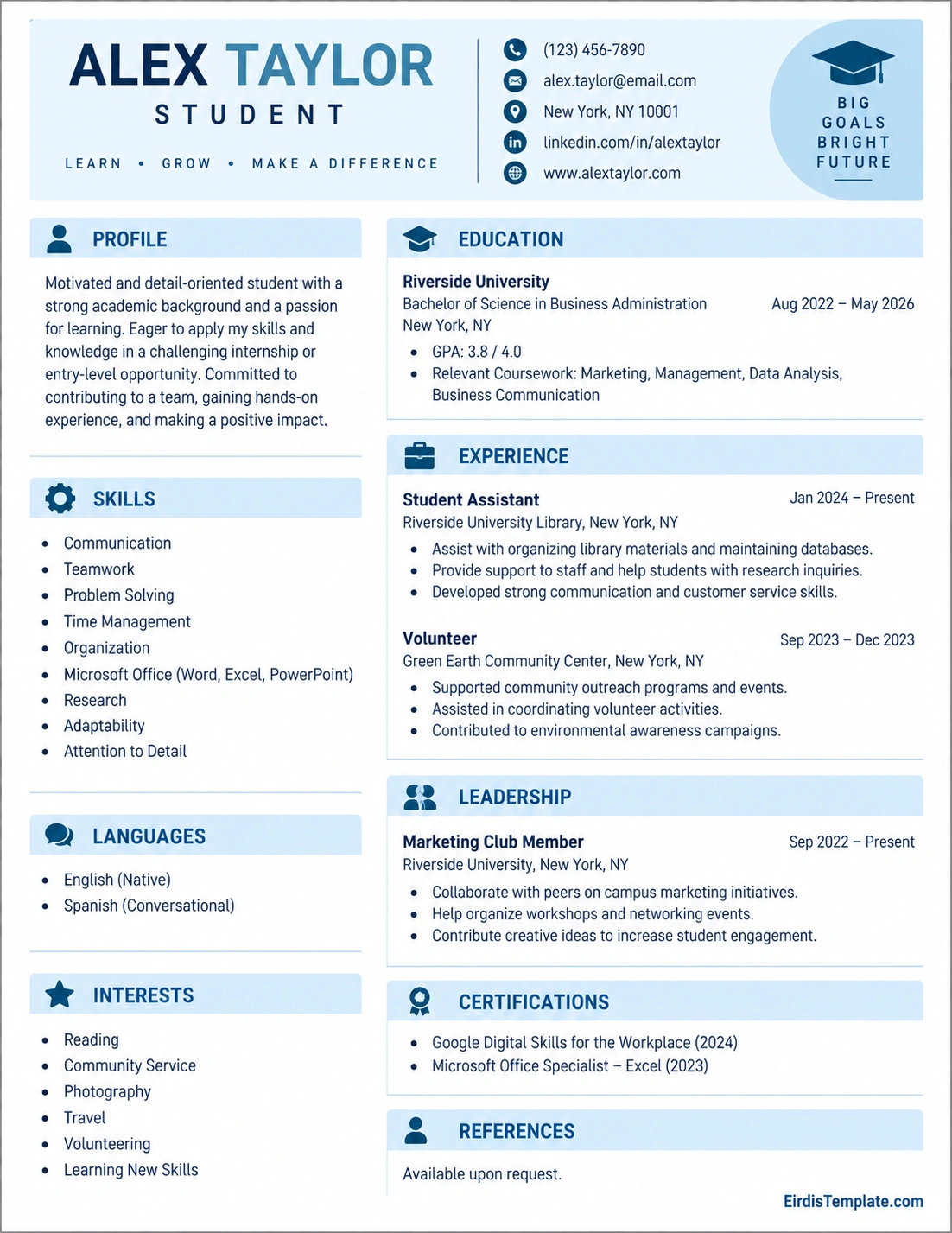
A student resume template provides a structured starting point for organizing your qualifications. Instead of designing a resume from an empty page, you can use predefined sections for contact information, education, skills, experience, activities, and achievements.
A template can be particularly helpful for students creating their first resume because it provides a visual structure and helps reduce the chance of overlooking important sections.
However, the template should be treated as a starting point rather than a finished resume. Customize the content to reflect your actual experience and adjust the sections according to the specific opportunity.
Student Resume Checklist
Before submitting your resume, review each of the following items:
- Your full name and contact information are correct.
- Your email address looks professional.
- Your education information is current.
- Your most relevant skills are clearly listed.
- Your experience includes specific descriptions of your contributions.
- Relevant projects and activities are included.
- Important achievements are highlighted.
- The resume is tailored to the opportunity.
- Formatting is consistent.
- Spelling and grammar have been checked.
- The resume is concise and easy to scan.
- The final file follows the employer, school, or organization’s submission requirements.
Conclusion
A student resume gives students a professional way to present their education, skills, achievements, activities, projects, and experience when applying for internships, jobs, scholarships, and academic opportunities.
Limited work experience does not mean a student has nothing valuable to include. Academic projects, extracurricular activities, volunteer work, leadership roles, certifications, personal projects, and technical skills can all demonstrate abilities that are relevant to future opportunities.
The most effective approach is to focus on relevant qualifications, describe experiences specifically, keep the document easy to read, and tailor the content to the opportunity. A well-organized student resume template can make this process easier by providing a clear structure for presenting your background and accomplishments.
Download: Student Resume Template

- Free Student Resume Template (Word) - September 21, 2026
- Free Printable Travel Itinerary Template - September 21, 2026
- Free Printable Trip Schedule Template - September 21, 2026
