A Treatment Plan provides a structured roadmap for addressing a health condition, managing symptoms, and working toward specific care goals. It helps organize important information about a patient’s needs, recommended strategies, expected outcomes, and follow-up activities in one central document.
A well-organized plan can also improve communication between patients and healthcare providers. By clearly documenting goals, interventions, responsibilities, and progress, everyone involved can better understand the direction of care. A treatment plan can be updated as circumstances change, making it a useful tool for ongoing care rather than a one-time document.
What Is a Treatment Plan?
A Treatment Plan is a written document that outlines how a particular health condition or care need will be addressed. It typically connects the patient’s current condition with specific goals, recommended interventions, monitoring methods, and follow-up arrangements.
The content can vary significantly depending on the type of care. A medical treatment plan may focus on diagnosis, medication, procedures, lifestyle changes, and follow-up appointments. A mental health treatment plan may emphasize symptoms, therapeutic goals, counseling strategies, coping skills, and progress measurement.
The plan should be developed by an appropriately qualified healthcare professional and tailored to the individual’s circumstances. It is not intended to replace professional medical advice or serve as a universal set of instructions.
Why Is a Treatment Plan Important?
Healthcare can involve multiple appointments, recommendations, medications, therapies, and long-term goals. Without a clear structure, important details can become difficult to track. A written care plan helps organize these details so that patients and providers have a shared reference point.
- Clarifies goals: Specific objectives give the care process a clear direction.
- Improves communication: Patients and providers can refer to the same documented information.
- Supports accountability: Responsibilities and action steps can be clearly identified.
- Tracks progress: Results can be reviewed against previously established goals.
- Encourages consistency: A structured plan can help keep recommended activities organized.
- Supports adjustments: The plan can be reviewed and modified when results or circumstances change.
- Reduces confusion: Important goals, interventions, and follow-up information remain in one place.
Key Components of a Treatment Plan
Although treatment plans differ between healthcare settings, many include several core sections. A useful document should contain enough information to explain the current situation, desired outcomes, recommended actions, and method for reviewing progress.
Patient Information
Begin with basic identifying information needed to associate the document with the correct patient. Depending on the setting, this may include the patient’s name, date of birth, contact information, and other relevant administrative details.
Provider Information
Include the healthcare provider, practice, clinic, or facility responsible for developing or managing the plan. Contact information can also be included when appropriate.
Diagnosis or Condition
The plan should identify the condition, concern, symptoms, or care needs being addressed. The level of detail should be appropriate for the intended use of the document and should reflect information established by the qualified provider.
Treatment Goals
Goals describe what the care plan is intended to accomplish. Effective goals should be understandable and, when appropriate, measurable. Instead of relying only on broad statements, providers may identify specific outcomes that can be reviewed over time.
Treatment Strategies
This section describes the interventions or approaches that may be used to work toward the established goals. Depending on the situation, strategies may include therapy, medication management, procedures, education, lifestyle recommendations, referrals, or other professional interventions.
Action Plan
An action plan translates broader treatment strategies into practical steps. It can identify the action, responsible person, target date, and current status. This makes it easier to determine what has been started, what is in progress, and what has been completed.
Progress Monitoring
A treatment plan should explain how progress will be reviewed. Monitoring may involve follow-up appointments, symptom assessments, functional measures, treatment response, or other appropriate methods determined by the healthcare provider.
Follow-Up Information
Include information about the next review or appointment when applicable. A follow-up section can provide space for the next appointment date, review frequency, progress notes, and changes that may need to be considered.
Treatment Plan Template
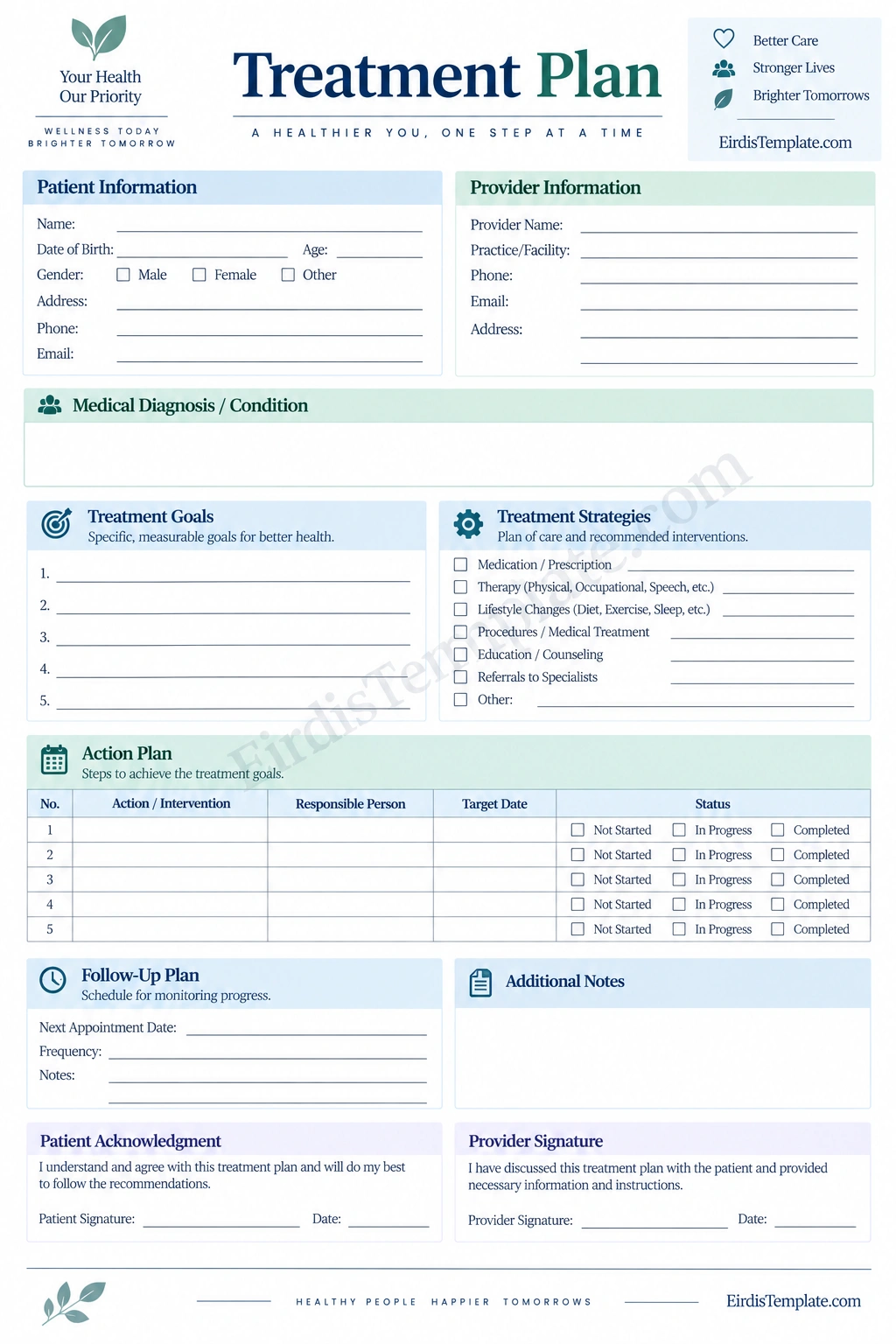
A Treatment Plan Template provides a reusable structure for documenting patient information, care goals, treatment strategies, action steps, progress, and follow-up details. Using a consistent format can make documentation easier to organize while ensuring that important sections are not overlooked.
A printable template may be particularly useful for healthcare professionals, counselors, therapists, clinics, educational settings, or administrative workflows that require structured planning documents. The template should always be adapted to the specific requirements of the healthcare setting and the needs of the individual.
The following template includes areas for patient and provider information, the medical condition or diagnosis, treatment goals, treatment strategies, an action plan, follow-up information, additional notes, and acknowledgment signatures.
How to Create a Treatment Plan
Creating a useful plan requires more than filling in a form. The information should reflect the individual’s needs, professional assessment, agreed goals, and appropriate care strategies.
1. Identify the Primary Care Need
Start by clearly documenting the condition, symptoms, concern, or reason for treatment. The information should be based on an appropriate professional assessment rather than assumptions.
2. Establish Specific Goals
Define what the treatment is intended to accomplish. Goals should be realistic and relevant to the individual’s situation. Where appropriate, use measurable outcomes so progress can be evaluated during later reviews.
3. Select Appropriate Strategies
Document the interventions or services that are appropriate for the identified needs. Each strategy should have a clear connection to the treatment goals. The exact interventions should be determined by the qualified healthcare professional responsible for care.
4. Assign Action Steps
Break the broader plan into manageable actions. Identify who is responsible for each action and establish target dates when appropriate. This can make a complex care process easier to follow.
5. Define How Progress Will Be Evaluated
Determine how the provider and patient will know whether the plan is producing the intended results. Progress measures should be appropriate for the condition and treatment approach.
6. Schedule Follow-Up Reviews
Establish when the plan will be reviewed. Regular reviews provide an opportunity to discuss progress, identify concerns, and make appropriate adjustments based on professional assessment and new information.
What Makes a Treatment Plan Effective?
An effective plan should be clear enough that the people involved understand its purpose and next steps. It should also remain flexible enough to accommodate changes in the patient’s condition, response to treatment, or circumstances.
Several qualities can make a care planning document more useful:
- Clear: Use straightforward language and avoid unnecessary ambiguity.
- Specific: Connect interventions to identifiable goals and needs.
- Measurable: Include appropriate ways to evaluate progress.
- Realistic: Establish goals that are appropriate for the individual’s situation.
- Collaborative: Encourage appropriate communication between the patient and care team.
- Flexible: Allow the plan to be reviewed and updated when circumstances change.
- Documented: Keep relevant decisions, progress, and revisions properly recorded.
Treatment Plan for Different Types of Care
The structure of a treatment plan can differ depending on the healthcare environment. The underlying purpose remains similar: organize care around identified needs and meaningful goals.
Medical Treatment Plan
A medical care plan may address a diagnosed condition, symptoms, treatment interventions, medication management, procedures, monitoring requirements, and follow-up appointments. The content should be based on the patient’s clinical circumstances and the provider’s professional judgment.
Mental Health Treatment Plan
A mental health treatment plan may document presenting concerns, therapeutic goals, counseling approaches, coping strategies, progress indicators, and review dates. Plans can be updated as the individual’s needs and treatment response change.
Physical Therapy Treatment Plan
A physical therapy plan may focus on functional goals, exercises, mobility, strength, pain management strategies, activity recommendations, and progress measurements. The therapist determines appropriate interventions based on the patient’s evaluation.
Long-Term Condition Management
For ongoing conditions, a treatment plan can help organize recurring appointments, monitoring activities, lifestyle recommendations, medication-related information, and long-term goals. Regular professional review is important because ongoing care may need to change over time.
Common Mistakes When Creating a Treatment Plan
A poorly structured plan can make documentation harder to understand and may reduce its usefulness as a communication tool. Avoid unnecessary complexity and make sure important information is easy to locate.
- Using vague goals that cannot be meaningfully reviewed.
- Listing interventions without explaining their connection to the treatment goals.
- Leaving out follow-up or progress-review information.
- Using language that the patient cannot reasonably understand.
- Failing to update the plan when relevant circumstances change.
- Including unnecessary information that makes the document difficult to navigate.
- Using a generic plan without adapting it to the individual’s needs.
Tips for Better Treatment Planning
Good treatment planning should support communication rather than create additional confusion. Keep the document organized and focus on information that is relevant to the patient’s care.
- Use clear headings: Separate goals, strategies, action items, and follow-up information.
- Keep goals visible: Make important objectives easy to find during reviews.
- Document changes: Record relevant updates when the plan is revised.
- Encourage questions: Patients should have an opportunity to discuss information they do not understand.
- Review regularly: Reassess the plan at appropriate intervals rather than treating it as a permanent document.
- Protect privacy: Handle patient information according to applicable privacy, security, and recordkeeping requirements.
How Often Should a Treatment Plan Be Updated?
There is no single update schedule that applies to every type of treatment or every healthcare setting. The appropriate review frequency depends on the patient’s condition, treatment approach, provider requirements, and applicable professional or regulatory standards.
A plan may need to be reviewed when treatment goals are reached, progress changes, a new concern develops, an intervention is changed, or the patient’s circumstances require a different approach. Regular review helps ensure that the document continues to reflect the current direction of care.
Treatment Plan Checklist
Before finalizing a treatment planning document, review the information to make sure the important sections are complete and understandable.
- Patient information is accurate.
- Provider information is included where appropriate.
- The condition or primary care need is documented.
- Treatment goals are clearly stated.
- Recommended strategies are documented.
- Action steps and responsibilities are identified when applicable.
- Progress measures are defined where appropriate.
- Follow-up information is included.
- Relevant notes or special considerations are documented.
- The plan is reviewed with the appropriate patient and care team members.
- Required signatures or acknowledgments are completed when applicable.
- The document is stored and handled according to applicable recordkeeping and privacy requirements.
Final Thoughts
A Treatment Plan provides a practical framework for organizing care around specific needs, goals, interventions, and progress. By putting important information into a structured document, healthcare providers and patients can maintain a clearer understanding of the direction of care and the steps involved.
A well-designed Treatment Plan Template can simplify documentation by providing dedicated sections for goals, strategies, action items, follow-up, and notes. However, the template itself is only a framework. The actual treatment decisions, goals, interventions, and changes should be determined by appropriately qualified healthcare professionals based on the individual’s circumstances.
When used thoughtfully and reviewed regularly, a treatment plan can support clearer communication, more organized care, meaningful progress tracking, and better coordination between the people involved in the treatment process.
Download: Treatment Plan Template

- Teacher Letter of Recommendation Template - September 17, 2026
- Free Printable Treatment Plan Template - September 17, 2026
- Free Printable Service Invoice Template - September 17, 2026
